
This is part 2 of an ongoing series about volunteerism challenges in the Eastern Sierra.
Our office’s volunteer programs are experiencing a reduction in how committed volunteers are to service. We still are getting participation, but it is trending toward less time commitment along with some other changes in what service looks like. We are not alone in experiencing these larger changes affecting volunteerism across the country.
In the previous post, I reviewed data related to changes in how the number of volunteers has mostly rebounded post-Covid, but that there has been a trend even before the pandemic of reduced participation where the median number of hours spent by volunteers in a formal volunteer role has declined significantly.
I’ve been continuing my reading on volunteer trends in the past several weeks. Some are reports from the non-profit sector and others are research articles. Just like there isn’t really one source of truth on what is happening to our pool of volunteers, it turns out there isn’t really one cause either. Many things are going on. The data are all over the place. Volunteer motivation is complex!
Americans are still interested in civic engagement, but there are trends, including the aforementioned reduction in time commitment that are affecting non-profits.
In this post I'm interested in a shortage of volunteers entering leadership roles.
Leadership Roles
According to a recent survey, over 46% of volunteer programs are reporting recruiting sufficient volunteers as a “big problem.” It’s the number one concern from a list of many challenges. It’s also clear that there is an ongoing underinvestment in professional volunteer management, but it’s better overall than it used to be. As someone who directly manages volunteers, having more resources dedicated to volunteer engagement would greatly impact our programs’ effectiveness and ability to recruit more members. (Dietz & Grimm 2023)
Having fewer volunteers on its own is a problem, but logically it follows that it affects all levels of how an organization functions by having a reduced pool of volunteers available to serve in leadership roles, especially when there is an expectation that leaders should be drawn from within the group, as we often do in Cooperative Extension programs.
The shift toward a preference in “episodic volunteering” continues. This is volunteer work that is project-based and more focused. (Macduff 1990; Cnann et al. 2022).
Before I actually looked into the literature, I called these folks whom you could call on to get a task done “worker bees.” You could put out a call for a one-off task, and someone would probably show up. They might even do it several times a year, but if you asked them to lead anything requiring an ongoing commitment, they would run to the hills. This is episodic volunteering.
In the Eastern Sierra we see it in forms like helping at fairs or community events, cleaning up sites in the forest, and volunteering at school functions, to name few. When there is alignment with someone’s passion and a definite need, if you can do the organizing to make every happen, it’s usually possible to find short-term volunteers.
As an example of the scale of episodic volunteering, Hager and Brudney (2021) found that, pre-Covid, there is an almost equal division between long-term and short-term volunteers.
Volunteer Assignments
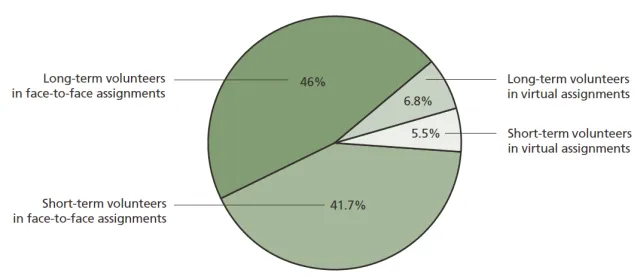
Current trends indicate people are more willing to dedicate personal volunteer effort if the commitment is well-defined and not ongoing. It takes someone in a leadership role to coordinate this episodic work, and with a shortage of leadership capacity, it can be a hard hill to climb. This certainly aligns with my experience managing volunteer groups.
Where the trouble comes, from my perspective, is filling certain ongoing, long-term roles in a non-profit group:
- Board service or officers
- Core, ongoing work that sustains a group
- Leading projects or roles with responsibility like a 4-H Club leader
These usually have some sort or regular, time-bound responsibility component, which runs contrary to the increase in episodic volunteerism. When this effect is combined with an underinvestment in volunteer engagement, we see groups not able to live up to their promise, and a few key volunteers doing more than their share to keep things moving at the risk of personal burn-out.
When you take the combined trends of a shift toward less time spent volunteering by individuals and an increase in episodic volunteerism, the logical place you end up is a challenge finding leaders to fill key roles. I see this looking at our own local volunteer data, but the trend exists nationwide. Leading with Intent, the BoardSource index of non-profit board practices, found that 32% of executives and 53% of board chairs reported difficulty finding people to serve on the board. 22% of board chairs reported they were selected because they were the only person willing to serve. That's not ideal.
Cooperative Extension designed many of its volunteer-based models at a time before episodic volunteerism really emerged as an important factor. We have, especially in California, a system that values (and requires!) long-term service and needs volunteers to take leadership roles. Most of our leadership positions are required by policy to be an approved, trained, background-checked volunteer. We don’t easily have the ability to recruit volunteers for a specific leadership role for which they are well-suited if they are outside our system. Hopefully it’s a problem that you don’t share in your group.
Oddly, there isn’t a very well-developed body of work on non-profit board recruitment particularly in relation to the effects of episodic volunteering. It seems like that would be an important area to consider. When one looks at several threads together (engagement, recruitment, governance) recent evidence suggests that non-profits face not only a general volunteer recruitment challenge, but also a more specific leadership-capacity challenge. National governance reports show concerns about finding the right board members, board engagement, community representation, and succession planning. At the same time, volunteer-engagement research shows nonprofits reporting shortages of volunteers, while broader volunteering research points to increasing time scarcity and episodic participation. Together, these suggest that organizations may be able to attract short-term help more easily than they can fill durable governance, committee, and leadership roles.
Strategies to Consider
I wish I had a simple, direct solution, but I don’t think that exists. I do have some strategies that we’re implementing in our programs to help ameliorate the impact.
- Create and utilize short-term, episodic volunteer work to relieve some of the burden on your volunteers in leadership roles (see this link for basic guidance; PDF, 3 pages);
- Aim to keep existing volunteers happy: all volunteers have a natural cycle of entering and leaving a group, but if you can extend that cycle by following good engagement practices, then these larger trends have less impact in the short term;
- Try to be flexible: volunteer work looks different from each individual and that’s okay;
- Have fewer meetings and make those you do have more productive;
- If you have the ability to do so, recruit from new sources of volunteers whose interests align with your mission even if they don’t fit your usual profile or historical demographic;
- Make sure you have a message and mission that continues to resonate with volunteers, and that their work is impactful.
Perhaps these suggestions might be helpful to other groups in a similar situation as us.
If you crack the code to get more leaders, please share it with the world. Or at least with me. 😉