

Well, this year is speeding by. I do know I am ready for some fall and winter weather. The weather forecasts for the beginning of August are anything but winter weather. So, I will briefly go over again on how to care for your roses in hot weather.
Make sure you water deeply on the days you can water. Cycle your watering. It is best if you stagger your water times, so it gives the plant an opportunity to absorb the water and have it go deeply into the soil to water the roots. Mulch (about 3 inches) around the base of your plants to help conserve water and keep the roots cooler during this weather.
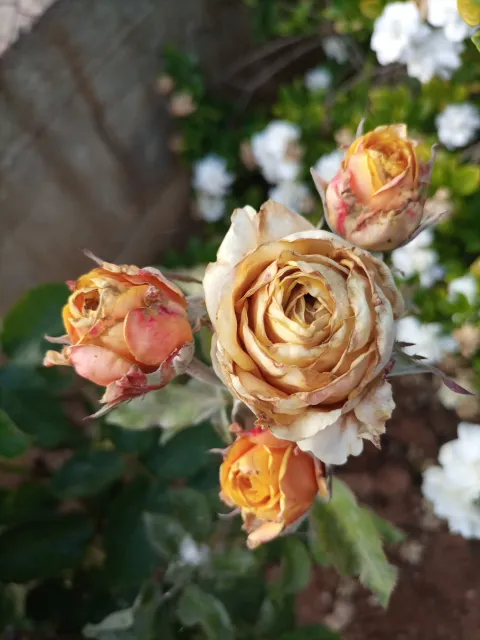
Now it not the time to feed your plants. They are just trying to stay alive. Go ahead and let them flower. If they are not under a shade cloth, don’t prune or deadhead them. You can let the flower petals fall off and just leave the remaining flower to form a hip. You can give your plant a light deadheading when the weather is cooler. Do not remove burnt leaves as they will help to prevent the canes from burning.
If your roses are shaded by an umbrella or shade cloth, you can go ahead and deadhead the spent flowers off the plant. This is a deadhead, not a pruning. Just cut the spent flowers back to a quarter inch above a five-leaf leaflet.
Keep on the lookout for spider mites. This is their favorite time of year, and they can kill your plants if you are not careful. Spray them off the plant with a strong blast of water. Do not use insecticide with horticultural oil or neem oil. The oil can burn your leaves when it is this hot outside.
Different types of roses continued
I couple of months ago I started to describe different types of roses. This month, I will discuss the difference between climbing roses and rambling roses. Anytime I hear those words, my mind goes to the song, Rambling Rose by Nat King Cole. That song was written by the Sherman Brothers, who wrote the songs for Disney’s Marry Poppins and other Disney movies. Gotta love those oldies but goodies!
The differences between those types of roses are simple. Rambling roses (which tend to get huge, by the way) bloom once a year for about four to eight weeks. Climbing roses bloom all season. You may have seen a rambling rose blooming in the spring. CalTrans has planted this rose alongside the freeways. It has yellow flowers on a very vigorous shrub. The rose is thornless and the canes can grow 20-40 feet long! I call those roses “house eaters.” Rambling roses bloom on what is called “old wood,” which are year-old canes. You prune ramblers in the summer after they are finished blooming. This is different than climbers who get pruned, in our climate, in late winter/very early spring.
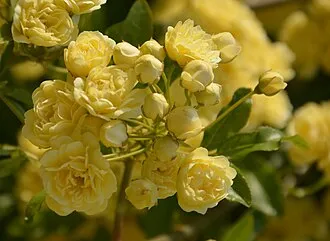
Lady Banks Rose
Since this seems to be a trivia month for me, the Lady Banks Rose was named in 1807 after Dorothea Lady Banks, the wife of Sir Joseph Banks, an explorer and botanist and long-time president of the Royal Society of London for Improving Natural Knowledge. Lady Banks was known for her porcelain collection which often featured botanical motifs that echoed her husband’s work. The species, Rosa banksiae, was introduced to Europe from China in 1807. William Kerr had been dispatched on a botanical expedition by Sir Joseph Banks (who was the unofficial advisor to Kew Gardens in Britain). The double, white-flowered form was first to be scientifically described as Rosa banksiae by William Aiton in 1811 in honor of Dorothea Banks. The yellow-flowered cultivar, Rosa banksiae ‘Lutea’ was introduced to Europe in 1824 and has become the popular Lady Banks Rose. It was named as a tribute to her refined gardening taste in early 19th-century Britian.
In memoriam
I was saddened to hear of the passing of David J.C. Austin, who passed away the week of July 23, 2026. He was the chairperson of David Austin Roses, which was founded by his father, David C.H. Austin. He oversaw David Austin Roses for more than three decades. David J.C. Austin died from Creutzfeldt-Jakob disease, an incurable neurological disorder, at the age of 67. He grew the Austin rose brand from a specialty nursery to a globally recognized name throughout the world. I have grown several of his roses in my garden and their flowers and scents are pure delight. The legacy of David Austin Roses will be carried on through his children and other family members.
Until next time …
Rose leaves, when the rose is dead,
Are heaped for the beloved’s bed;
And so thy thoughts, when thou art gone,
Love itself shall slumber on.
-Percy Bysshe Shelly
___________________
Written by UC Master Gardener Debbie D.