
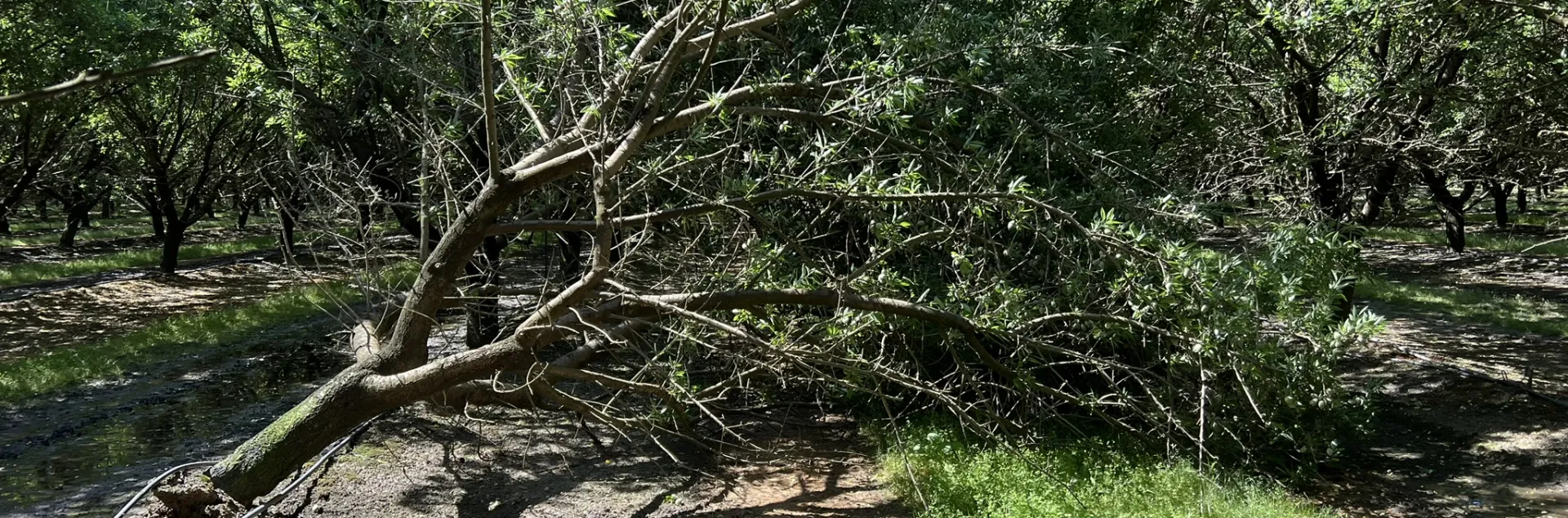
Recent studies conducted by scientists at UCCE and CSU Bakersfield demonstrate that a common disease prevalent in vineyards and orchards may impact long-term orchard longevity of almonds in the southern San Joaquin Valley. Almond orchards with a high incidence of crown gall, a disease caused by a ubiquitous soilborne pathogen, exhibit high rates of tree failure caused by a newly identified wood rotting disease.
Crown gall is common in walnut and almond orchards and can be readily identified by the tumors it induces on the roots and crowns of trees. Unless severe, crown gall generally does not cause tree mortality, but may limit tree size, thus affecting overall yield. Growers with crown gall-affected orchards often replant young trees that exhibit girdling by the tumors but leave mature trees untreated. Within the past decade, however, growers have noticed heightened prevalence of tree mortality due to butt rot in crown gall-affected almond orchards. The butt rot disease is caused by an introduced fungal pathogen, Ganoderma adspersum, that was first reported in California in 2016.
From 2024 through 2026, UCCE researchers have surveyed over 23,000 almond trees in Kern and Tulare Counties, documenting prevalence of both butt rot and crown gall. Molecular identification of the butt rot pathogen in each surveyed orchard was conducted by scientists at CSU Bakersfield. The study found that Ganoderma adspersum was the only species of Ganoderma isolated in all surveyed orchards. Additionally, the results indicated that orchards with crown gall were six times more likely to have butt rot disease. Trees with historic or active signs of butt rot also exhibited 1.5 times the mortality rate of healthy trees over a 26-month survey period.
The results of this work demonstrate that the introduction of the new butt rot pathogen may elevate the importance of crown gall as a predictor of orchard longevity. The implication of this finding is that the planting of crown gall-free rootstocks during orchard establishment may be key to future reduction of risk from G. adspersum. Similarly, Mohammad Yaghmour and Elizabeth Fichtner, Farm Advisors in Kern and Tulare Counties, respectively, found that crown gall was also associated with increased incidence of thousand cankers disease on walnut. Fichtner has also reported that crown gall is related to heightened root predation by ten-lined June beetle on walnut.
The current study was conducted with support from the Almond Board of California and as a collaborative effort between UCCE scientists including Elizabeth Fichtner, Santosh Bhandari, Mohammad Yaghmour, and Raymond Mireles, and CSU Bakersfield Professor Isolde Francis and Chance Kophamer, graduate student.