
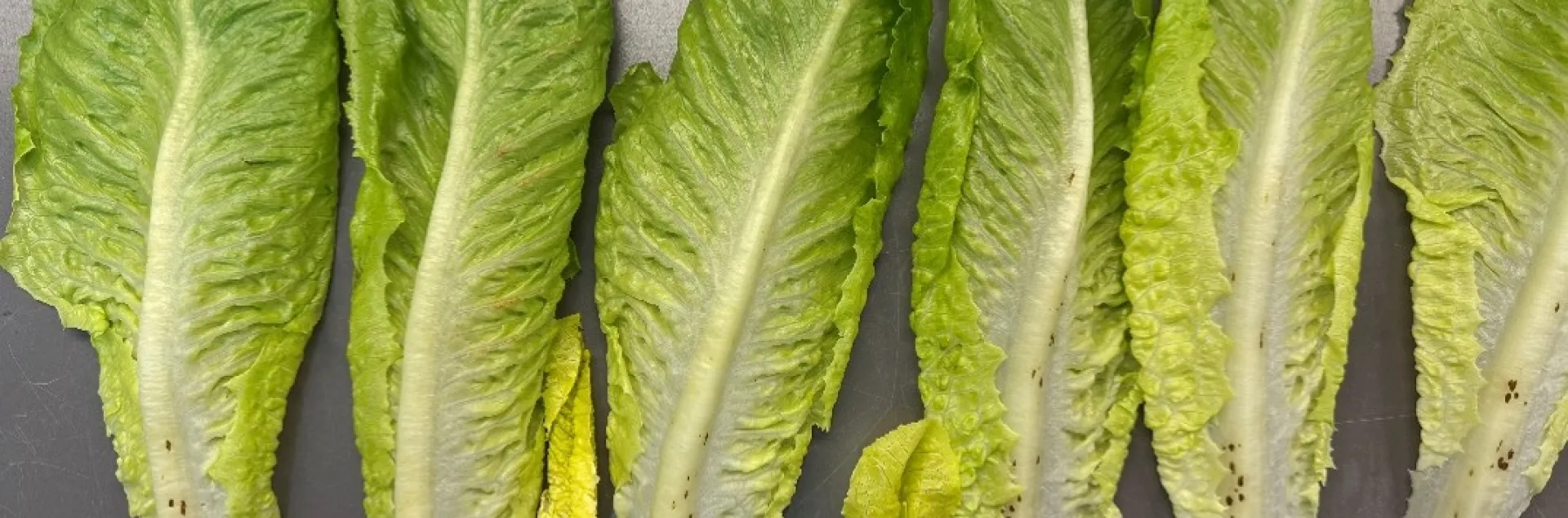
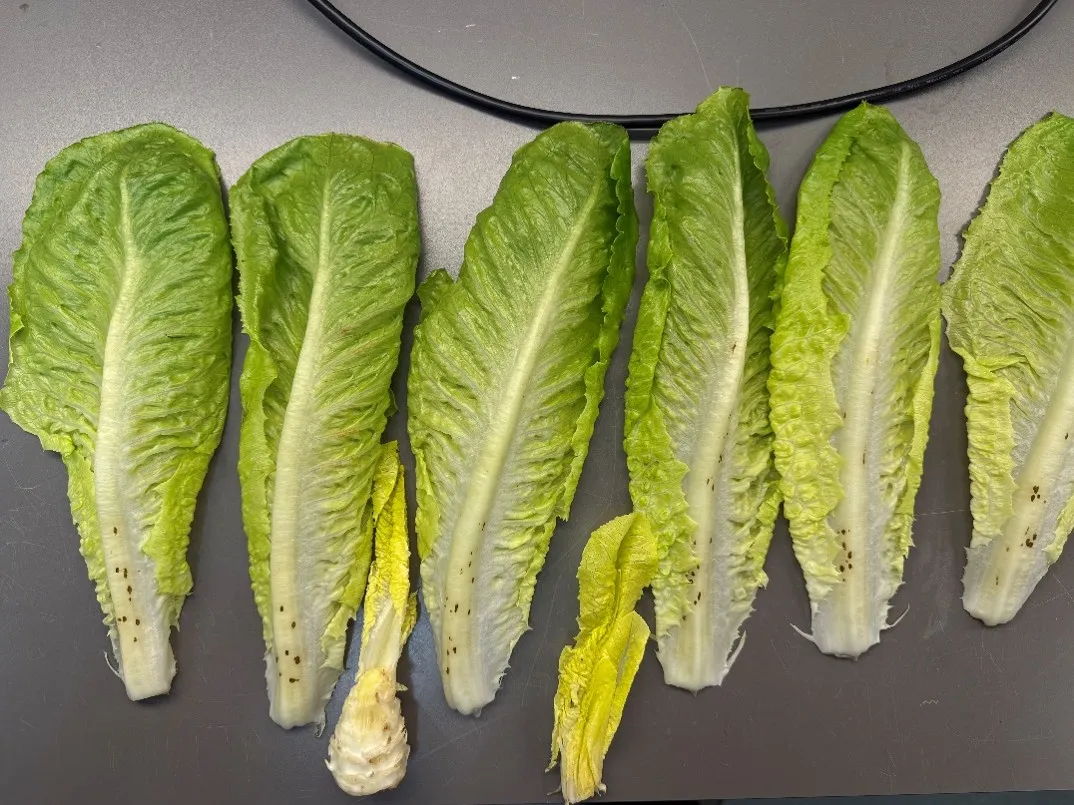
In early July, a pest control adviser (PCA) brought samples of romaine lettuce to the UC Cooperative Extension office of Monterey County in Salinas. The lettuce was from a couple of fields in Gonzales nearing harvest. The PCA was concerned about blemishes on the leaf midribs that appeared as small dark-brown spots with defined margins (Figure 1). The PCA suspected Impatiens necrotic spot virus (INSV) to be the cause.
INSV, vectored by western flower thrips (Frankiniella occidentalis), can cause severe disease in lettuce that can lead to significant economic damage in a lettuce crop. Typical symptoms of INSV in lettuce include brown to dark brown necrotic spots on leaves and midribs, and dying of leaves. The necrotic leaf spots can appear on old and new leaves, depending on the infection timing. The samples brought to the Cooperative Extension office all tested negative for INSV, Tomato spotted wilt virus (TSWV), and various common bacterial and fungal pathogens of lettuce. We visited the fields the next day.
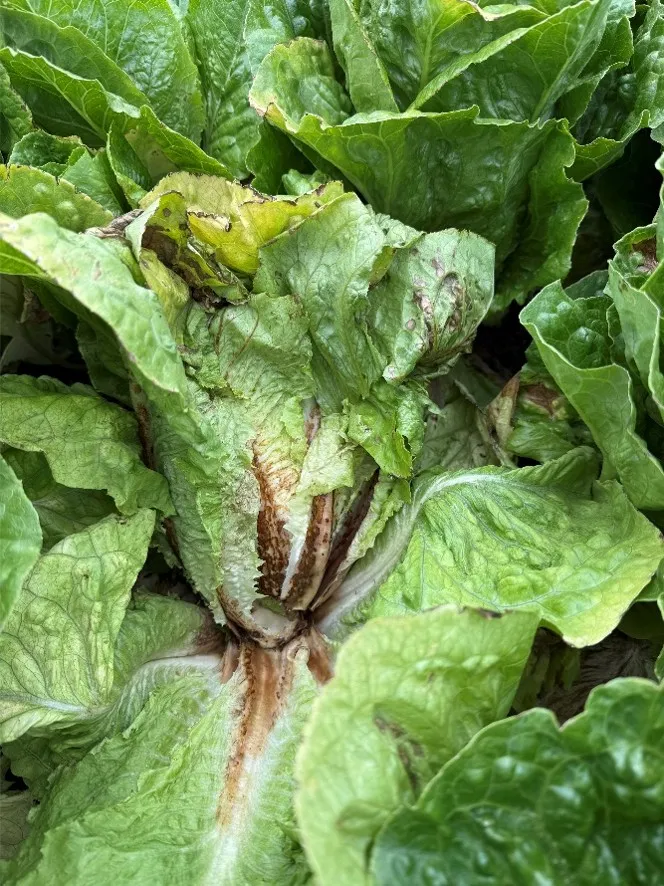
In the fields, the leaf midrib spots tended to not appear on the most mature, outer leaves of the plant. Several leaves had to be removed before noticing the spots. The spots appeared consistently on consecutive leaves within the head of the plants. Approximately 95% of plants in the fields had these symptoms. Symptomatic plants could be found uniformly throughout the entire fields, not isolated to any localized areas within the fields. The fields did have plants with apparent symptoms of INSV (Figure 2). We took additional samples of symptomatic plants from the field back to the Cooperative Extension office in Salinas for additional testing.
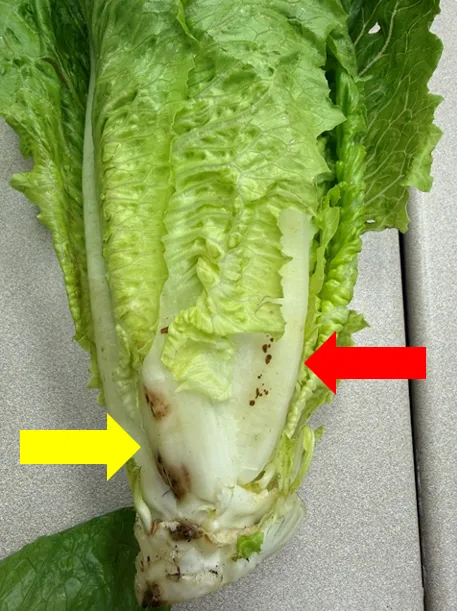
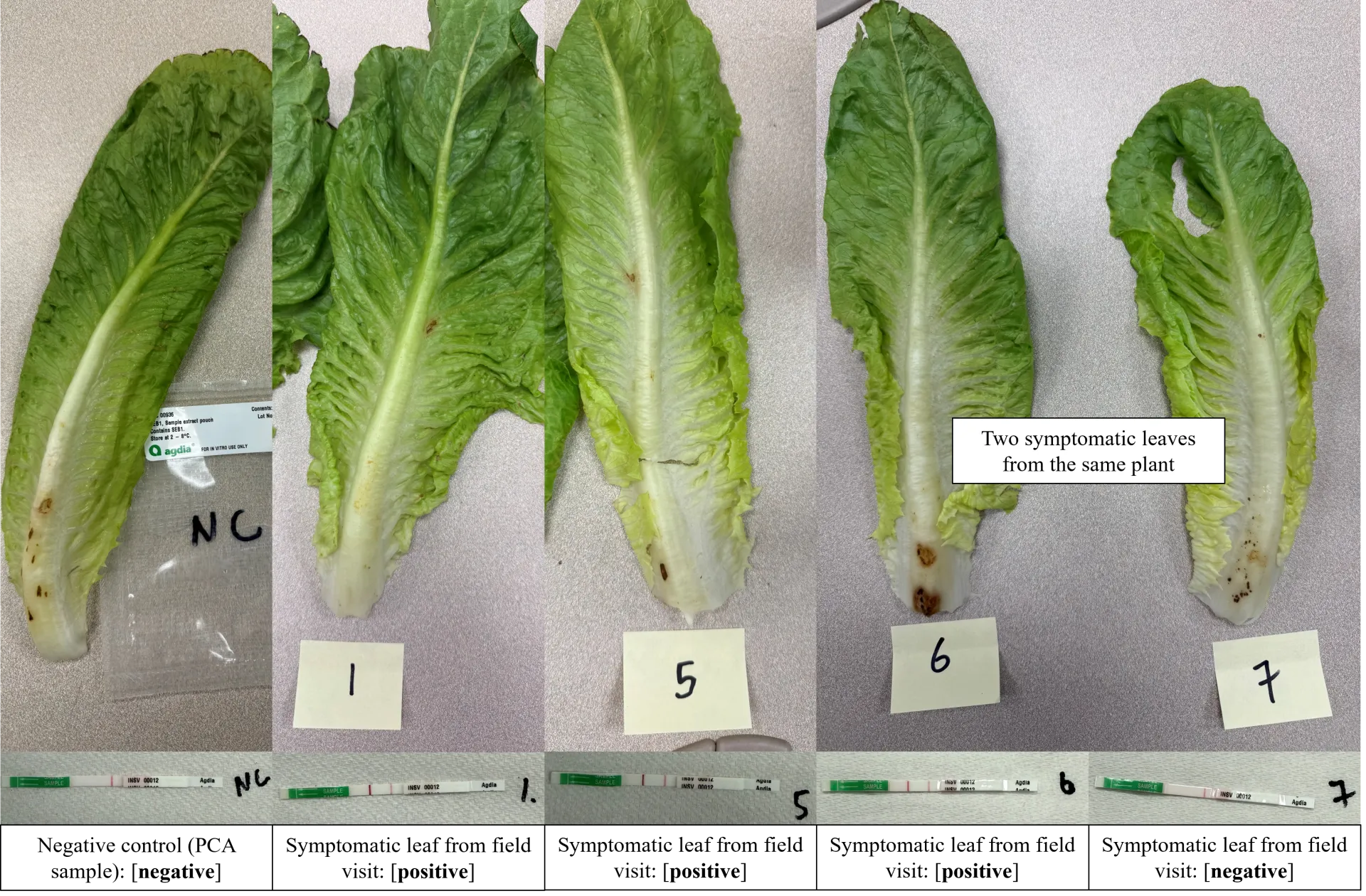
Upon return, additional INSV tests were performed on the original samples the PCA brought, and again, the results were negative for INSV. We performed INSV tests on the samples we collected from the field, and the results were interesting. Some plants tested positive for INSV, some tested negative for INSV, and one plant tested both negative and positive depending on which leaf we took symptomatic tissue from (Figure 3).
In an unexpected turn of events, when the INSV test was performed on tissue taken from a single plant from a leaf where the symptoms were confined to the midrib and only exhibited small brown spots with defined edges, the result was negative. When the test was run on tissue taken from a leaf with larger brown spots on the midrib with diffuse edges, the result was positive (Figure 4).
It is currently unclear what the root cause of the small, dark-brown midrib spotting is. However, it is apparent that it is possible for a plant with these symptoms, somewhat similar to necrotic lesion symptoms of INSV, to test negative for the virus. These small spots appear similar to what was previously characterized as russet spotting in head lettuce, a postharvest physiological disorder linked to oxidation of organic compounds in the plant when exposed to ethylene. Ethylene is naturally produced and released as a gas by plants as they ripen. One hypothesis we are considering is that this crop may have been left in the field too long and began to accumulate ethylene in the heads, which led to these symptoms appearing. Breeders of the variety in this field have remarked that these symptoms also appear on other varieties as well as some of the parental lines of those varieties. This points to some genetic influence of these symptoms. USDA-ARS research geneticist, Ivan Simko, shared that he also observed these symptoms on mature butterhead lettuce in a field near Spreckles, so it appears it is not a condition isolated to romaine types of lettuce.
What does this mean for producers and PCAs? For now, check with your seed representatives to be sure the varieties you plan on planting are suitable for longer crops (a later harvest) if that’s part of your goal. This case proved challenging, because INSV was present in the field, but similar symptoms also appeared and were not apparently related to the virus. If you notice these or similar symptoms in the field, you can always ask for assistance from UC Cooperative Extension for further identification. If it turns out that your field develops these russet spot-like symptoms, it may mean the crop is unmarketable. Unfortunately, the best move forward from that point would be to learn from the experience and attempt to harvest fields of the same variety in an earlier timeline.