
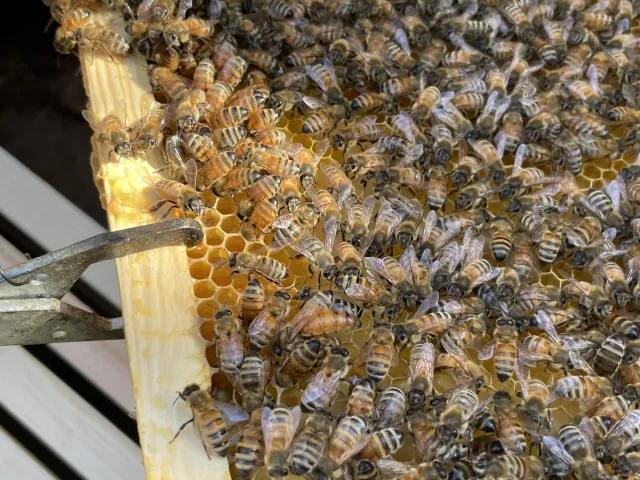
Honeybees (Apis mellifera) are a common visitor to backyard gardens in the summer months. As gardeners and beekeepers, my family loves seeing our hard-working bees moving from flower to flower. In Davis, you might see honeybees pollinating, looking for water, swarming, or traveling back and forth to a hive. Honeybees benefit your garden through pollination but can also overwhelm limited water sources and compete with other native pollinators in the area. In this article, we discuss attracting honeybee pollinators to your garden, why they might be crowding your pool or dog’s water bowl, and how to support native bee species as well as non-native honeybees.
One of the main attractions of honeybees to gardeners is pollination services. Most of the honeybees you see out of the hive are female worker bees. Like most animals, bees require food, water, and shelter to survive. As a gardener, you can support bee populations (native and non-native) by planting diverse gardens rich in nectar and pollen-producing plants. For lists of bee garden superstar plants, the UC Davis Bee Haven has a good collection. Honeybees collect pollen as a protein-rich food source that is mixed with nectar to make “bee bread” and fed to baby bees as they grow. Honeybees collect nectar and subsequently condense it to make honey as a carbohydrate-rich food for the colony. Bees are hard workers and travel great distances back and forth from their hives to collect and store pollen and nectar for the colony. If you are planning to support pollinators, be careful with pesticide applications, as these can harm local pollinators.
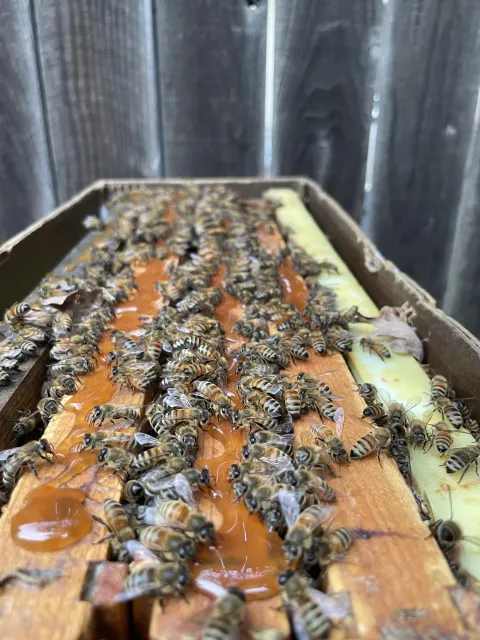
In addition to searching for sources of pollen and nectar, honeybees need water. Late in the summer, once nectar (water-heavy) rich foraging sources dry up, bees start diluting their stored honey to make bee bread and feed the colony. Especially when there are a lot of brood (baby bees) in a hive, the colony needs water to dilute honey for consumption. This can increase the need for water when the environment is dry in late summer. Desperate bees often clump around the few water sources they can find (the dog’s water bowl, pool edges, etc.) to collect water. If you are interested in supporting bees in their collection of water, a bee watering station can be a welcome addition to your garden. In our yard, this is simply a five-gallon bucket of water that is regularly refilled with several pieces of wood floating on top. The wood (wine corks also work great) is important so that the bees have something to land on and they can self-rescue if they fall in the water.
The honeybees used for commercial pollination and backyard hobbyist beekeeping are not native. We do have many species of native bees in the Davis area. In addition to planting diverse, native, flowering plants and creating a bee-safe watering station in your yard, native bees can be further supported by creating suitable nesting sites in your yard. Some of our common native bees (like Mason bees or Osmia bicornis) like to nest in hollowed-out tubes in wood. In the wild, they would occupy tunnels carved out by other insects. In your backyard, you can make Mason bee-friendly homes by drilling holes into a piece of wood or clumping together small-diameter wooden tubes. Ground nesting bumblebees are a whole group whose nesting needs can be supported by leaving a clear patch of dirt (they will not move mulch aside to get to the ground).
However you choose to support local pollinators, your garden can benefit from these hard-working bees. In the Davis summer months, honeybees and native bees are common backyard visitors. While their pollination services are much appreciated, their crowding of water sources can be less so. Between intentional plantings and reduced pesticide use, bee-safe water sources, and native bee housing support, gardeners can have a big impact on local bee health and survival.
References
UC Master Gardeners of Napa County - Native Bees
Ralph L. Parker (1926) The Collection and Utilisation of Pollen by the Honey Bee, Bee World, 8:9, 141-142, DOI: 10.1080/0005772X.1926.11096088
GOULD, J. Honey bee communication. Nature 252, 300–301 (1974). https://doi.org/10.1038/252300a0
M. Lindauer (1955) The Water Economy and Temperature Regulation of the Honeybee Colony, Bee World, 36:5, 81-92, DOI: 10.1080/0005772X.1955.11094876
Photos of her hives by Caroline Gengo.