
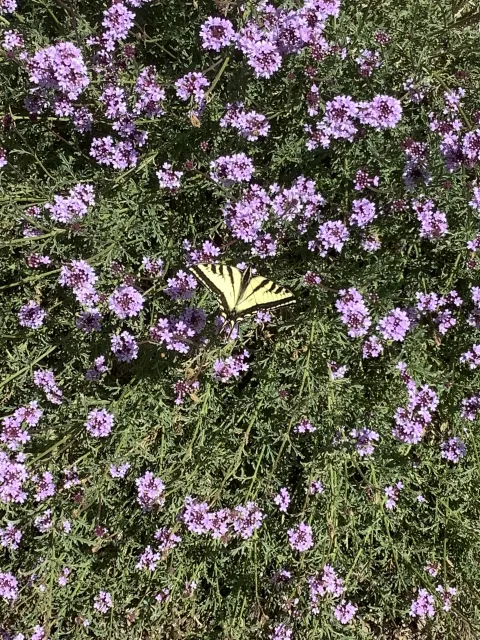
In the early 1900s a subtle way of warning a naive young person to avoid being misled or put in a “compromising position” was “Don’t be led down the garden path!” Oh my! Prim matrons knew that gardens are a sensual experience (and the perfect place for romance). If you enjoy being quiet and observant in a garden, you already know they can stimulate all of our senses.
We might hear birdsong or the humming of insects, see brightly colored flowers being visited by equally bright butterflies, and we taste the succulent fruits of our labors. We feel the warmth of the sun, a cooling breeze, or the brush of leaves. The garden’s scents are what I find to be most enchanting. That is because the perfume of a garden is dispersed and floats on the air. Now you perceive it and the next moment you don’t. The source of a scent in a garden may not be immediately obvious; you may find yourself wandering around trying to identify it. Other aromas, however, may be immediately identifiable and bring back fond memories.
If you love a scented garden as much as I do, you might enjoy the easy-to-grow, scented native California perennial plants, shrubs, and small trees, as well as a few non-native but water-wise favorites listed here. In many cases, the scent comes from leaves as well as flowers, and the fragrance may wax and wane depending on the time of day or season.
For ground covers, California wood strawberry (Frageria californica) is a good choice for shady spots and has lightly fragrant leaves and flowers. It is cold and moisture-tolerant, but does require some irrigation. It can spread, so planting it in a contained space is a good choice. A personal favorite scented ground cover is woolly thyme (Thymus pseudolanuginosus), but any of the low-growing thyme family looks wonderful between rocks or pavers, spreads slowly, and tolerates heat and low-water situations. When you walk on them, the sweetly herbal scent floats up to meet you. Thyme originated in the Mediterranean.
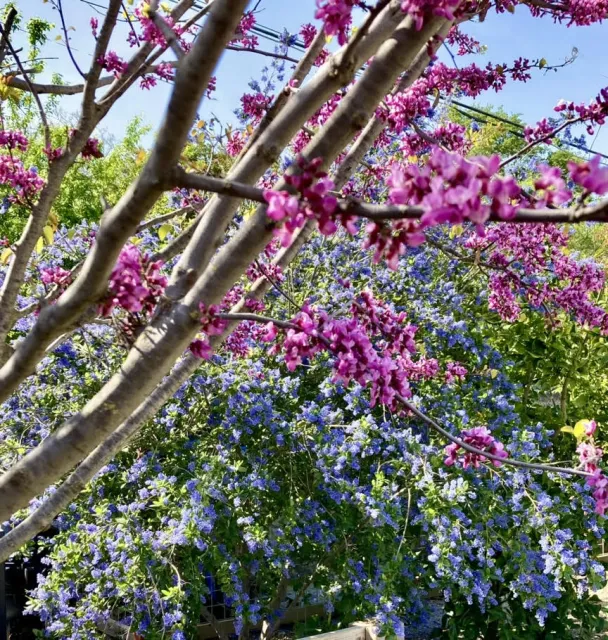
I grew up on the central coast of California, so whenever I catch the scent of a Ceanothus in bloom, it takes me right back to springtime at the family cabin, where different varieties were native. Today, there are Ceanothus hybrids available in nurseries that fit different gardening needs, are fairly easy to grow, and smell heavenly in bloom. Some Ceanothus can be trained as a small tree or large shrub and others are low-growing.
All of the native Salvias are scented. The leaves are aromatic, but some have scented flowers, too. Hummingbird sage (Salvia spathacea) likes shade, grows low, but sends up tall, dark red flower spikes. It spreads, but slowly, and is easy to maintain. Salvia clevelandia and Salvia clevelandia x Pozo Blue have both abundant scented blooms and scented leaves. Other deliciously scented perennial native shrubs include Verbena lilacina De La Mina (scented flowers), and Monardella villosa, known as Coyote Mint (scented leaves). Both of these have lavender flowers.
While I love California natives for their color and scent, they also support native birds and insects. But my grandmother’s cottage garden is also imprinted on my memories. So, my garden is a 70/30 mix of scented natives plus roses, gardenias, citrus and fruit trees, bulbs, and a few other Mediterranean plants that work, which explains why my windows are often open.
For more information, see the California Native Plant Society article Fragrant Natives for the Garden and the Las Pilitas Nursery webpage - The Fragrant Garden - fragrance of California native plants.
Photos by Joy Sakai.