
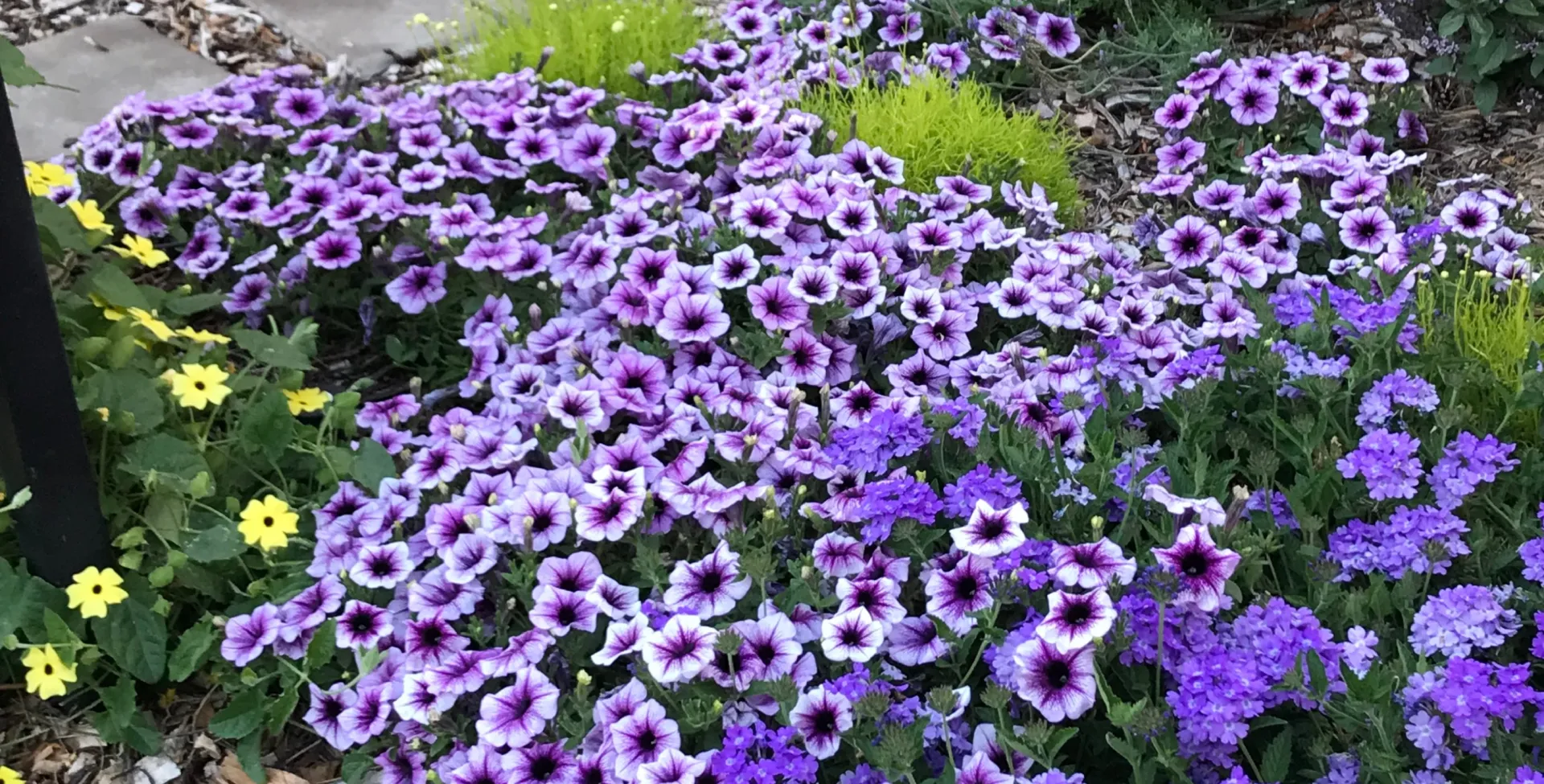
Petunias have been a staple in nurseries for years, and when I was a young gardener, seduced by their bright, clear colors, I tried them several times and gave up. They were too much work, and the reward was too small. They were fragile and hard to keep alive, needed constant deadheading to keep blooming, and needed routine spraying for bugs and disease. Inevitably, the pests won. Give me a zinnia, cosmos, or marigold any day over the fussy, frustrating petunia.
But while I was ignoring petunias, plant breeders were hard at work. The first breakthrough was petunias that did not set seed, thus did not need weekly deadheading to keep blooming. Breeding continued to improve vigor and disease resistance. The petunia of today is a far cry from the petunia of fifty years ago. This was forcibly brought to my attention by a local master gardener, Janey Santos, who has a YouTube channel Dig,Plant,Water,Repeat, where she showcases just how impressive petunias have become. Every summer, her garden becomes a dazzling riot of color, and petunias form the backbone of her display. I sat up and started taking notes on how she did it. It boiled down to three simple steps.
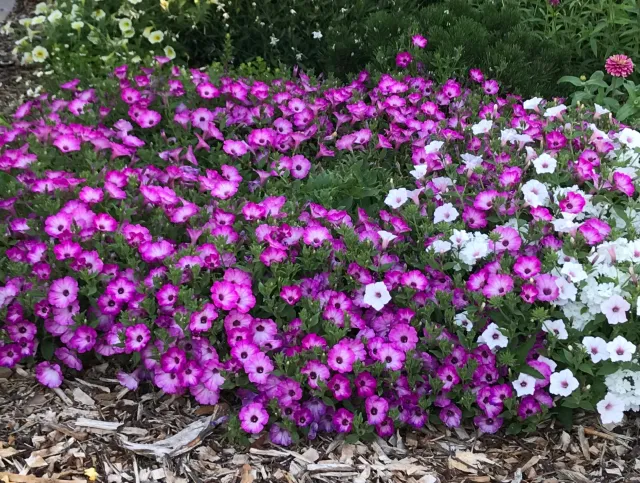
Step one was to choose the right variety. There are several producers of high-performing petunias out there, and choosing from these makes more of a difference than you would think. I know it seems galling to pay up to ten dollars for a four-inch petunia plant, when you can get a six-pack at a big box store for far less than that, but in the end, the expensive plant pays for itself. I winced at the price and bought a petunia called Pink Tiara this spring. It came in a quart pot and had been trimmed back hard by the shipper, so it was barely wider than the pot. I put it in at the end of the second week of April this year. I’m writing this the second week of June. The plant is three feet across and shows no inclination to slow down. This is after only nine weeks- a bit more than two months- in the ground. It’s been in continuous full bloom for seven of those weeks. To be honest, I’m almost afraid of it; it’s so aggressive. I think the breeder slipped in some kudzu genes when nobody was looking. Most of these high-performing petunias are vegetatively propagated, but there are a few (Wave petunias) that can be grown from seed. They can be hard to find; local independent nurseries carry some, but for the best selection of high-performance petunias, mail order is the way to go.
The second step is regularly scheduled fertilizing. You don’t get a plant that grows three feet in nine weeks by sprinkling a little compost in the hole on planting, or even including a teaspoon of Osmocote. These petunias require massive amounts of nutrients, and the simplest and fastest way to provide them is to use a water-soluble, concentrated fertilizer applied by a hose-end sprayer. Janey Santos fertilizes her petunias weekly. I was fertilizing weekly too, until the plants got so big they were starting to crowd out their neighbors. I’ve dropped down to biweekly fertilizing at this point; the plants are certainly big enough, I just want to support flowering at this stage.
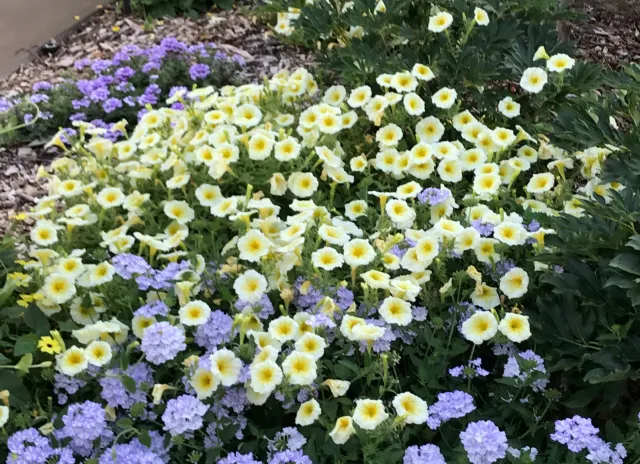
The last step is controlling budworms. Those pretty white butterflies flitting above your plants aren’t there for nectar; they’re laying eggs on the petunias. The eggs hatch into small, pale green worms that devour petunia buds and flowers as fast as the plants produce them. Unchecked, they’ll eat your petunias bald. The solution is a biological control agent, called Bacillus thuringiensis, or Bt for short. This is a bacterium in spore form that is sprayed on the plant, resulting in the worm ingesting the spores when taking a bite of the plant. The spores cause paralysis of the digestive tract; the worm stops eating and dies. The bacterium has several strains that control various insect types, but the one that controls budworm is the most widely available and can be bought at any garden store. It should be applied in the evening, since it is susceptible to damage by UV light. Bt application lasts a week unless your overhead watering system washes it off, or it rains; then it needs to be applied again. I overhead water one night a week; I put the Bt on the evening of the day after watering. Store this product inside your house; the spores die if stored in a hot garden shed or garage during the summer.
I won’t call this a fourth step, but be aware that these high-performance petunias can grow so large that they swallow up nearby annuals, perennials, and small shrubs. They are quite sneaky about it. They first grow underneath the other plant, then climb up unnoticed into the interior, then the plant disappears under an emerging canopy of petunia foliage that pops out of the top. So, give these plants plenty of room when you plant them, or be prepared to keep trimming them back periodically during the second half of the summer.
That’s basically it. Buy high-performing petunia varieties, feed regularly, control budworms, and watch for encroachment into nearby plants. Oh, and enjoy the large sheets of color that will fill your garden and make you the envy of the neighborhood!
Photos by Sue Fitz, adapted.