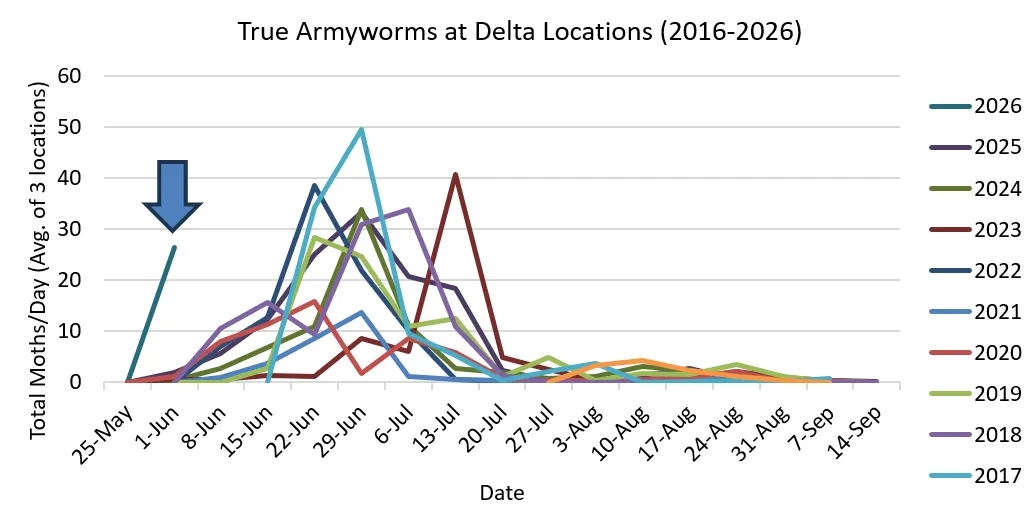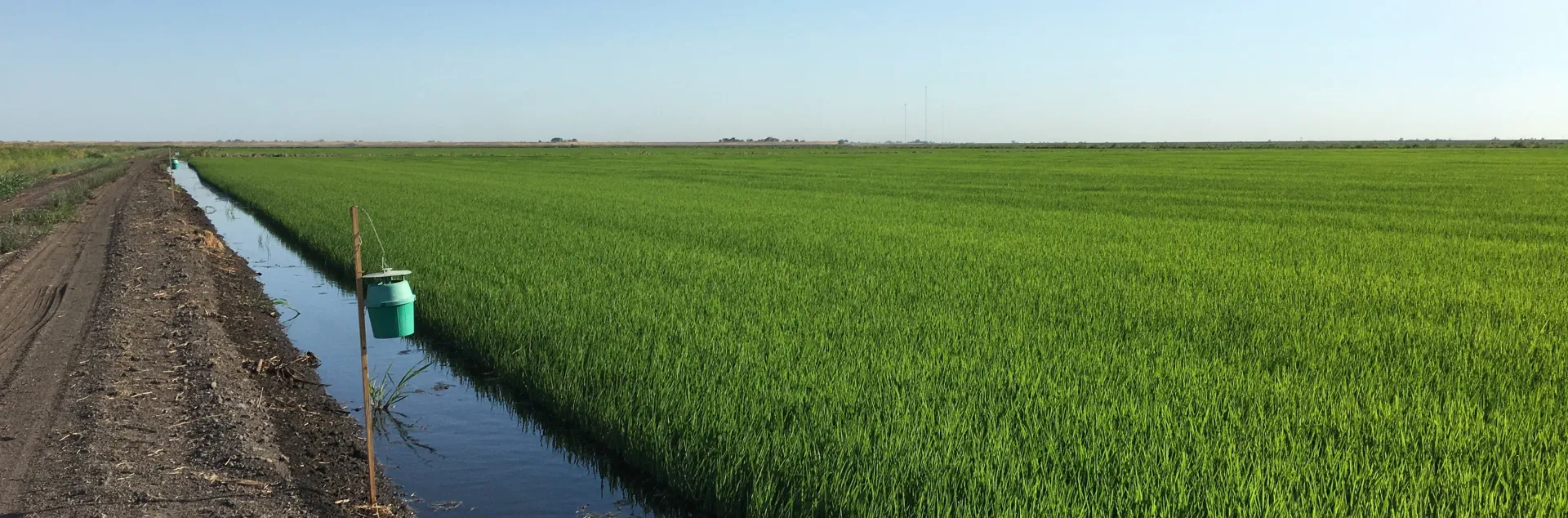
We have begun seasonal monitoring for armyworms in rice. Our monitoring involves scouting for damage and deployment of pheromone bucket traps that catch the true armyworm moths. Traps are set up at three Delta locations, where at each location, there are three traps in adjacent checks. The traps are checked weekly, and monitoring data since 2016 are depicted in Figure 1. The large blue arrow indicates the population trend line this year after the first week of trapping. Data are expressed as moths caught per day, averaged across all nine Delta traps. The data allow us to visualize how the population is tracking within the season and compared to previous years. There is a pretty obvious difference between this year and past years. Today, on our first day of trapping, we caught more moths than we have ever caught at this time of year, but I do not want to set off “alarm bells”. We had a very warm month of March, and the armyworm phenology is probably reflecting the circumstances of the weather this year.
Growers and consultants, nevertheless, should make note and start scouting early. It is important to pair the monitoring data with observations in the field. Scouting should occur in the early morning hours. In the heat of the day, larvae recede into the canopy near the water line and are difficult to find, particularly the early instars. UC IPM provides treatment guidelines that include damage assessments and signs of the worms in the field. At the foliar stage, if at least 25 percent defoliation from feeding is observed and worms are visible, then treatment may be warranted. At the panicle stage, if 10 percent of the panicles are damaged and worms are present, then treatment may be warranted. I want to emphasize that field monitoring is an important part of armyworm management. Do not rely on the trapping data alone because there is variability across farms and even across fields on the same farm.
Armyworm larvae will grow to full size and pupate in about 3 to 4 weeks. We have learned over the years that when moth flights peak, if treatment is warranted based on field monitoring and damage thresholds, the treatment is most effective if applied in the week or two after the peak moth population. Over the season, I will be connecting with the rice farming community to communicate ‘real-time’ monitoring data to help advise management. Anyone who has questions about rice armyworm management, or who wants to be included in ‘real-time’ monitoring communications, should reach out to me promptly so that I can update my contact list. I will post a blog summary of the seasonal data in the fall, along with a recap of Delta rice research. Good luck this season!