
How Southern California households, landscapers, and communities can save water, protect local waterways, and build healthier landscapes this summer
It is that time of year again. July is Smart Irrigation Month, an annual opportunity to pause and think more carefully about how we water our landscapes.
Last year, we introduced Smart Irrigation Month and shared practical ways Southern California households could save water outdoors. This year, we are building on that conversation by looking more closely at what makes irrigation truly smart, beyond simply installing a new controller.
As summer temperatures rise and outdoor water use increases, it is a good time to ask whether water is reaching plants where and when they need it, or whether it may be running off, creating waste, or carrying pollutants toward local waterways.
For many Southern California households, outdoor watering is one of the largest parts of summer water use. Landscapes need thoughtful care during hot, dry weather, but more watering does not always mean healthier plants. Prolonged excess moisture can reduce oxygen around roots, contribute to plant stress and root disease, increase maintenance needs, and create runoff. That runoff can carry sediment, fertilizer, pesticides, pet waste, bacteria, trash, and other pollutants toward storm drains and local waterways. [1, 2]
Smart irrigation is not simply about installing a new controller. It is about making better decisions across the entire landscape.
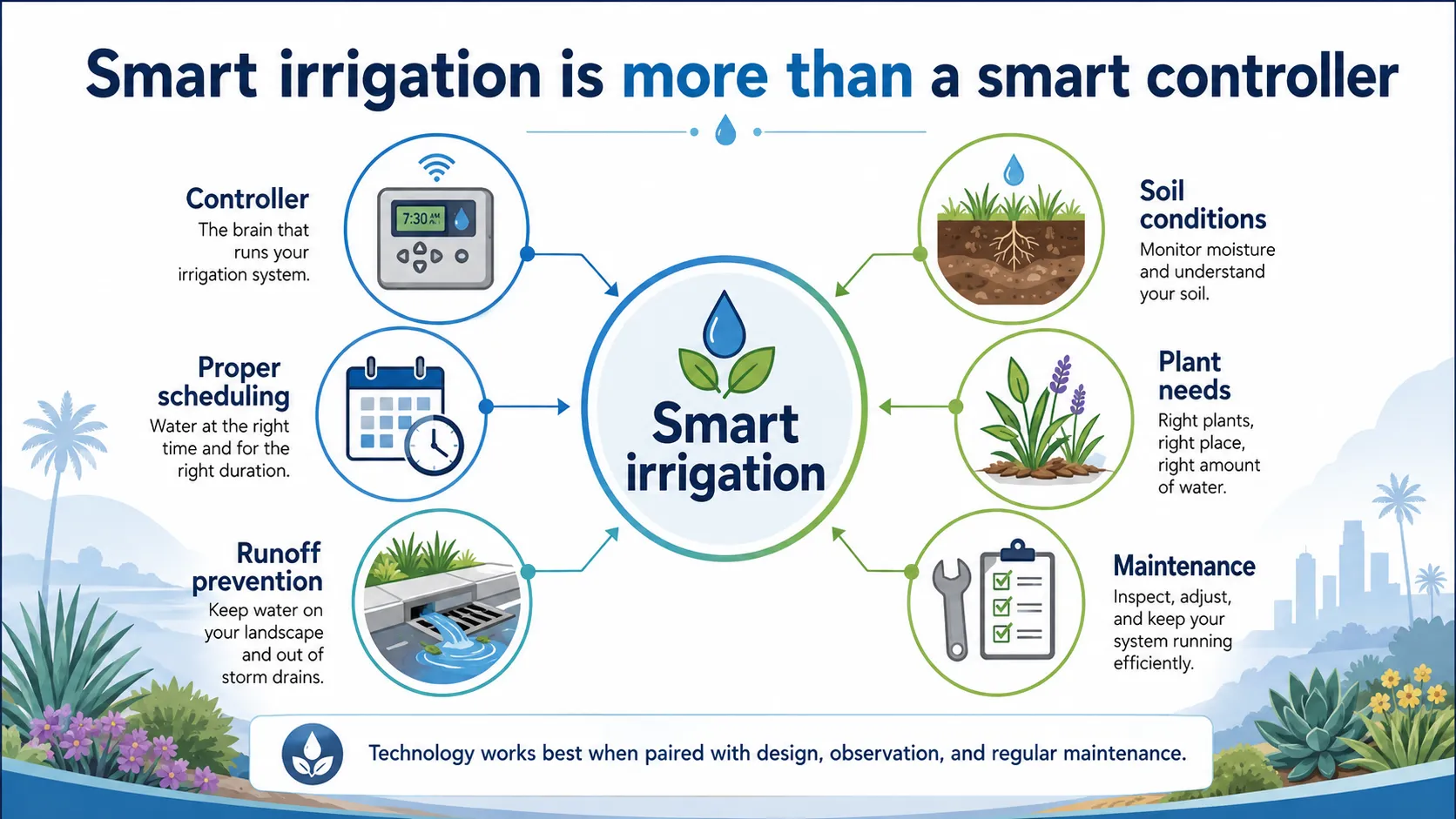
That means checking the irrigation system, understanding soil and plant needs, adjusting schedules as weather changes, preventing runoff, and choosing water-efficient technologies that fit the property.
This July, let us move beyond the question, “How often should I water?” and ask a more useful one; Is my irrigation system watering smarter, or just watering more?
What is Smart Irrigation Month?
Smart Irrigation Month is observed each July to raise awareness about efficient irrigation practices, water-saving technologies, and the importance of applying water only when plants need it.
The Irrigation Association’s 2026 campaign includes Wear Blue Wednesday on July 15. Residents, water agencies, landscape professionals, educators, and community organizations are encouraged to wear blue and share messages about efficient irrigation throughout the month using #SmartIrrigationMonth. [3]
For Southern California, smart irrigation matters because choices made at homes, parks, schools, businesses, and community spaces affect more than water bills. They can influence water supply reliability, landscape health, local creek and ocean water quality, energy use, and community resilience during heat and dry weather.
💡 Did you know?
A smart controller cannot repair a broken sprinkler head, a leaking valve, clogged drip emitters, poor water pressure, compacted soil, or sprinklers that spray onto sidewalks and driveways. Technology works best when it is paired with a well-designed, maintained, and properly programmed irrigation system. [4, 5]
Smart irrigation is more than a smart controller
A smart irrigation system combines technology, regular maintenance, seasonal adjustments, and landscape design. Each part matters.
Weather-based irrigation controllers
Weather-based irrigation controllers use local weather and landscape information to adjust watering schedules. Depending on the product and setup, they may consider temperature, rainfall, humidity, solar radiation, wind, and evapotranspiration.
Evapotranspiration, often shortened to ET, describes the combined loss of water through evaporation from soil and plant surfaces and transpiration through plants. It is one of the main concepts used to estimate landscape water demand.
Instead of following one fixed schedule all year, a weather-based controller can reduce watering during cooler conditions and increase watering when plant demand rises. However, the controller still needs accurate information about the landscape, including plant type, sun exposure, soil, irrigation method, precipitation rate, and slope. Default settings are a starting point, not a substitute for observation. [4, 5, 6]
A weather-based controller may be especially useful for households, HOAs, schools, parks, and commercial properties where schedules are not regularly adjusted by hand. It can also be helpful for people who travel frequently or manage several irrigation zones with different conditions.
Soil-moisture sensor systems
Soil-moisture sensors measure moisture near the root zone, where plants take up water. When soil moisture is sufficient, the sensor can delay or override a scheduled irrigation cycle.
This differs from a weather-based controller. A weather-based controller estimates plant water demand from weather and site information. A soil-moisture sensor responds to conditions in the soil itself.
Soil-moisture sensors can be particularly useful for trees, shrubs, deeper-rooted landscapes, areas with variable soil, and sites where soil moisture is difficult to judge from the surface. Their effectiveness depends on proper sensor placement, installation depth, calibration, and maintenance. One sensor may not represent conditions across a large or highly variable landscape. [4, 7]
Flow monitors and leak-detection devices
Flow-monitoring devices track water movement through a property’s water system. Some can identify unusual water use and alert the customer to a possible leak, such as a damaged irrigation line, broken valve, continuously running toilet, or other plumbing issue.
A flow monitor does not automatically identify the precise location or cause of a problem. It is an early-warning tool that can prompt a homeowner or landscape manager to inspect the property.
For a household, catching an unexpected flow issue early can prevent a larger water bill, landscape damage, and prolonged runoff.
High-efficiency nozzles and drip irrigation
High-efficiency rotating nozzles generally apply water more slowly than conventional fixed spray nozzles. That slower application rate can help water soak into the soil rather than running off, particularly on slopes, compacted soils, and landscapes with poor infiltration.
However, nozzles should be selected and installed carefully. Irrigation components with very different precipitation rates should not be grouped on the same irrigation zone unless the system has been specifically designed to manage those differences. Mixing conventional spray heads, rotating nozzles, and drip irrigation on the same valve can create uneven watering because each method applies water differently.
Drip irrigation delivers water near the root zone and can be a good option for trees, shrubs, gardens, and many water-efficient plantings. However, drip irrigation is not automatically efficient. It still needs appropriate filtration, pressure regulation, flushing, inspection, emitter placement, and maintenance. A clogged emitter, damaged tubing, missing pressure regulator, or unnoticed leak can leave one plant stressed while another receives too much water. [5, 8]
💡 Did you know?
A smart controller can improve scheduling, but it cannot compensate for an irrigation system that applies water unevenly. Distribution uniformity, which describes how evenly water is applied across a zone, is one of the most important foundations of efficient irrigation. [5]
What Smart Irrigation Technology Cannot Fix on Its Own
New technology can be helpful, but it cannot replace observation and maintenance.
Even the best controller may not prevent waste if the irrigation system has underlying problems. A monthly irrigation inspection is one of the most useful water-saving practices a homeowner, landscape manager, HOA, or maintenance crew can adopt.
Look for these common issues:
- Sprinklers watering pavement, walls, fences, streets, or driveways
- Broken, tilted, clogged, or missing sprinkler heads
- Water pooling near valves, irrigation lines, or low spots
- Drip emitters that are clogged, disconnected, damaged, or buried too deeply
- Runoff flowing toward sidewalks, gutters, storm drains, or neighboring properties
- Trees, shrubs, turf, flowers, and vegetables grouped in the same irrigation zone despite having different water needs
- Irrigation equipment with different application rates operating together on the same valve
- Irrigation systems operating during rain because a rain sensor, weather-based controller, or manual seasonal adjustment has not been used
- One schedule being used throughout the year without adjustment for weather, plant growth, or seasonal changes
- Excessive irrigation frequency that keeps the root zone wet for long periods
💡 Did you know?
Plants growing in shade often need less water than plants growing in full sun. Slopes and compacted soils may need shorter irrigation cycles with time between them for water to soak in. Young trees, established trees, turf, vegetable gardens, containers, and drought-tolerant shrubs may all need different schedules. [2, 5]
Why irrigation efficiency is also a water-quality issue
When water is applied faster than soil can absorb it, the excess can become runoff.
Runoff from lawns, gardens, driveways, and landscaped areas often flows into a curb, gutter, or storm drain. In many Southern California communities, storm drains are part of a separate drainage system that conveys runoff to local creeks, rivers, wetlands, beaches, or the ocean. Unlike wastewater from sinks and toilets, storm-drain flow is not generally routed through a wastewater treatment plant before reaching receiving waters.
Runoff can pick up pollutants as it moves across the landscape and hard surfaces. Depending on the source area, those pollutants may include sediment, fertilizers, pesticides, bacteria, pet waste, trash, debris, oil, metals, and other materials.
Reducing overwatering is therefore not only a water-conservation action. It is also a practical way to reduce pollutant transport to local waterways.
Diagram showing how excess irrigation flows along a curb into a storm drain, then to local waterways and the ocean, carrying pollutants such as sediment, fertilizer, pesticides, bacteria, and pet waste.
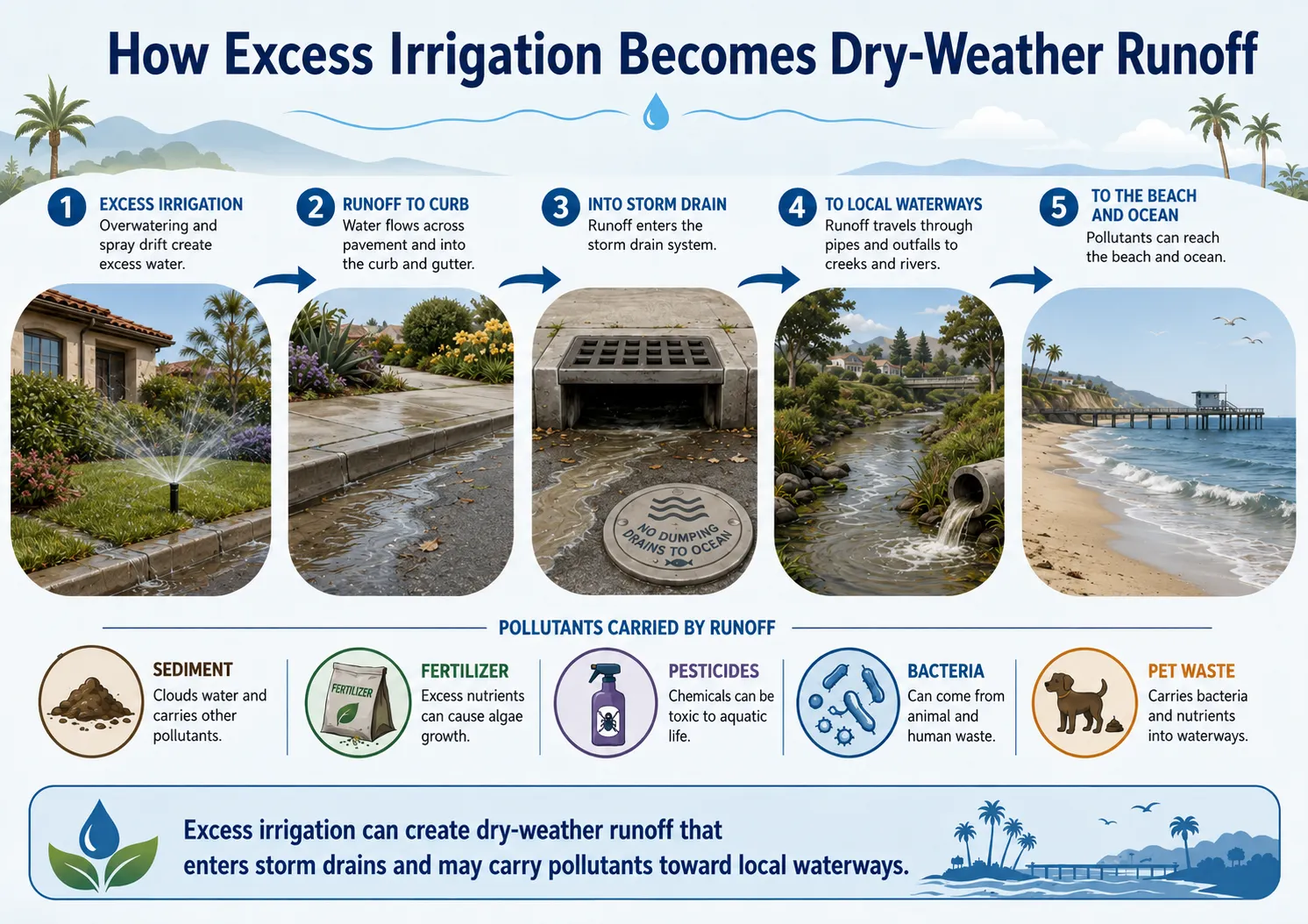
This connection is especially important in urban areas, where sidewalks, driveways, roads, parking lots, and other impervious surfaces prevent water from soaking into the ground.
Irrigation runoff and dry-weather flow
In Southern California, excess irrigation can also contribute to dry-weather flow.
Dry-weather flow is water moving through gutters, storm drains, channels, or creeks when it has not recently rained. It is important not to assume that every dry-weather flow is illegal, polluted, or caused by irrigation. Dry-weather flow can come from several sources, including permitted nonstormwater discharges, groundwater seepage, potable-water leaks, irrigation runoff, car washing, wash water, and other outdoor activities.
However, excess irrigation is one controllable source of urban dry-weather runoff. When sprinklers overspray onto pavement, irrigation lines leak, or water is applied faster than soil can absorb it, that water can enter the storm-drain system even on a clear day.
Water-quality impacts depend on the source of the flow, the pollutants present, the amount of water, and receiving-water conditions. During dry periods, lower flow volumes may provide less dilution for some pollutants. That is one reason preventing unnecessary irrigation runoff is important for local water quality. [9, 10, 11]
💡 Did you know?
Water that runs off your property from excess irrigation does not simply disappear. It can become part of the storm-drain system and may carry pollutants toward local waterways.
Five ways to water smarter this July
1. Inspect your irrigation system
Run each irrigation zone long enough to watch what happens.
Check for leaks, broken heads, overspray, runoff, clogged emitters, uneven watering, and areas where water pools or escapes onto pavement.
Look carefully at the beginning and end of each irrigation cycle. Some problems are visible only after a zone has been running for several minutes.
A quick inspection can reveal problems that a controller cannot see.
2. Adjust your schedule for summer conditions
Water needs change throughout the year. A July schedule should not be the same as a spring, fall, or winter schedule.
Review controller runtimes, watering days, start times, and seasonal adjustment settings. Consider current weather, plant type, soil conditions, sun exposure, slope, recent irrigation, and whether the landscape is newly planted or established.
Daily irrigation is often unnecessary for established landscape areas, particularly established trees, shrubs, and many turf areas. However, short-term frequent watering may be appropriate for newly planted material, containers, shallow-rooted annuals, or other specific situations. The right schedule depends on the landscape, not a single universal rule. [2, 5]
3. Use cycle and soak when runoff occurs
Cycle and soak means dividing one long irrigation event into shorter watering periods with time in between.
For example, instead of running a sprinkler zone for 20 continuous minutes, a homeowner may run the zone for 8 minutes, pause long enough for water to soak in, and then run another 8-minute cycle later. The actual run time and soak time should be based on the site, soil, slope, sprinkler application rate, and the point at which runoff begins.
Cycle and soak can be useful on slopes, compacted soils, clay soils, or landscapes with spray irrigation. It gives water time to infiltrate rather than flowing off the surface. [2, 12]
4. Group plants by water need
Trees, shrubs, turf, vegetables, succulents, native plants, and flowers do not all need the same amount of water.
When possible, group plants with similar water needs together on the same irrigation zone. This practice is often called hydrozoning.
Hydrozoning makes it easier to water efficiently without stressing one group of plants or overwatering another. It can also make a future irrigation upgrade easier because each zone has a clearer purpose.
For example, a mature tree should not necessarily be irrigated on the same schedule as nearby turf. A vegetable garden may need different management than a drought-tolerant shrub bed. A shaded side yard may need different runtimes than a sunny south-facing slope.
5. Choose upgrades based on your actual landscape needs
A smart controller may be the right next step for one property. A leak repair, irrigation audit, pressure adjustment, drip conversion, soil-moisture sensor, rotating nozzle retrofit, rain barrel, mulch application, or landscape redesign may be a better first step for another.
Start with an irrigation inspection. Then identify the changes that will make the greatest difference for your property.
💡 Did you know?
A traditional controller can also be used efficiently when it is correctly programmed and regularly adjusted. Smart technology can make those adjustments easier, but the greatest savings often come from correcting leaks, overspray, uneven application, and unnecessary irrigation first. [5, 6]
Smart irrigation supports healthier and more resilient landscapes
Water-efficient landscapes are not landscapes that receive no water. They are landscapes that receive water intentionally.
A healthy, resilient landscape considers:
- Soil type and drainage
- Sun and shade conditions
- Plant water needs
- Root depth
- Slope and runoff potential
- Mulch and organic matter
- Irrigation system design
- Seasonal weather conditions
- Rainwater capture opportunities
- Long-term maintenance needs
California Friendly and climate-appropriate plants can help reduce irrigation needs when selected for the right location and established properly. Native plants are not automatically “no-water” plants. Even drought-tolerant and native landscapes need thoughtful establishment watering, and some may need supplemental irrigation during extended hot and dry periods.
Mulch can help retain soil moisture, moderate soil temperature, reduce weeds, and reduce erosion. A layer of organic mulch is often most effective when kept away from tree trunks and plant crowns to reduce the risk of persistent moisture against sensitive plant tissue. [2, 13]
Trees deserve special attention. Mature trees provide shade, help cool neighborhoods, support habitat, and improve the comfort of outdoor spaces. Their irrigation needs may differ substantially from surrounding turf or ornamental plantings. Both too little and too much water can stress trees, and prolonged excess moisture can contribute to root decline and disease. [1, 14]
💡 Did you know?
A landscape conversion can be both a water-conservation project and a stormwater project. Turf replacement, climate-appropriate plants, improved irrigation, mulch, rain gardens, and permeable surfaces can work together to reduce irrigation demand while helping rainwater soak into the soil.
Rebates and incentives in Southern California
Many Southern California water agencies offer rebates or incentive programs for water-saving landscape upgrades. Programs vary by water agency, service area, customer type, property type, product eligibility, funding availability, and current program rules.
Always check eligibility before purchasing equipment or beginning work. Some programs require a reservation, application, or approval before turf removal, irrigation conversion, or landscape installation begins.
Rebate amounts and availability can change. The links in the references section are the best places to confirm current terms, eligible models, application deadlines, and whether local incentives can be combined with SoCal Water$mart funding.
Los Angeles County
Residents served by the Los Angeles Department of Water and Power can review the Residential SoCal Water$mart Water Rebate Program for qualifying water-efficiency devices and landscape upgrades.
Current LADWP listings include weather-based irrigation controllers, soil-moisture sensor systems, rotating nozzles, smart hose bib controllers, rain barrels, cisterns, turf replacement, leak detection, and other qualifying products or projects. LADWP’s current program page notes that the weather-based controller rebate cannot be combined with the soil-moisture sensor-system rebate for the same project. [15]
LADWP customers who meet specific eligibility requirements may also qualify for the Landscape Efficiency Assistance Program, or LEAP. The program is funded through a California Department of Water Resources grant and may provide free services for eligible single-family households in state-defined disadvantaged communities. Services may include California Friendly landscaping, rain capture features, drip conversion, weather-based controllers, smart water-use monitoring devices, and high-efficiency sprinklers. Eligibility requirements, including property ownership or written owner permission and front-yard turf area, should be verified directly with LADWP. [16]
For commercial, institutional, multifamily, and public-agency sites, LADWP also provides a commercial rebate program that includes irrigation and landscape efficiency measures. [17]
Orange County
Orange County residents should begin by checking with their retail water provider and the SoCal Water$mart rebate portal.
Irvine Ranch Water District currently lists outdoor rebates for turf replacement, drip irrigation conversion, weather-based irrigation controllers, rotating nozzles, rain barrels, cisterns, soil-moisture sensors, smart hose bib controllers, and other landscape measures. IRWD advises customers to confirm current funding through SoCal Water$mart before purchasing because rebate amounts may change. [18]
Santa Margarita Water District currently lists rebates for smart sprinkler timers, soil-moisture sensor systems, flow monitors, high-efficiency nozzles, smart hose bib controllers, rain barrels, cisterns, turf replacement, spray-to-drip conversion, and H2OC RainSmart rain-capture projects. SMWD’s current program page also identifies separate rebate opportunities for residential, commercial, and public-agency customers. [19]
💡 Did you know?
At Santa Margarita Water District, a qualifying smart irrigation timer rebate was temporarily increased to $200 through February 2026 and then returned to $100 beginning March 1, 2026. This is a good example of why residents should verify current incentive levels before making a purchase. [20]
Riverside County
Riverside County includes many water providers, so residents should check with their local water agency first.
Eastern Municipal Water District customers can review the SoCal Water$mart program for qualifying weather-based irrigation controllers, rotating sprinkler nozzles, soil-moisture sensor systems, rain barrels, cisterns, and turf replacement. EMWD’s current page also notes additional district funding for turf replacement and a possible tree add-on rebate when new qualifying trees are included as part of an approved turf replacement project. [21]
Riverside Public Utilities offers a Smart Irrigation Program for residential and business customers in its service area. As of May 2026, the program provides a free irrigation assessment and may support repair or replacement of up to $300 in qualifying irrigation equipment. RPU reports that the program has helped customers install smart irrigation controllers and high-efficiency sprinkler nozzles. [22]
Western Municipal Water District provides water-efficiency assessments, rebate resources, water-wise landscape guidance, and a Turf Transformation Partnership Program. The district is also helping commercial, institutional, municipal, and HOA common-area customers prepare for the statewide phaseout of potable-water irrigation for nonfunctional turf beginning January 1, 2027. [23]
San Bernardino County
San Bernardino County residents should check with their local retail water provider because programs vary across the county.
San Bernardino Municipal Water Department currently offers outdoor rebates for weather-based irrigation controllers, standard controllers, drip systems, high-efficiency sprinkler nozzles, drought-tolerant plants, turf removal, turf-replacement materials, professional landscape design associated with turf removal, pool covers, and other qualifying improvements. [24]
Inland Empire Utilities Agency offers participating customers residential rebates for turf replacement, weather-based irrigation controllers, hose bib controllers, rotating sprinkler nozzles, rain barrels, cisterns, and soil-moisture sensor systems. [25]
Commercial, institutional, and multifamily properties should consult their own water provider or SoCal Water$mart for applicable large-landscape incentives. Requirements often differ from residential programs.
A practical rebate reminder
Before starting a project:
- Confirm your water provider and account eligibility.
- Read the current program rules and terms.
- Check whether pre-approval or a reservation is required.
- Confirm that the proposed product model is eligible.
- Save receipts, photographs, invoices, proof of water service, and other required documentation when transitioning after approval. Some projects do not fund past projects.
- Do not remove turf or install equipment until you understand the program requirements and you are given a go ahead to do so.
- Ask whether local agency funding can be combined with regional incentives.
- Keep a copy of your approved design or application materials for future reference.
💡 Did you know?
Some programs allow either a weather-based irrigation controller or a soil-moisture sensor system, but not both for the same project. LADWP’s current program is one example. Always read the program terms before purchasing equipment. [15]
Smart Irrigation Month events and learning opportunities
July is a good time to learn how to improve irrigation practices before the hottest part of summer.
Event details, registration requirements, and availability can change, so check the linked agency page before attending.
Across Southern California
Metropolitan Water District-sponsored workshops scheduled for July 2026 include:
- California Friendly and Native Plant Landscape Training, July 7, virtual
- Transforming Lawns: A Sustainable Approach, July 8, virtual
- Garden Design Seminar, July 9, virtual
- Roots to Rainwater, July 14, virtual
- Irrigation and Controller Basics: Smart Watering, July 15, virtual
- Drip Irrigation: Maintenance and Troubleshooting, July 16, virtual
- Transforming Lawns: A Sustainable Approach, July 22, virtual
- Drip Irrigation: Maintenance and Troubleshooting, July 23, virtual
- California Friendly and Native Plant Landscape Training, July 25, Oceanside Public Library Civic Center Community Room
- Roots to Rainwater, July 28, virtual
- Irrigation and Controller Basics: Smart Watering, July 29, virtual
- Drip Irrigation: Maintenance and Troubleshooting, July 30, virtual
The July 15 and July 29 irrigation workshops specifically include controller programming, cycle and soak, seasonal adjustments, common irrigation problems, weather-based controllers, drip irrigation basics, and troubleshooting. [26]
Orange County
Santa Margarita Water District will host an Outdoor Watering Expo on Wednesday, July 22, 2026, from 6:00 to 8:00 p.m. at 26111 Antonio Parkway in Rancho Santa Margarita.
The event includes irrigation and landscape-watering guidance, smart-timer information, high-efficiency nozzle and drip-irrigation information, rebate assistance, and an opportunity drawing for water-saving prizes. Attendees may bring receipts for rebate-eligible purchases made within the prior 300 days and receive application assistance at the event. [27]
Santa Margarita Water District is also listing a “Water Better, Not Wetter” event on Thursday, July 9, 2026, focused on smart irrigation and water-wise landscapes, as well as a July 23 drip-irrigation workshop. [28]
Riverside County
Riverside Public Utilities customers can explore the Smart Irrigation Program, including the free irrigation assessment and qualifying equipment support described above. [22]
Western Municipal Water District customers can explore water-efficiency assessments, outdoor rebates, water-wise landscaping guidance, and the Turf Transformation Partnership Program. [23]
San Bernardino County
San Bernardino Municipal Water Department offers water-saving workshops and webinars that include efficient irrigation techniques, outdoor water-use guidance, and irrigation-system information. Check the current conservation calendar for upcoming opportunities. [29]
Statewide
Wear Blue Wednesday is July 15, 2026. Share a photo, a water-saving tip, or a reminder to inspect irrigation systems using #SmartIrrigationMonth. [3]
A July irrigation check-in
Before the end of Smart Irrigation Month, take 15 minutes to walk through your landscape and ask:
- Are sprinklers watering plants instead of pavement?
- Is water running off the property?
- Are controller settings appropriate for current weather?
- Are drip emitters working and free of obvious leaks or clogs?
- Are different plant types being watered according to their needs?
- Is there a leak, broken head, damaged valve, or pressure problem that needs repair?
- Is there a rebate that could help pay for an upgrade?
- Could rainwater be captured, slowed, spread, or soaked into the landscape instead of flowing away?
- Does the irrigation schedule reflect the actual needs of this landscape, rather than a fixed routine?
Smart irrigation begins with paying attention.
It is not about using as little water as possible. It is about using the right amount of water, in the right place, at the right time, while protecting landscapes, household budgets, local waterways, and Southern California’s long-term water future.
Learn more
Check with your local water provider for current rebate eligibility, workshops, and water-saving resources.
For regional programs, explore SoCal Water$mart and Be Water Wise resources. For landscape design guidance, explore California Friendly landscaping resources, local water-agency workshops, UC Cooperative Extension resources, and the California Native Plant Society’s Calscape plant database.
Your turn!
How are you managing outdoor water use?
Want to be a Smart Irrigator this July? Take our short Smart Irrigation Month survey, check your irrigation system, and consider wearing blue to help spread the message about smarter outdoor water use.
As part of Smart Irrigation Month, we are asking Southern California residents and landscape managers to share their experiences with watering, irrigation technology, runoff, and water-saving upgrades.
Your feedback will help identify the resources, workshops, rebate information, and local support that would be most useful to communities across Los Angeles, Orange, Riverside, and San Bernardino Counties.
Smart Irrigation Month survey link
References and local resources
- UC Agriculture and Natural Resources. Watering Landscape Trees and Shrubs: The Good and the Bad.
https://ucanr.edu/node/115308/printable/print - UC Agriculture and Natural Resources. Conserve Water in Landscapes.
https://ipm.ucanr.edu/home-and-landscape/conserve-water-in-landscapes/ - Irrigation Association. Smart Irrigation Month.
https://www.irrigation.org/IA/Resources/Smart-Irrigation-Month/IA/Resources/Smart-Irrigation-Month-Home.aspx - U.S. Environmental Protection Agency. WaterSense Labeled Controllers.
https://www.epa.gov/watersense/watersense-labeled-controllers - UC Agriculture and Natural Resources. Landscape Irrigation System Evaluation and Management.
https://ucanr.edu/sites/default/files/2013-02/160836.pdf - UC Agriculture and Natural Resources. Smart Weather-Based Irrigation Controllers, Publication 8674.
https://anrcatalog.ucanr.edu/pdf/8674.pdf - Singh, A., et al. Smart Soil Moisture Sensor-Based Irrigation Controllers. University of California Agriculture and Natural Resources, 2026.
https://escholarship.org/content/qt6q44h5v5/qt6q44h5v5.pdf - UC Agriculture and Natural Resources. Your Irrigation System During Drought.
https://ucanr.edu/site/uc-master-gardener-program-contra-costa-county/article/your-irrigation-system-during-drought - California State Water Resources Control Board. Guidance for Stormwater and Dry Weather Runoff.
https://www.waterboards.ca.gov/water_issues/programs/stormwater/storms/docs/swrcb_schools_lid_2018fnl.pdf - California State Water Resources Control Board. Stormwater Capture at Schools, Appendix Materials.
https://www.waterboards.ca.gov/publications_forms/publications/legislative/docs/2018/stormwater_capture_at_schools_with_appendices.pdf - California State Water Resources Control Board. Enhancing Urban Runoff Capture and Use.
https://www.waterboards.ca.gov/water_issues/programs/stormwater/storms/docs/STORMS-capture-use.pdf - UC Agriculture and Natural Resources. Water-Wise Gardening.
https://ucanr.edu/node/128809/printable/print - UC Agriculture and Natural Resources. Sustainable Landscaping in California.
https://ucanr.edu/sites/default/files/2014-05/190001.pdf - UC Agriculture and Natural Resources. Landscape Tree Irrigation 101.
https://ucanr.edu/blog/environmental-horticulture-news/article/landscape-tree-irrigation-101 - Los Angeles Department of Water and Power. Residential SoCal Water$mart Water Rebate Program.
https://www.ladwp.com/residential-services/programs-and-rebates-residential/residential-socal-water-mart-water-rebate-program - Los Angeles Department of Water and Power. Landscape Efficiency Assistance Program.
https://www.ladwp.com/residential-services/programs-and-rebates-residential/landscape-efficiency-assistance-program - Los Angeles Department of Water and Power. Commercial SoCal Water$mart Water Rebate Program.
https://www.ladwp.com/commercial-services/programs-and-rebates-commercial/commercial-socal-water-mart-water-rebate-program - Irvine Ranch Water District. Residential Rebates.
https://www.irwd.com/residential/rebates - Santa Margarita Water District. Rebate Programs.
https://www.smwd.com/179/Rebate-Programs - Santa Margarita Water District. Smart Irrigation Controller Rebate Reminder.
https://www.smwd.com/CivicAlerts.aspx?CID=1 - Eastern Municipal Water District. SoCal Water$mart Residential Programs and Rebates.
https://www.emwd.org/save-with-us/additional-programs-and-rebates/socal-watermart-residential-programs-rebates - Riverside Public Utilities. Customer Engagement Program Updates, May 2026.
https://riversideca.gov/utilities/sites/riversideca.gov.utilities/files/pdf/2026/51126LatestProgramUpdateReport.pdf - Western Municipal Water District. Save Water Resources and Turf Transformation Partnership Program.
https://westernwaterca.gov/9/Save-Water
https://westernwaterca.gov/742/Turf-Transformation-Partnership-Program - San Bernardino Municipal Water Department. Outdoor Rebates and Incentives.
https://www.sbmwd.org/259/Outdoor-Rebates-Incentives - Inland Empire Utilities Agency. Residential Rebates.
https://www.ieua.org/save-your-water/rebates/residential/ - Metropolitan Water District-sponsored Landscape Workshop Calendar.
https://www.rainbowmwd.ca.gov/landscape-workshops - Santa Margarita Water District. Outdoor Watering Expo.
https://smwd.com/m/newsflash/home/detail/422 - Santa Margarita Water District. Classes and Events.
https://www.smwd.com/170/Classes-Events - San Bernardino Municipal Water Department. Conservation Resources.
https://www.sbmwd.org/205/Conservation - California Department of Water Resources. Model Water Efficient Landscape Ordinance.
https://water.ca.gov/Programs/Water-Use-And-Efficiency/Urban-Water-Use-Efficiency/Model-Water-Efficient-Landscape-Ordinance - SoCal Water$mart. Residential Rebates and Eligibility.
https://socalwatersmart.com/en/residential/ - Metropolitan Water District of Southern California. Be Water Wise.
https://www.bewaterwise.com/ - California Native Plant Society. Calscape.
https://calscape.org/