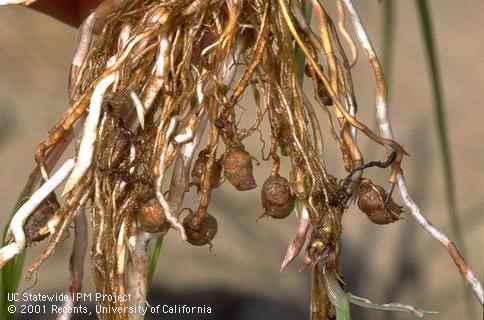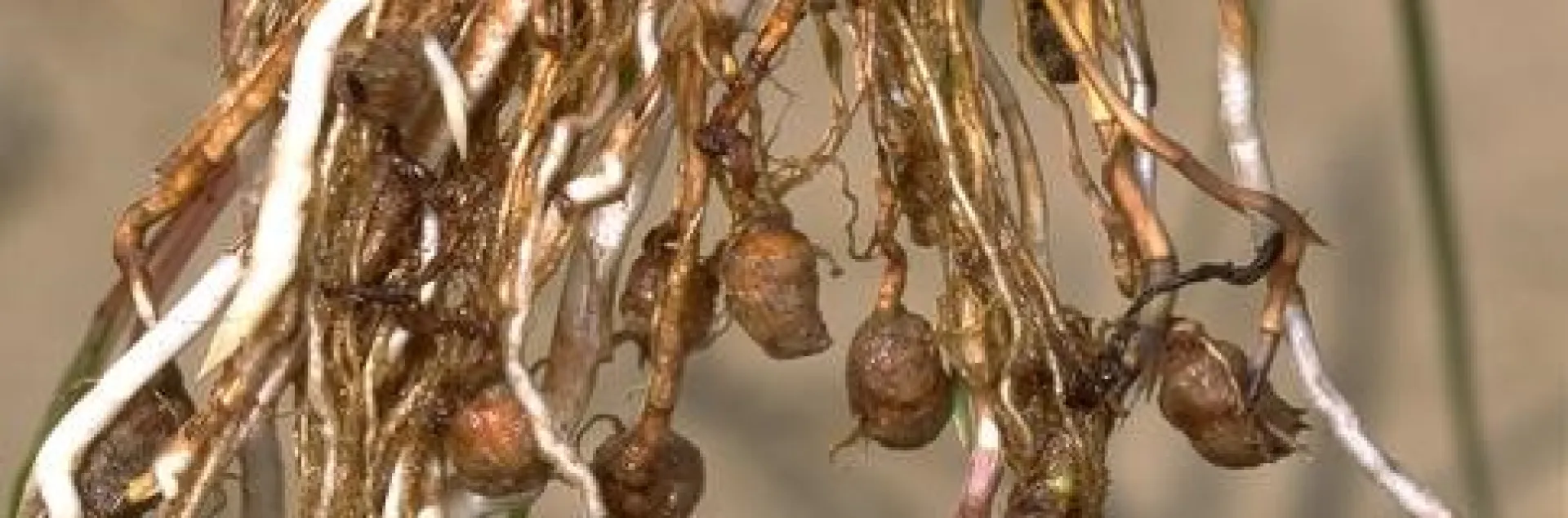
Cyperus rotundus is a perennial plant, that may reach a height of up to 140 cm (55 inches). It is a common weed in Southern California. The names "nut grass" and "nut sedge" – shared with the related species Cyperus esculentus – are derived from its tubers, that somewhat resemble nuts, although botanically they have nothing to do with nuts. But they are tasty to pigs, geese, and chickens and in horchata consumed by humans. Maybe the reason it is so widespread is because people spread it. It also has nothing to do with grass or sedges, jus that they look sort of like grass or sedge.
Yellow and purple nutsedge appear similar to grasses but have leaves that are triangular in cross-section, while grass leaves are round. The flowers resemble those of grasses. Yellow nutsedge flowers are yellow in color, while purple nutsedge flowers are purple. They are easily distinguished from each other by looking at their tubers. Yellow nutsedge tubers are nearly round and somewhat smooth. Purple nutsedge tubers are oblong and very rough and scaly. Purple nutsedge tubers are linked together by rhizomes (underground stems), while yellow nutsedge tubers are found only at the ends of rhizomes. Tubers of both species have three to seven buds that are capable of forming a new plant. Nutsedge plants develop from sprouts on a tuber; the sprout forms a bulb just under the soil surface. Leaves then grow from the basal bulb.
In a field trial in Georgia, purple nutsedge grown in fertilized soil without competing vegetation flowered and began to form tubers about 7–8 weeks after emergence and developed 2.4 tons above ground and 4.2 tons below ground dry weight per acre by 12 weeks. After that point, active foliar growth diminished while tuber formation accelerated; by 20 weeks, shoot biomass was 3.3 tons per acre while below ground biomass reached 12 tons per acre. Underground dry weights of approximately 5–8 tons per acre have been observed in naturally occurring heavy infestations at other sites. For comparison, the above ground biomass of an 8-ft pearl millet or sorghum-sudangrass cover crop with a fully closed canopy is about 5–6 tons per acre.
Weed pulling usually results in breakage of roots, leaving tubers in the ground from which new plants emerge quickly. Rototilling and discing distributes the tubers in the field, worsening the infestation; even if the rototiller cuts up the tubers to pieces, new plants can still grow from them. In addition, the tubers can survive harsh conditions, further contributing to the difficulty to eradicate the plant. Deep plowing that exposes tubers to drying on the surface can reduce numbers, but plowing must be frequent which leads to added costs and soil degradation.
Most herbicides may kill the plant's leaves, but most have no effect on the root system and the tubers. Glyphosate will kill some of the tubers (along with most other plants) and repeated application can be successful. Chlorsulfuron-methyl[18] will control nut grass after repeated applications without damaging lawns.[19] The plant does not tolerate shading and 2,4 dichlorophenoxyacetic acid (2,4-D) slows its growth in pastures and mulch crops.
Shading can have a significant impact on nutsedge populations. A tall cover crop, such as barley, oats, sorghum, buckwheat, and others will gradually deplete the tuber reserves and eventually eliminate the problem. But it takes time, several years for this to happen. I once told a grower who was going organic but had a field huge with nutsedge to first spray it out with an herbicide before going organic. The grower demurred and said that they wanted to ridge up and plant avocado trees and they would plant cover crops in the three-year period before organic certification. Well, it worked. Nutsedge, 4 years later is only just another of the many on-farm problems, but not insurmountable. A good thick layer - 6-8 inches deep, also restricts nutsedge growth. They were and are persistent in removing the stray nutsedge to keep it in check.
Other good readings: SARE: https://www.sustainablemarketfarming.com/tag/organic-weed-management-of-nutsedge/
Extension Foundation: https://eorganic.org/node/5131
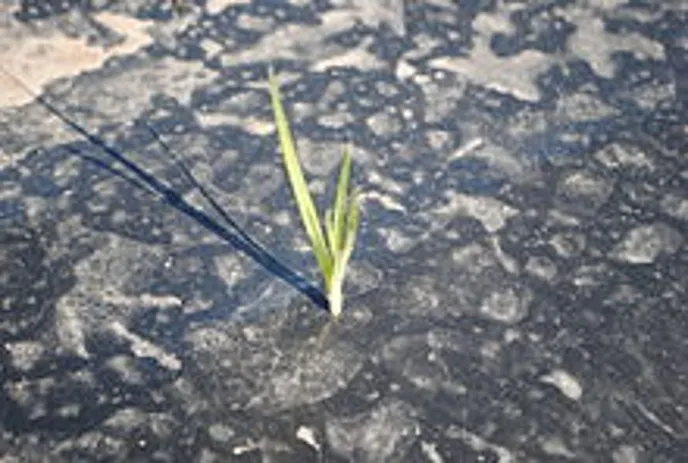
Cyperus rotundus emerging through plastic mulching.