I found blast in two fields last week; one is near Willows and the other is near Maxwell. The infections seem to be starting; there were only a few leaf lesions. In these fields, and in a third one near Knights Landing, I am also monitoring weather.
Three things are needed for disease to start: the pathogen, a susceptible host, and a favorable environment. We know the blast pathogen is present in all the rice production area, though we do not know how much variability in inoculum loads there is between regions. The three fields I am monitoring are all planted with a susceptible variety. When it comes to the environment, there is definitively differences between regions.
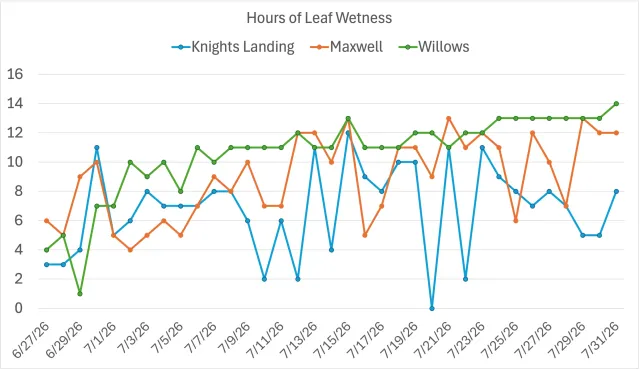
Leaf wetness (LW), or water on the surface of the leaf, is one of the main requirements for blast infection. The graph below shows daily hours of leaf wetness at the three fields. At the Willows field, there has been consistently 13 h of LW per day for the past week. At the Maxell field, the number of hours of LW has been more variable, but it has been around 12 for the past three days. At the Knights Landing field, the number of daily hours of LW has been lower than 8 for the past week and it has been very variable before that.
If the number of hours of LW continues to increase, we may see more infections. If this happens, fields planted with a susceptible variety in blast areas should protect the crop with a fungicide application at late boot to early heading. If the field is planted with M-210, no fungicide is needed.