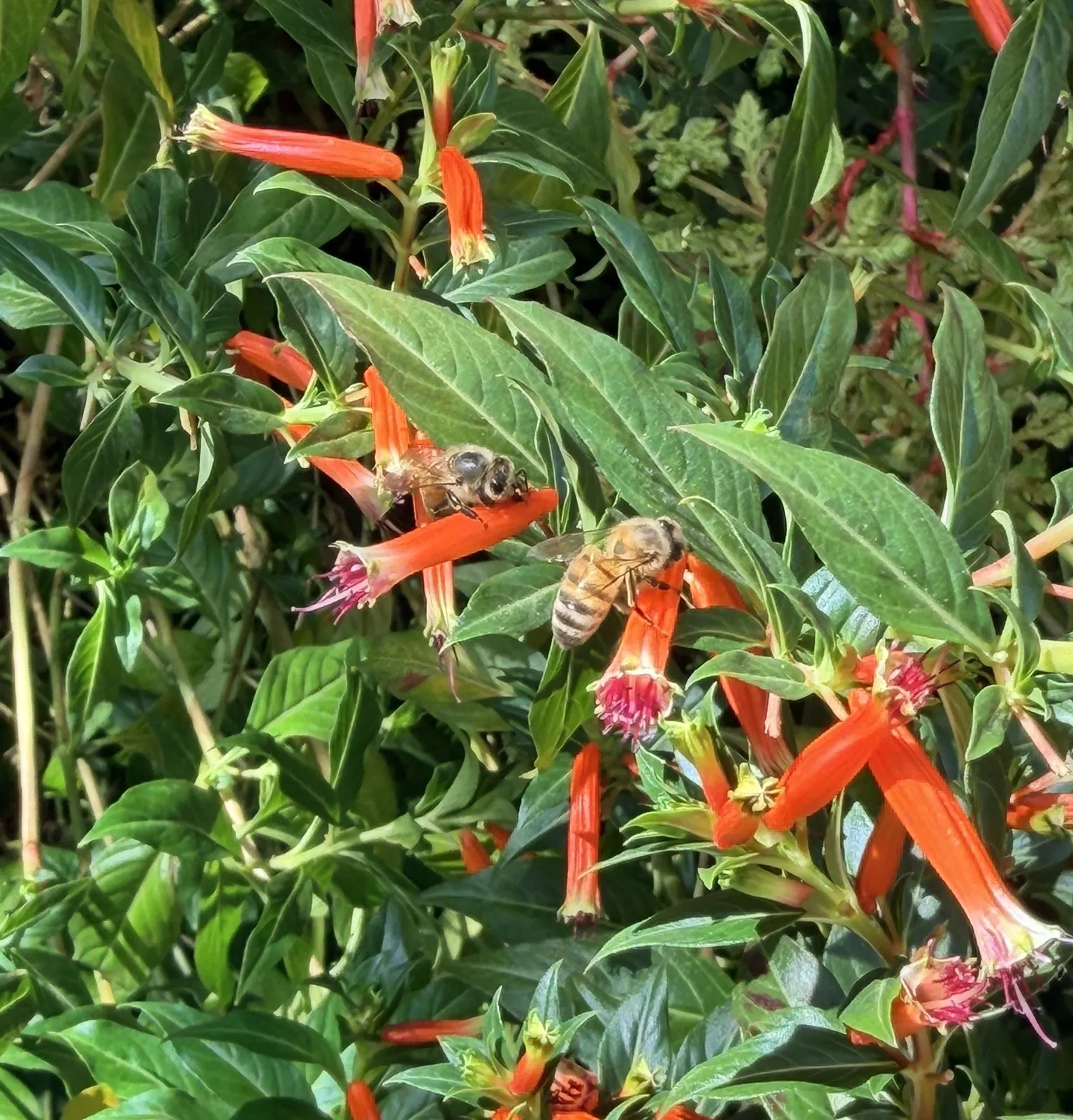
I recently stumbled upon a crime in progress, catching the perpetrators in the act. The elements of this transgression included a crime syndicate, accomplices, dubious ethics, and theft.
I planted a Cuphea ignea seven years ago as a hummingbird attractor in my garden dedicated to pollinators. Cuphea ignea, with its bright green elliptical leaves and mass of red-orange tubular flowers, puts on an almost unending floral display. The information that came with the plant, as well as online, states that the shrub will grow to 2’-3’ tall and wide. This was just the size I needed to fill a spot near the front of the garden area. This plant is exceedingly happy where it is and grows 5’ tall and wide, making it less than desirable in its current location.
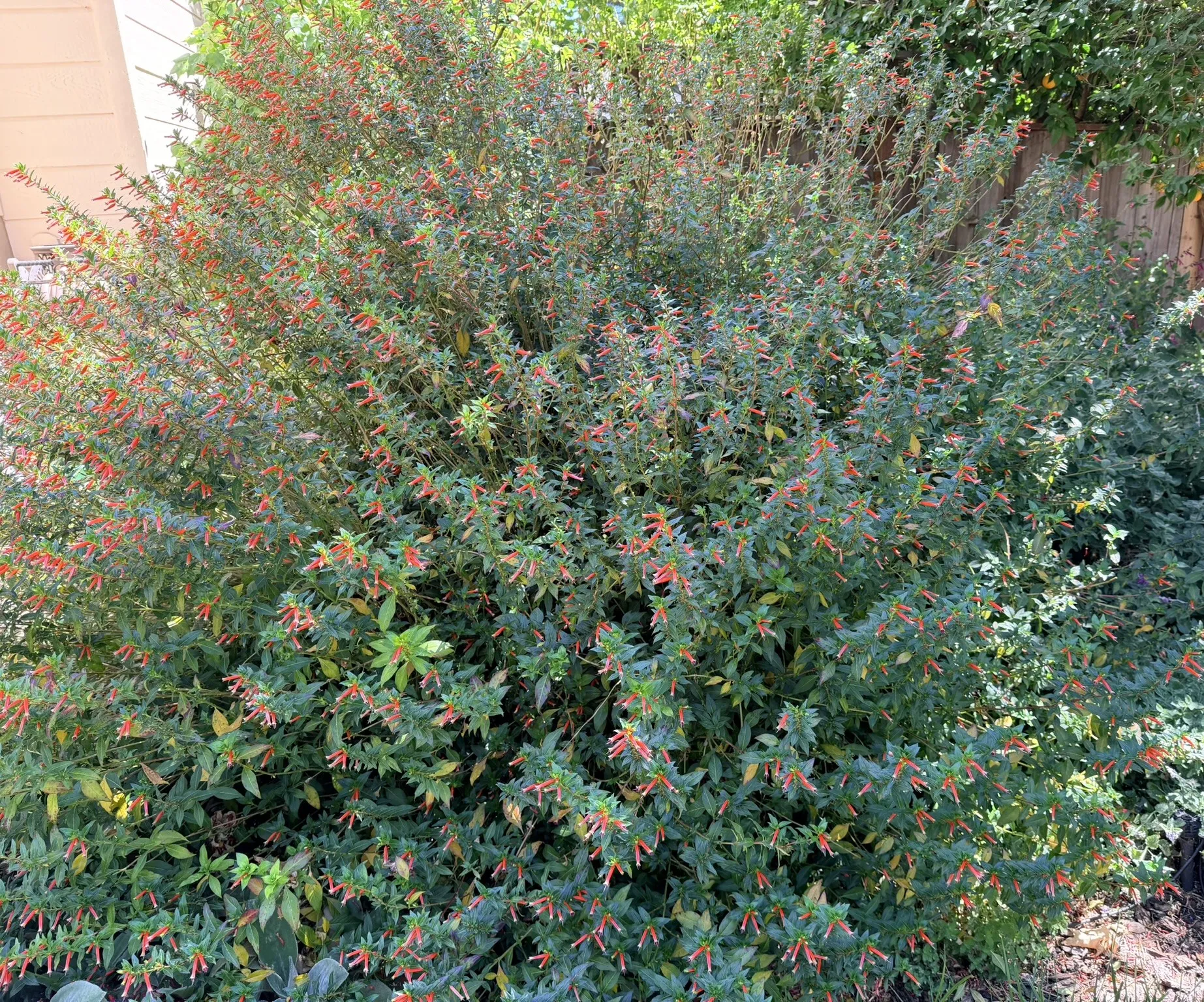
Cuphea ignea is native to Mexico and the West Indies. Common names include cigar plant, cigar flower, firecracker plant, Mexican cigar, cigarette plant, or cigarette bush. The references to cigars and cigarettes stem from the shape and color of the flowers, which are long and red-orange, with a white rim around the opening, resembling a burning cigar. The base of the tubular flower is called a basal hypanthium, due to its rounded, sac-like pouch where nectar is produced and accumulates.
Like most perennial shrubs, the cigar plant benefits from pruning after flowering. However, this plant is almost always in bloom, making it difficult to know when to prune. I’ve taken to pruning whenever it gets too big, which is often. While pruning recently, I noticed a plethora of bees buzzing around the cigar plant. I was confused by their interest in the cigar plant flowers. The flowers are the color and shape sought after by hummingbirds, not bees. Confounded, I watched the activity for a while until I understood that a “crime” was being committed! The bees were valley carpenter bees (Xylocopa varipuncta), bumblebees (Bombus sp.), and honeybees (Apis mellifera), “robbing” nectar directly from the basal hypanthium.
Certain bees, notably carpenter and bumble bees, have developed a habit of drilling a tiny hole directly at the base of a flower and sipping nectar through the hole. This negates the symbiotic pollinator relationship, where a flower depends on an animal to move past the male (anther) and female (stigma) parts on its way to feeding upon the nectar. This action provides “accidental” pollination by distributing pollen from male to female flowers. When a bee forgoes rubbing against the anther and stigma and drills directly to the nectar source, the flowers remain unpollinated. Honeybees generally don’t drill these rogue holes themselves, as their proboscis isn’t strong enough to penetrate the petals. They watch and follow behind carpenter and bumblebees, profiting from their efforts.
The Case of the Stolen Nectar has been solved, with a positive ending. Although the cigar plant is not receiving pollination services from the bees, all is not lost. Hummingbirds frequent the plant in the mornings and evenings. Their long tongue is designed to reach deeply into the long flowers, pollinating the blossoms while reaping nectar rewards.