
There is no question that gardening improves the quality of life, as well as the physical and mental well-being of older adults. It is also true that some things get more challenging as we age. Many older adults have two or more chronic conditions. This could make gardening even more important and adaptations more impactful.
Some general suggested adaptations and accessories for older adults
- Eliminate trip hazards
- Use raised beds, at least twenty-four inches tall
- Self-watering containers
- Lightweight watering cans
- Ergonomic tools, lightweight and long-handled for extended reach
- A vertical garden trellis at a standing height
- A lightweight kneeler bench that allows you to push up with your arms.
- A place to sit
Therapeutic Horticulture and Horticultural Therapy
With Therapeutic Horticulture, selected plant-based activities are used with targeted goals, and the plant serves as the motivation to achieve them.
Goals might be cognitive, physical, psychological/emotional, sensory, and social.
Among other things, activities may be targeted for specific populations such as youth or older adults, the bereaved, individuals with medical or mental illness, or those living in correctional or rehabilitation settings. Horticultural Therapy adds, among other things, additional elements such as a registered Horticultural Therapist, an assessment to define goals tailored to an individual with specific physical, cognitive, emotional, or social challenges, and documentation of progress.
An example of an activity is making a “Tussie Mussie.” Horticulture As Therapy; Principals and Practice defines a Tussie Mussie as “a small bouquet of herbs and flowers designed to express a particular sentiment,” but there is much more to the story.
There are many sources available for step-by-step instructions, and many will include information about "The Language of Flowers.” This source details each step and includes a number of the therapeutic goals I have listed below.
A Horticultural Therapy Activity from the North Carolina Botanical Garden
Potential Therapeutic Goals
- Cognitive - This activity encourages mental activity through making choices.
- Education - The history of the Tussie Mussies is interesting. Wholehearted Eats writes that in the 18th century, Tussie Mussies were thought to “ward off bad smells, or miasmas,” and it was thought that “the pleasant scents from flowers and herbs would encourage good health.” Searching for “The Language of Flowers” will help you find a list for discussion. Both ideas allow for this part of the activity to be expanded.
- Leisure/recreation - This activity has a lot of artistic potential and offers a bouquet that can be gifted or used to decorate.
- Social interaction - In addition to being given as a gift, the activity offers an opportunity for socializing with others.
- Psychological/Emotional - This activity is perfect for “Reminiscence Therapy”- to reminisce and evaluate our lives. Robert Butler, M.D., a psychiatrist who specialized in working with the geriatric population, called this concept “life review.”
- Sensory - Stimulates the senses with textures, colors, and aromas.
- Physical - Potentially increases fine motor skills.
Making a Tussie Mussie
I chose from among what was aromatic and looked nice now in my June garden, with the goal of hanging the bundle upside down to dry. Many were aromatic and could easily be dried.
Image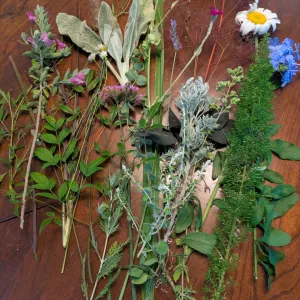
Cut flowers and foliage. photos by Nanelle Jones-Sullivan - I cut each stem about ten inches long and held it in water.
- After stripping the leaves from the bottom four inches, I started placing them in a bundle, with the largest flower in the center, adding one at a time, each a bit lower than the one before.
- Finally, I cut the stems evenly and placed them back in the water. Later, I bound them with a rubber band and hung them upside down to dry. A rubber band will shrink and hold them together.
Alternatively, you can bind with a ribbon or doily with a hole cut in the center. The linked activity suggested spreading out a square of plastic wrap and putting a piece of moist cotton in the center, folding up the square around the stems of the bouquet, twisting it around the stems like the flaps of a folded umbrella.
My Victorian meanings turned out to be:
- Oregano – substance, joy
- Lamb's Ear – support, softness, gentleness
- Rosemary – remembrance, protection
- Artemisia – wormwood protection for travelers
- Daisy – innocence
- Salvia/sage – esteem, wisdom
- Verbena – magic and charm
Lavender – healing
Image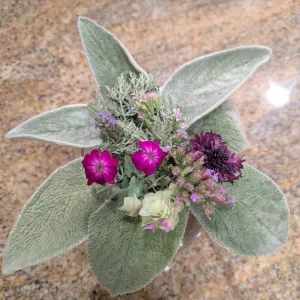
My Tussie Mussie.
References
What is the evidence for the impact of gardens and gardening on health and well-being: a scoping review and evidence-based logic model to guide healthcare strategy decision-making on the use of gardening approaches as a social prescription.
Sample Horticultural Therapy Activity “Tussie-Mussies” — Bouquets with Meaning