
I’ve always been fascinated by plants. As a young child, I wandered my neighborhood in Hayward, California, admiring colorful flowers and the insects that were attracted to them. As an older child in New Jersey, I played among the whimsical columbine and watched in wonder when the first crocus emerged in the spring. Appreciating nature, however, is very different from knowing how to grow plants and what their environmental and nutritional needs are.
My gardening knowledge has evolved as a result of experience, education, and trial and error. I think of this evolution as the seasons of my gardening life.
Spring
When I purchased my first home as a young adult, I was anxious to grow everything. Even then, I was conscious of our limited water supply. I single-handedly ripped out the lawn in the front yard and replaced it with rocks, a dry creek bed, and plants that I bought at a big-box store. I found a pamphlet, also in a big-box store, that described how to install drip irrigation. I bought the supplies and installed drip irrigation to water my new plants and others that I eventually planted throughout my garden. I grew lots of annuals, vegetables, and whatever struck my fancy at the store. I had the energy and the ambition to develop a lovely yard, but I lacked information. For instance, I didn’t realize that the plants found at big-box stores aren’t necessarily a good fit for our local climate. Those stores may also carry plants that are invasive in our area, or those that have been treated with neonicotinoids, which have been linked to honeybee colony collapse.
Summer
In 2013, I was fortunate to receive Master Gardener training through the University of California Extension program. The training provided copious information, with several key takeaways. For me, the most important message from the training was that flora should be planted in an environment that allows them to thrive. In Solano County, we have a Mediterranean climate, one of five in the world. Other areas with Mediterranean climates are: the areas surrounding the Mediterranean Sea (of course), as well as central Chile; the Western Cape of South Africa; and Southwestern and South Australia. Mediterranean climates are characterized by hot, dry summers and mild, wet winters.
Native plants are ideal; they’ve evolved in this climate, along with insects and other wildlife which have developed symbiotic relationships with the plants. Plants from other Mediterranean regions are also well suited to our environment.
Will plants that are not Mediterranean-climate natives grow here? Absolutely. However, the plants must tolerate clay soil and endure hot, dry summers and cooler, wet winters. Forcing an unsuitable plant to live in our inhospitable conditions is like driving a square peg into a round hole. It can require unreasonable amounts of effort, water, and fertilizer, and may never thrive.
Fall
I continued my horticultural education by taking classes at Solano Community College, where I learned about the crucial part healthy, living soil plays in the life of a garden. Organic soil management involves the use of compost, mulch, natural fertilizer, and IPM (Integrated Pest Management). Organic matter attracts microbes and other valuable soil dwellers, which create a soil food web. The food web results in symbiosis between the plant roots and the microbes and mycorrhizae in the soil. Consequentially, less watering is necessary because microbes have improved water and air holding capacity, and the plant needs less fertilization because of microbial recycling of nutrients in soil.
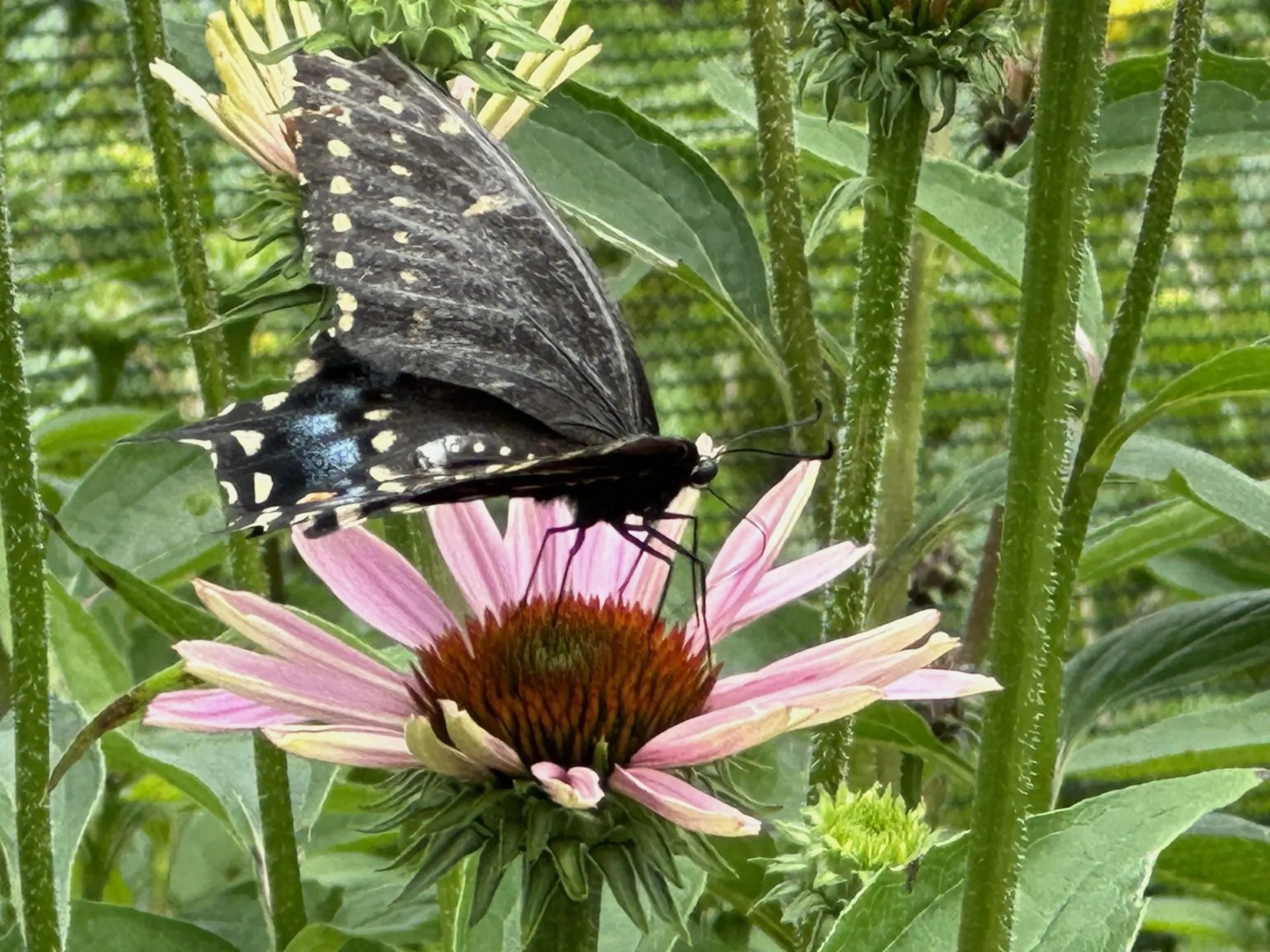
Around the same time, I took a pollinator class at UC Davis, which was designed for Master Gardeners. We received a wealth of knowledge about bees, hummingbirds, and butterflies. For example, the honeybee is not native to the United States, having been introduced to this continent by the Europeans in the 1600’s. There are around 4,000 species of native bees in the US, with approximately 1,600 in California. Most native bees live a solitary lifestyle, with 70% nesting underground and 30% nesting in hollow branches or other cavities. Native bees evolved with our local plants and climate. They are responsible for pollinating 75% of fruits, nuts, and vegetables in the US and 80% of flowering plants.
We learned that the ideal pollinator garden contains 20 different plant types, massed together in 4’ x 4’ areas. While this may be impractical in our small subdivision yards, larger groupings of the same type of flowering plant ensure that they will be seen by flying pollinators. Selecting a variety of plants that will provide continuous bloom all year is key to a successful pollinator garden.
- Winter
As I approach the winter of my gardening (as well as my actual) life, I wonder what will change. I’m definitely moving towards a garden that contains plants that serve a purpose. That purpose may be providing fruits and vegetables for my family and friends, delivering nectar and pollen to our pollinators, supplying shade, or simply offering a beautiful environment that reduces stress and brings me joy.
I will continue to experiment with different propagation methods. In recent years I’ve begun saving seeds, and all my summer vegetables have been started from seed. I often attempt propagation by cuttings, with mixed results, so there is room for education and improvement in that area.
As I age and my body rejects the bending, kneeling, stooping, lifting, and shoveling required by gardening, I will find ways to adapt to my new reality. I may reduce the number of plants, utilize fewer high-maintenance plants, or hire someone to help with the heavy lifting. I will definitely work in shorter stretches and rest for longer ones. And resting in the garden while I observe the fruits of my labor sounds like a lovely way to spend my “winter” years.