
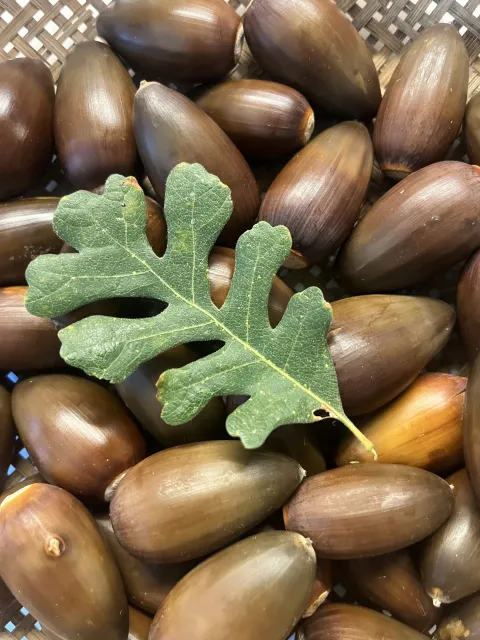
Valley oak, California’s largest and most majestic native oak, grows throughout Solano and Yolo counties. In nature, Valley oaks thrive in sunny locations where they have a year-round supply of groundwater. Locally, the deciduous Valley oak is the iconic tree of Solano College and grows in most of our parks and open spaces. In Solano County, excellent examples of Valley oak habitats can be found in Patwino Worrtla Kodoi Dihi Open Space Park (County) and Lagoon Valley (Vacaville). In Yolo County, Valley Oak Park (Winters), Valley Vista Regional Park (Rumsey), and Capay Open Space Park (Esparto). Additionally, the UC Davis Arboretum contains beautiful groves.
According to CalScape, Valley oak hosts over 270 species of butterflies and moths and feeds many birds and its acorns are consumed by many birds and mammals. Definitely a keystone species!
If you plant a Valley oak from an acorn, you will be surprised at how quickly it grows. In the right spot, it can reach heights of 20 feet or more in just a few years. This is based on personal experience!
Before you begin your Valley oak landscape, make a plan. Be sure to remove your lawn. Minimize hardscape under the oak canopy. Instead of pavement or asphalt, use stepping stones, DG (decomposed granite), gravel, or permeable paving. Be sure to mulch to reduce weeds. Remember to keep irrigation away from the base of the tree and bark.
As you plan, remember that a Valley oak will take up a large amount of space and create significant shade and litter (fallen leaves, twigs and acorns). Acorns will only be produced after a tree matures, and acorn crops may vary in size from year to year. Note that most deep-rooted plants should be planted several yards away from the tree trunk, even as far out as the edge of the canopy.
As you plan your garden, you can consult the following short list of a few of the many native plants compatible with Valley oaks. Plants are grouped by form: Grasses, groundcovers, bulbs, wildflowers and low and tall shrubs. All of those listed are available at native plant nurseries and/or California Native Plant Society sales. CalScape is an excellent reference to use for locating plants.
Grasses: Native perennial grasses do quite well under Valley oak. California’s state grass, purple needlegrass (Stipa pulchra), will thrive here. Other low-growing perennial grasses include Torrey’s Mellicgrass (Mellica torreyana), California Fescue (Festuca), and Eyebrow grass (Bouteloua gracilis), an attractive, low-water species.
Spreading groundcovers: California fuchsia (Epilobium), Yarrow (Achillea), and coyote mint (Mondardella villosa) will attract pollinators. If you plan to water these during the summer, make sure to plant on the edge of the canopy. Dutchman’s pipevine (Aristolochia californica) will be happy under Valley oaks
Many small shrubs will thrive along the canopy edge. Both California fuchsia and buckwheat are pollinator favorites. California fuchsia’s tubular red or orange flowers attract hummingbirds. Other small shrubs are the sages, prostrate coyote bush, and prostrate manzanita and ceanothus species.
Perennial Bulbs: Most of the native bulbs will grow well in the understory. For spring blooms, plant Wild hyacinth (Dichelostemma multiflorum), native iris (Iris) Blue-eyed grass (Sisyrinchium bellum) and Ithuriel’s Speak (Triteleia laxa). The star-like flowers of the Soap Plant (Chlorogalum spp) will emerge in the summer and attract many pollinators.
Wildflowers: Since Valley oak is deciduous and has an extensive canopy, there will be dappled light throughout the year. Wildflowers commonly found in Blue oak habitats include Farewell-to-spring (Clarkia amoena), Chinese Houses (Collinsia), California Poppy (Eschscholzia californica), Lupines (Lupinus) and Baby Blue Eyes (Nemophila menziesii). Sow native annual wildflower seeds in the fall after the first germinating rain. Once established, many will reseed themselves.
Small shrubs will thrive along the canopy edge. Monkeyflower (Diplacus) and California fuchsia (Epilobium) are pollinator favorites. California fuchsia’s tubular red or orange flowers attract hummingbirds. Other small shrubs are the lower-growing varieties of Sage (Salvia), prostrate manzanita (Arctostaphylos) and low-growing wild lilac (Ceanothus).
Tall shrubs for this habitat include: Gooseberries (Ribes), Pitcher sage (Lepechinia), Coffeeberry and Redberry (Rhamnus species). These should be planted farther out from the tree trunk.
Would you like online help with a plan? https://bayarea.calscape.org/wp-content/uploads/2022/10/111022_Woodland-1.pdf
Resources
How to Grow California Oaks
https://oaks.cnr.berkeley.edu/how-to-grow-california-oaks/
Growing Oaks from Acorns
https://ucanr.edu/sites/ccmg/files/123756.pdf
Planting Under Oaks, UC Master Gardener Program of Sonoma County
http://sonomamg.ucanr.edu/Planting_Under_Oaks
California Oaks, a project of the California Wildlife Federation
https://californiaoaks.org/
https://ucanr.edu/site/uc-master-gardener-program-contra-costa-county/article/gardening-under-oaks
For more information, you can visit the Oak section of the UCANR IPM website at ipm.ucanr.edu, and the californiaoaks.org website