
Article by Peg Smith -
As gardeners, beginners or experienced, we have a strong spring urge to see what we can add to our collection of plants. Nurseries and plant sales are well stocked; seed racks are replenished; catalogues entice us. The million-dollar question is, will it thrive in our climate and do well in my garden?
What resources do we have to find out what is the ‘right plant, right place’ for our gardens?
Begin by studying the garden before choosing plants.
- Gardens may have a variety of microclimates within them: areas of full shade, areas of full sun, areas of morning sun then afternoon shade; areas of morning shade followed by an afternoon with the full heat of our summer sun.
- Knowing the compass orientation of your garden can help. Generally, a southern or western exposure will subject plants to the strongest levels of heat and sun; an eastern exposure will give morning light but avoid bright, direct sun in the afternoon; and a northern exposure will be the coolest environment for your plants. Consider the physical structures of your garden that will affect the sun exposure hours for both winter and summer. Include neighbors’ structures or trees that may impact your yard’s sun/shade exposure.
- Our local soil can vary from heavy clay to Yolo loam. Typically, our soil is alkaline. Plants that prefer an acidic soil, such as azaleas, rhododendrons and camelias may not thrive without specific acid feeding.
- Our temperatures go from summer daytime highs that are usually in the 90s, but can range from 100° to 116° F, to nighttime winter temperatures occasionally in the mid to high 20s. Our summers are dry, and our winters can be very wet.
How do we know a plant is well-suited for our garden? Information on temperature tolerance, growth habit, and water requirements will help refine the choice of a plant.
- Know your plant zone. There are two references to check.
- The USDA Plant Hardiness Map classifies zones based only on the average annual extreme minimum winter temperature without considering local climate effects. Yolo County and parts of central Florida are designated in the 9b zone. The caveat to following only the USDA map is that Tampa, Florida’s typical weather includes long, hot, oppressive, wet, and mostly cloudy summers, with short, cool, windy, and partly cloudy winters. Those weather patterns are dramatically different from Yolo County’s long, hot, dry summers and wet or quite dry winters. Extreme average minimum temperatures are important for frost hardiness of plants, but there are other factors to consider. The 2023 USDA Plant Hardiness Zone Map can be searched by zip code.
- The Sunset climate zone maps, which are more detailed and include local climate conditions, show Davis as zone 14, where the marine air flow of the delta breeze moderates the cold of winter and the heat of summer. Woodland is roughly on the margin of the marine air effects and so is listed as zone 8, a somewhat warmer summer and colder winter region. A list of plants, including some California natives, for each Northern California Sunset zone is available on the Sunset Climate Zone Region for Northern California webpage.
- Growth habit. Many labels give details of the height and breadth of the mature plant. This allows a garden design to provide the space needed for a fully developed, mature garden. When larger plants are young, the space surrounding them can be filled with shorter-lived annuals, bi-annuals, or perennials.
- When searching for a plant online, most listings will provide details of zone, growth pattern, flowering season, and preferred conditions. If you have a specific microclimate in your garden, not necessarily USDA 9a or 9b or Sunset zone for your area, the closer your choice of a plant with requirements similar to these zones, the greater your chances of success are.
- Local plant sources. Sales such as those offered by Woodland Community College and UC Davis Arboretum will provide a wonderful selection of plants propagated locally that are well-suited to our region. Local nurseries will also stock plants that will thrive locally.
- The UC Davis Arboretum’s Plant List webpage provides plant lists that fit various categories, such as pollinator attracting, shade plants, perennials, climate-ready plants, low water and the Arboretum All-Star list. The Sacramento Valley California Native Plant Society (CNPS) is a good resource for California Native Plant information.
- Water requirements
- When designing the landscape, it is important that plants with similar water requirements are grouped together to create hydrozones. If you have a plant that requires heavy supplemental watering next to one that requires low water, it will be difficult to give each the irrigation zone watering care it needs. Plants are usually classified into low, medium, or high water requirements. Check that any grouping of plants in the landscape on the same irrigation circuit has the same water needs.
- Water Use Classification of Landscape Species (WUCOLS) is a list of over 3,500 plants developed under the guidance of the California Center for Urban Horticulture. The list provides botanical name, common name, plant details, and water requirements. A guide on how to read, use, and access the list is available on the UC Davis Center for Horticulture Water Use Classification of Landscape Species (WUCOLS) webpage.
Planning the choice of plants to add to your garden will not guarantee success, but with care, attention, and adherence to the motto ‘right plant, right place,’ your garden should thrive. Enjoy!
April Tips
General maintenance
Continue the spring clean-up of the garden. Remove fallen leaves from the plant crowns to prevent fungal or bacterial disease. There may be lady beetles and other beneficial insects emerging, so a gentle approach is best. After the recent winds, check trees and shrubs and remove any broken or split limbs. As leaves push on dormant plants, it is easier to identify dead plant material and prune to above a healthy bud.
Paint the exposed lower trunks of fruit trees and any young ornamental trees with a dilute latex paint, preferably white or a pale color, to prevent sunburn, especially if exposed to the western sun.
Check garden tools to make sure they are sharp and clean. Make sure bird feeders are clean and well-supplied.
Weed
As the spring rain and showers continue, and the weather warms, watch for weeds. Pull any weeds when small.
Ornamentals and annuals
Wait until the blooms are finished on perennials such as viburnum and forsythia before pruning to shape, or wait until the fall to prune.
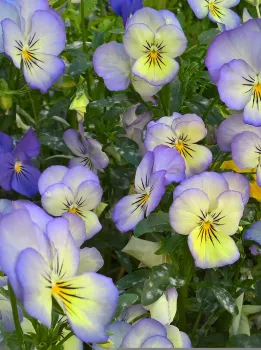
Plant candytuft, Iberis sempervirens, is an easy-care, low-growing perennial. Pansies, violas, and dianthus will give late spring and early summer color. Good shade plants include columbine and coral bells.
Waterwise sunny location plants include sunflower, zinnia, tithonia, ornamental sages, California golden rod, yarrow, blue gramma grass, California fuchsia, penstemon, lavender, coreopsis, rudbeckia, scabiosa, verbena, and dwarf plumbago.
Plant containers with your favorite annuals, such as portulaca and alyssum. Annual and perennial herbs also do well in containers; they are ideal as some will tolerate a little shade, while others prefer full sun.
Diseases and Pests
Always tip out small or large amounts of standing water to reduce mosquito populations.
Check roses for aphids; they love the spring bloom buds. A strong hose spray will control aphids. Watch for black spot, rust, and mildew on roses; they first show on the interior lower parts or the back of leaves. Remove affected leaves. If rose leaves have neatly cut out curved sections, that is the native leaf cutter bee, collecting leaf segments to line laying sites - a native insect pollinator we want to encourage.
Slugs and snails will emerge in the early evening and early morning. Use beer traps or iron phosphate pellets, a commercially available product.
Planting yarrow, alyssum, feverfew, dill, parsley, coriander, penstemon and asters will attract beneficial insects to the garden. Sunflowers attract birds, and they will consume large numbers of aphids, scale, and other pests.
To identify and treat a problem, refer to the UC IPM website, which describes the least environmentally toxic solutions.
Bulbs
As blooms fade on spring bulbs, deadhead (remove blossom stalks and finished blossom heads). Do not cut back bulb leaves until yellow. The longer the leaves feed the bulbs, the more likely they will produce good blooms next spring.
Begonia (tuberous) – Plant tubers from March through May. Bloom time is spring through summer. Best in containers. Lift tubers in the fall when the leaves die back. Store in a cool, dry place.
Calla (white) – Plant rhizomes from October through April. Bloom time is spring through summer. Needs year-round moisture. Grows well in light shade.
Calla (dwarf colored) – Plant rhizomes from October through April. Bloom time is spring through summer. Plant with ‘eyes’ up. Withhold water in late summer to early fall to encourage dormancy. Grow in light shade.
Canna – Plant rhizomes from February through April. Bloom time is summer through fall. Can also be grown in large pots. Cut stems to the ground after bloom.
Dahlia – Plant tuberous roots from February through May. Bloom time is summer through fall. Needs care to encourage large blooms and may need support. Can be susceptible to powdery mildew.
Gladiolus – Plant corms from February through April. Bloom time is spring, summer, and fall. Very good for cut flowers. To extend the bloom period, stagger the planting of corms. Over a six week period, plant a selection of corms every one to two weeks.
Tuberose – Plant rhizomes from February through April. Bloom time is summer through fall. Should bloom year after year.
Zephranthes (Argentine lily) – Plant bulbs anytime. Bloom time is summer through fall. Low water, prefers periods of wet and dry. Will multiply to give a good showing of crocus-like flowers.
Fertilizing, Composting and Mulching
Most plants will benefit from a spring application of compost or fertilizer. Always check the labels before applying. Excess nitrogen in the soil will stimulate rapid vegetative growth, which can be structurally weak, rather than fruit or bloom. Be sure to use the fertilizer recommended for each plant type. Follow the application and timing directions – more is not better!
To help control weeds and reduce soil moisture evaporation, apply a four-inch layer of mulch around plants and to cover open dirt. Watch for small holes in the dirt; these may be ground nesting bees, wait, and mulch that area later to allow the emergence of the next generation of native bees. For more information, visit Xerces Society Nesting Resources.
Vegetables
April begins the warm season for summer crops in the vegetable garden. If you have transplants of tomatoes, peppers, and eggplant, wait until you are sure the soil temperature has warmed. Transplants moved to cool soil will pause in growth until soil temperatures reach a more beneficial temperature. Annual vegetables depend on day length, moisture, air temperature, and soil temperature to produce well. Be flexible - check weather forecasts and soil temperatures, then adjust planting and transplanting dates accordingly. Refer to the UC ANR Soil Temperature Conditions for Vegetable Seed Germination guide (note: The referenced PDF is not fully accessible to screen readers. We have requested the creator of the PDF update it for accessibility.)
Click April Vegetable Planting Guide for a list of Yolo County and Sacramento area vegetables recommended for planting during the month of April, along with how and when to plant them.