
Plants make their own food through photosynthesis (converting water and carbon dioxide into sugar and oxygen using solar energy). When we fertilize a plant, we are adding specific nutrients to the plant’s environment to support growth or maintenance. Many of the fertilizers we buy include some combination of nitrogen (N), phosphorus (P), and potassium (K). Nitrogen supports healthy leaves, phosphorus supports healthy roots, and potassium supports flowers and fruits. Fertilizer packages are often labeled with the ratio of these three macro (large) nutrients as three numbers separated by dashes (nitrogen - phosphorus - potassium or N-P-K). For example, if the fertilizer bag in the illustration below. If this were a one-hundred-pound bag, there would be ten pounds of nitrogen, five pounds of phosphorus, and five pounds of potassium with eighty pounds of filler.
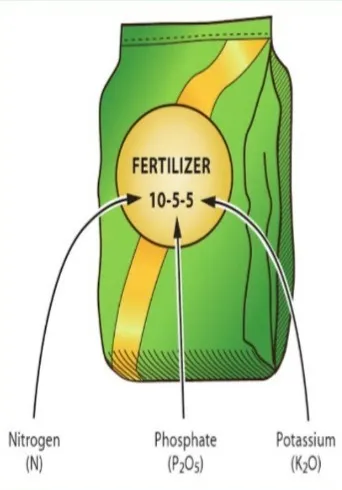
The ratio of N-P-K in a fertilizer impacts how the plant will respond. At the beginning of the season, when plants are just starting to grow and root and leaf development are key, higher proportions of N and P may be most beneficial. Later in the season, when flowers and fruit are important, higher proportions of K may be most beneficial.
There is often temptation to overfertilize to grow bigger, better plants. There are several reasons to avoid this. Excess fertilizer can pollute the environment by infiltrating groundwater and through surface water runoff (think about when water runs off a lawn and into the gutter). Excess fertilizer can also cause periods of rapid growth that, while potentially eye-catching, can also attract a myriad of pests that prefer to feed on soft new growth.
While synthetic fertilizers (manufactured) are easily accessible, organic fertilizers (developed from a plant or animal) can provide a slower and more consistent stream of nutrients as they are broken down. A slow and steady nutrient stream can help with sustained growth and maintenance, while a burst of highly concentrated nutrients can support a rapid flush of growth that may be less sustainable or attract a slew of unwanted pests.
Adding fertilizer to a garden can help support various aspects of each plant’s growth and maintenance. Recognizing the different functions of the three main macronutrients in most commercially available fertilizers (N-P-K) and how to read a fertilizer bag can help you get the most out of your fertilizer and reduce harmful overuse.
For more information -
- Oregon State University - A Guide to Understanding Fertilizers
- Cynthia Kerson, UC Master Gardener, Napa County - Fertilizer Remarks
- UC Master Gardeners, Contra Costa County - The ABCs of Fertilizer
Illustration: UC Master Gardeners, Riverside County