
A fungicide efficacy trial was conducted at the Emerald Seed Co. research farm in El Centro, CA, from September 2025 to March 2026 to evaluate the effectiveness of various fungicide treatments against onion downy mildew (Peronospora destructor) under field conditions. The trial included 9 treatments across 4 replicate blocks using a randomized complete block design. Results demonstrated significant differences in disease control efficacy, with Growers Rotation providing the greatest reduction in symptomatic leaves (62%) compared with the untreated control, followed by UCCE Rotation (43%).
MATERIALS AND METHODS
Trial Setup and Design
• Seeding: Friday, September 26, 2025, by Sensient®.
• Plot design: 8 beds planted
• Experimental design: Randomized Complete Block Design
• Replications: 4 blocks
• Treatments: 9 (including untreated control)
• Crop management: Standard irrigation, fertilization, and weed management practices
Misting System
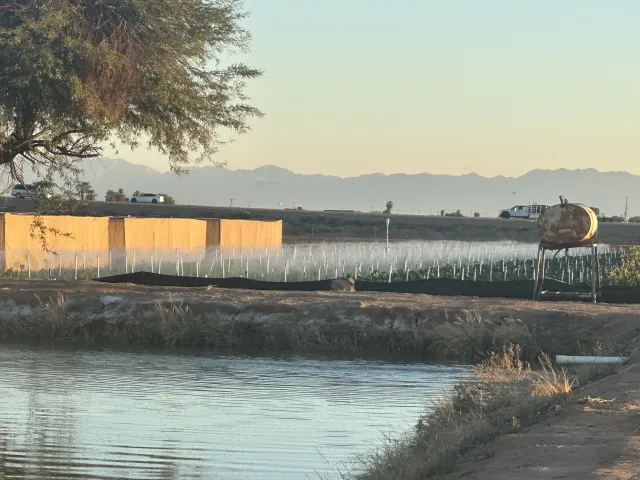
A very fine misting system was installed on January 15, 2026, to increase the duration of leaf wetness and promote disease development (Figure 1). The misting system operated from sunset for 4 hours, activating for 2 minutes every 30 minutes. Additional morning misting was applied the day after inoculations to enhance infection conditions.
Fungicide Applications
Five fungicide applications were made depending on weather conditions:
• First application: Wednesday, January 14, 2026
• Second application: Wednesday, January 28, 2026
• Third application: Monday, February 23, 2026
• Fourth application: Wednesday, March 4, 2026
• Fifth application: Wednesday, March 11, 2026
All fungicide treatments were applied using a backpack sprayer. Conventional fungicide treatments (Treatments 1–5) were applied at a spray volume of 30 gallons per acre, while alternative and biological treatments (Treatments 6–9) were applied at 50 gallons per acre. Specific fungicide rates and formulations were:
| Treatment | Product Name | Active Ingredient | Rate/Acre | FRAC Code |
|---|---|---|---|---|
| 1 | Orondis Ultra (Syngenta) + DyneAmic | Oxathiapiprolin + Mandipropamid | 8 fl oz + 6.4 fl oz | 49 + 40 |
| 2 | Zampro (BASF) + DyneAmic | Ametoctradin + Dimetomorph | 14 fl oz + 6.4 fl oz | 45 + 40 |
| 3 | Reason 500SC (Gowan) + DyneAmic | Fenamidone | 5.5 fl oz + 6.4 fl oz | 11 |
| 4 | Growers Rotation:
|
|
|
|
| 5 | UCCE Rotation:
|
|
|
|
| 6 | MilStop SP (Bioworks) | Potassium Bicarbonate | 1.25 lbs | NC |
| 7 | Serifel (BASF) + Nu-Film P | Bacillus amyloliquefaciens | 8 fl oz + 4 fl oz | BM02 |
| 8 | Kocide | Copper Hydroxide | 1.5 lbs | M1 |
| 9 | Untreated Control (Water only) | None | --- | --- |
Inoculation Protocol
Artificial inoculation was performed twice to ensure uniform disease pressure:
• First inoculation: February 4, 2026
• Second inoculation: February 11, 2026
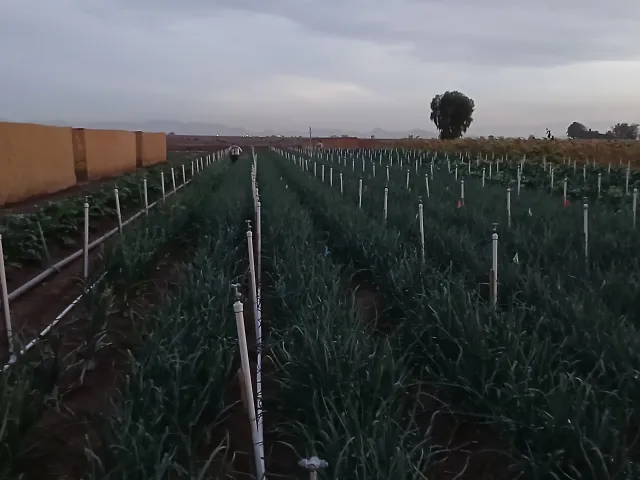
Inoculation methodology: Symptomatic leaves with downy mildew were collected from naturally infected plants, washed with distilled water to prepare a spore suspension, and uniformly applied across the entire research plot using a backpack sprayer (Figure 2).
Disease Assessment
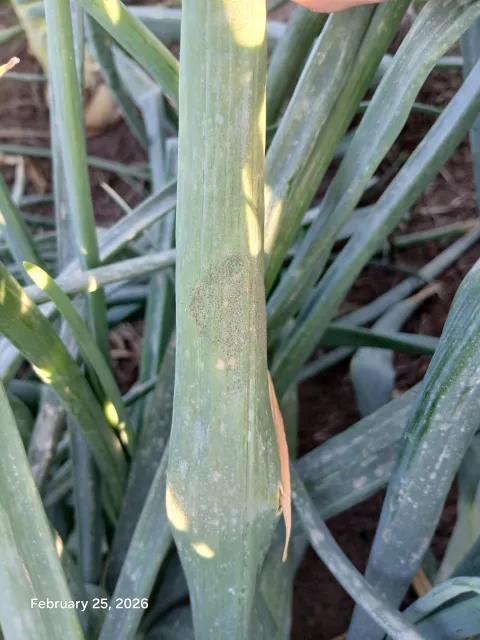
The first symptoms of onion downy mildew on the trial were observed on February 23th (Figure 3).
Final disease assessments were conducted on March 19, 2026, by counting the number of symptomatic leaves per plot. The primary target of the trial was onion downy mildew (Peronospora destructor). However, leaves showing symptoms of Stemphylium leaf blight were also included in the final assessment because it was not possible to determine whether Stemphylium was acting as a secondary colonizer of tissue previously affected by downy mildew. Therefore, the final disease rating reflects total symptomatic foliage present at the time of evaluation. Data were analyzed using ANOVA, and means were separated using Tukey’s HSD test.
RESULTS
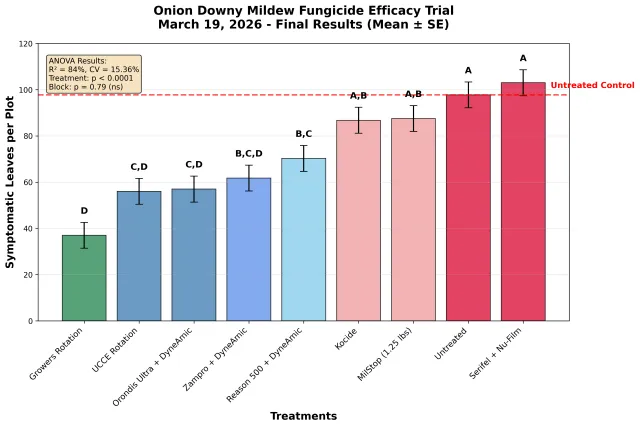
The ANOVA revealed highly significant treatment effects:
• R² = 84% (strong model fit)
• CV = 15.36% (acceptable experimental precision)
• Treatment effect: p < 0.0001 (highly significant)
• Block effect: p = 0.79 (not significant)
The trial demonstrated clear differences in fungicide performance under high disease pressure conditions:
1. Best Performing Treatment: Growers' Rotation provided the most effective disease control, reducing symptomatic leaves to 37.0 per plot compared to 98.0 in the untreated control (62% reduction).
2. Good Performance Treatments: UCCE Rotation was the second-best performer with 56.0 symptomatic leaves per plot (43% reduction). Orondis Ultra + DyneAmic, Zampro + DyneAmic, and Reason 500 + DyneAmic, as stand-alone treatments, also showed statistically significant reductions in disease compared to the untreated control.
3. Lower Performance Treatments: biological and copper-based treatments, such as Kocide, MilStop, and Serifel + NuFilm, performed statistically similar to the untreated control, suggesting limited efficacy under the high disease pressure conditions of this trial.
Final note: This trial was conducted under high disease pressure, with both onion downy mildew and Stemphylium leaf blight present at the time of evaluation. Because symptoms of both diseases were included in the final rating, treatment performance should be interpreted as the reduction of symptomatic foliage under mixed disease pressure rather than as a measure of efficacy against downy mildew alone. These conditions were similar to those observed in Imperial Valley onion fields during the 2025–26 season.
ACKNOWLEDGMENTS
We gratefully acknowledge the Imperial County Agricultural Benefit Program and the California Garlic and Onion Research Board for funding this trial. We gratefully acknowledge the participating crop protection companies, including BASF, BioWorks, Gowan, and Syngenta, for providing fungicide products and additional financial support. We also thank Rockwood Ag Services Co. for providing fungicide products for this trial.
We thank Emerald Seed Co. for providing the trial location, facilities, and field crew support. Special thanks to Mike Desert and Josh Cordova for their valuable input and field expertise. We also thank Sensient® for support with crop seeding. Special appreciation is extended to UCCE Imperial Ag Technician Gustavo Gamboa Paredes and Imperial Valley College student Roselia Chávez for their technical assistance.