
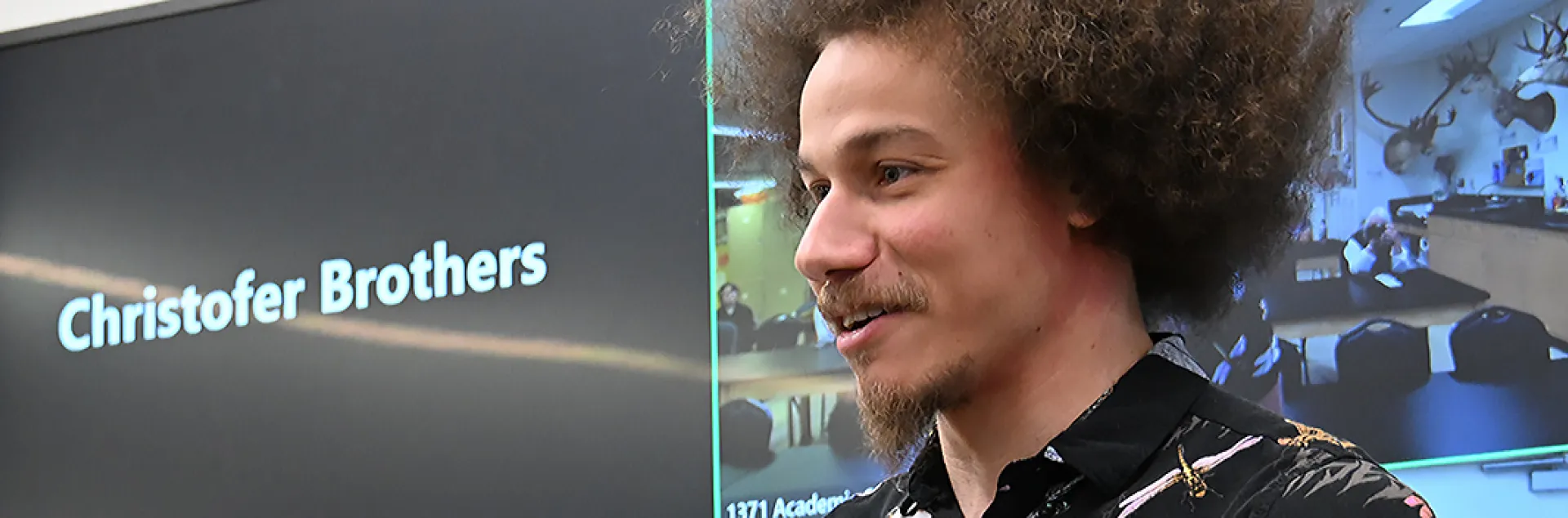
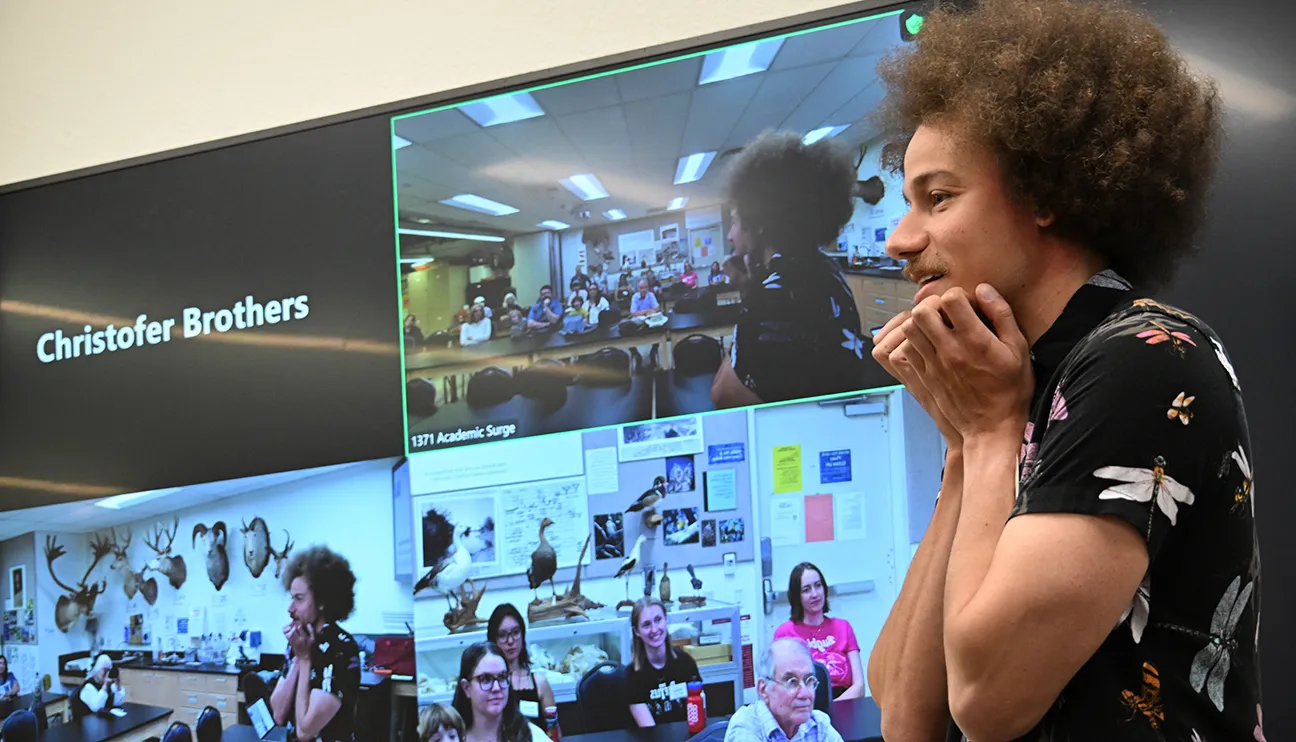
What a delight to hear UC Davis doctoral candidate and dragonfly researcher Christofer Brothers share his rhyming prose at a recent Bohart Museum of Entomology open house.
Brothers titled his 15-minute presentation, "Midair Basketweaving: A Doggerel of Dragonflies and Damselflies," a presentation representing preliminary work from his dissertation on dragonfly and damselfly hunting behavior.
Brothers described doggerel as "a term for funny, silly poetry without a universally set structure --though it can also sometimes refer to bad poetry, and some of my rhymes are certainly questionable!"
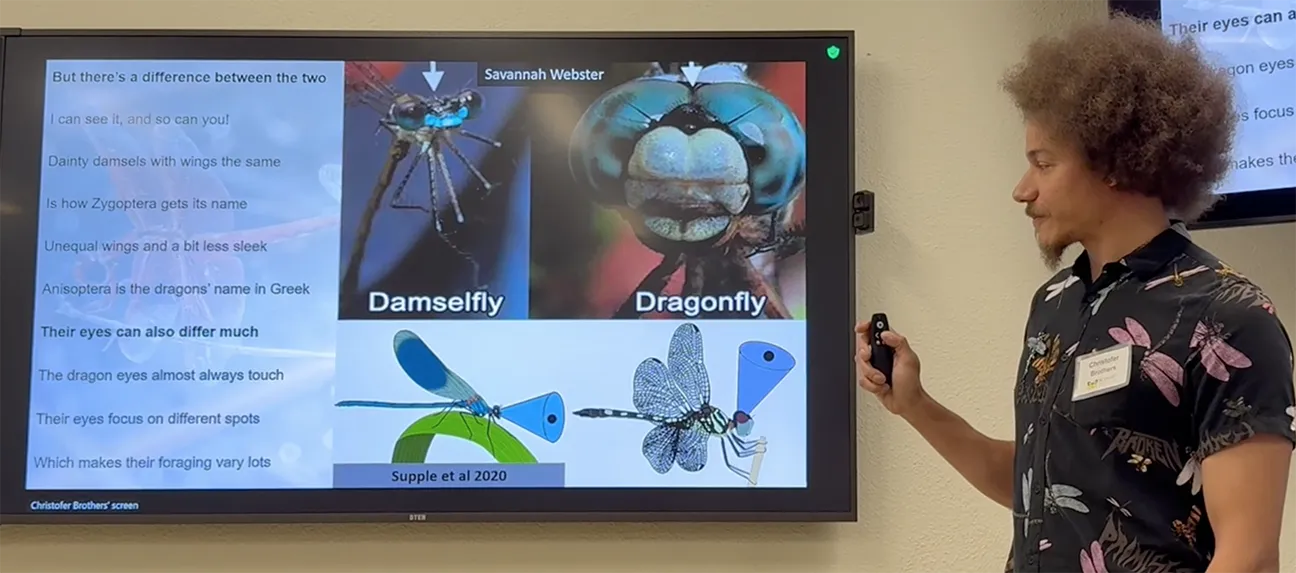
One of them:
With spiky feet they’re no devils in Prada
They’re the insect order known as Odonata!
The dragons and their damsel kin
Are the only insect groups within
"But there’s a difference between the two
I can see it, and so can you!
Is how Zygoptera gets its name
Unequal wings and a bit less sleek
Anisoptera is the dragons’ name in Greek"
Brothers ended his presentation with text that read:
"With these bugs I really yada
I simply know nada if not Odonata
Though we've limited time for questions
I encourage and all suggestions
If you have one, I'm not hard to find
I'll be the one dressed in dragonflies"
Brothers, a member of the UC Davis Animal Behavior Group, studies with Professor Stacey Coombs of the Department of Neurobiology, Physiology and Behavior, College of Biological Sciences. He is particularly interested “in the interplay between capture tools and behavioral tactics of predators, specifically in the suborder Anisoptera, the dragonflies.”
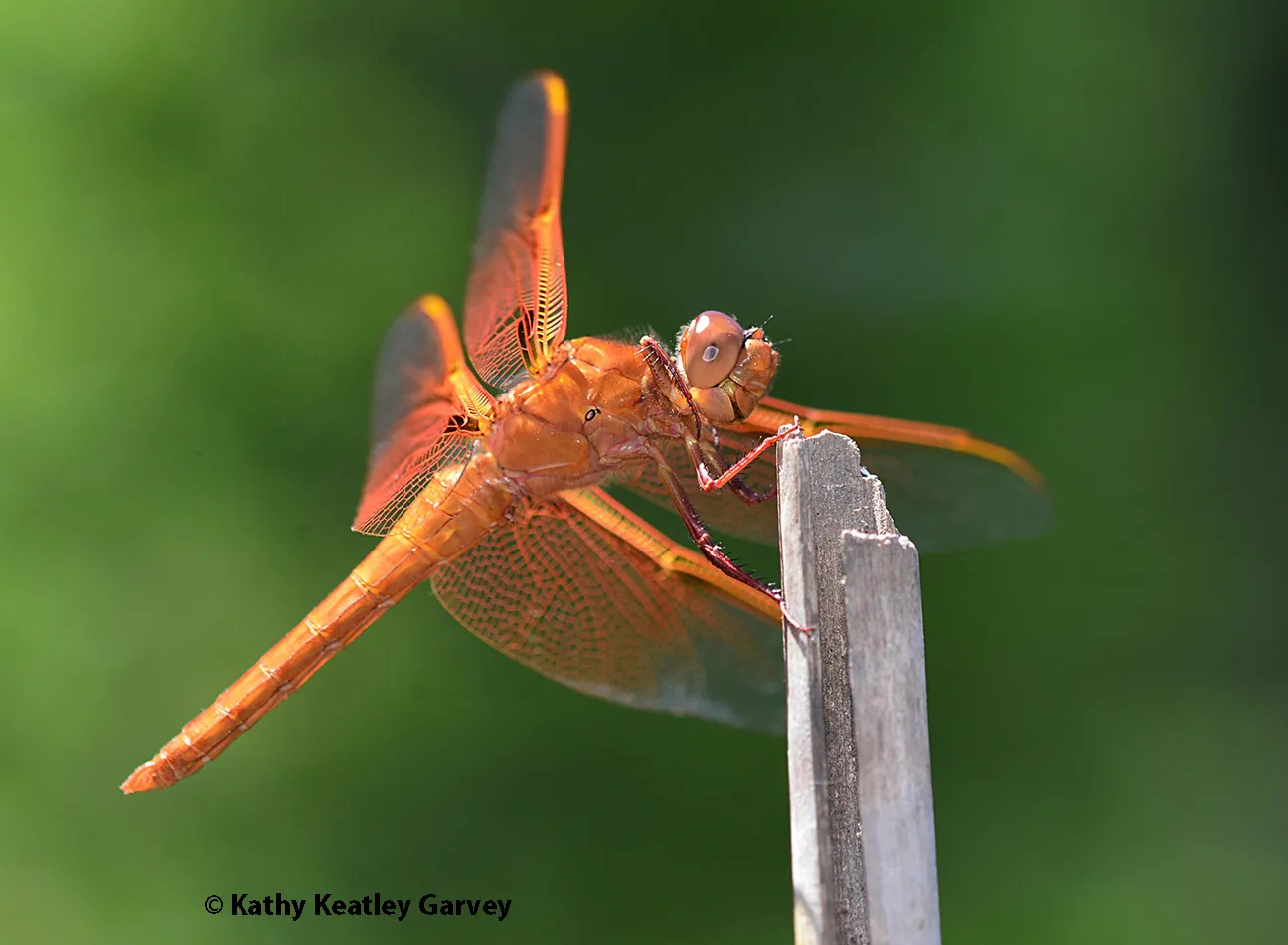
Brothers is a frequent presenter at Bohart Museum open houses, UC Davis Picnic Day and UC Davis Biodiversity Museum Day where he points out that there are more than 6400 species of dragonflies and damselflies in the insect order, Odonata. Like all insects, they have a head, thorax and abdomen.
Dragonflies have nearly 360-degree vision. “Their eyes are the biggest among insects, having up to 30,000 simple eyes within each of their compound eye," Brothers says, and "they are incredibly successful predators. The adults catch prey up to 97 percent of the time."
Not many know that the "the dragonfly larvae can live for up to eight years, but the adults are always less than a year, and usually only for a few weeks to months."
As predators, dragonflies employ two broad strategies: active, and sit-and-wait (ambush)," Brothers says. “When they're actively pursuing prey, they usually rely on speed or endurance. When they wait for prey, they usually rely on stealth, luring or surprise.”
Next Bohart Open House on July18
The next Bohart Museum open house is "Moth Night," set from 7 p.m. to 11 p.m., Saturday, July 18. It will include a blacklighting exhibit and moth displays, in keeping with National Moth Week. All open houses are free and family friendly.
The Bohart Museum is located in Room 1124 of the Academic Surge Building, UC Davis. Founded in 1946, it now houses a worldwide collection of eight million insect specimens, plus a live petting zoo (Madagascar hissing cockroaches, stick insects and more), and an insect-themed gift shop stocked with books, posters, toy insects, T-shirts, hoodies and insect-collecting equipment.
Director of the Bohart Museum is Professor Jason Bond, the Evert and Marion Schlinger Endowed Chair of the UC Davis Department of Entomology and Nematology, and the executive associate dean of the College of Agricultural and Environmental Sciences.
For more information on the Bohart Museum, including the hours it is open to the public, access the website at https://bohart.ucdavis.edu/ or email bmuseum@ucdavis.edu.