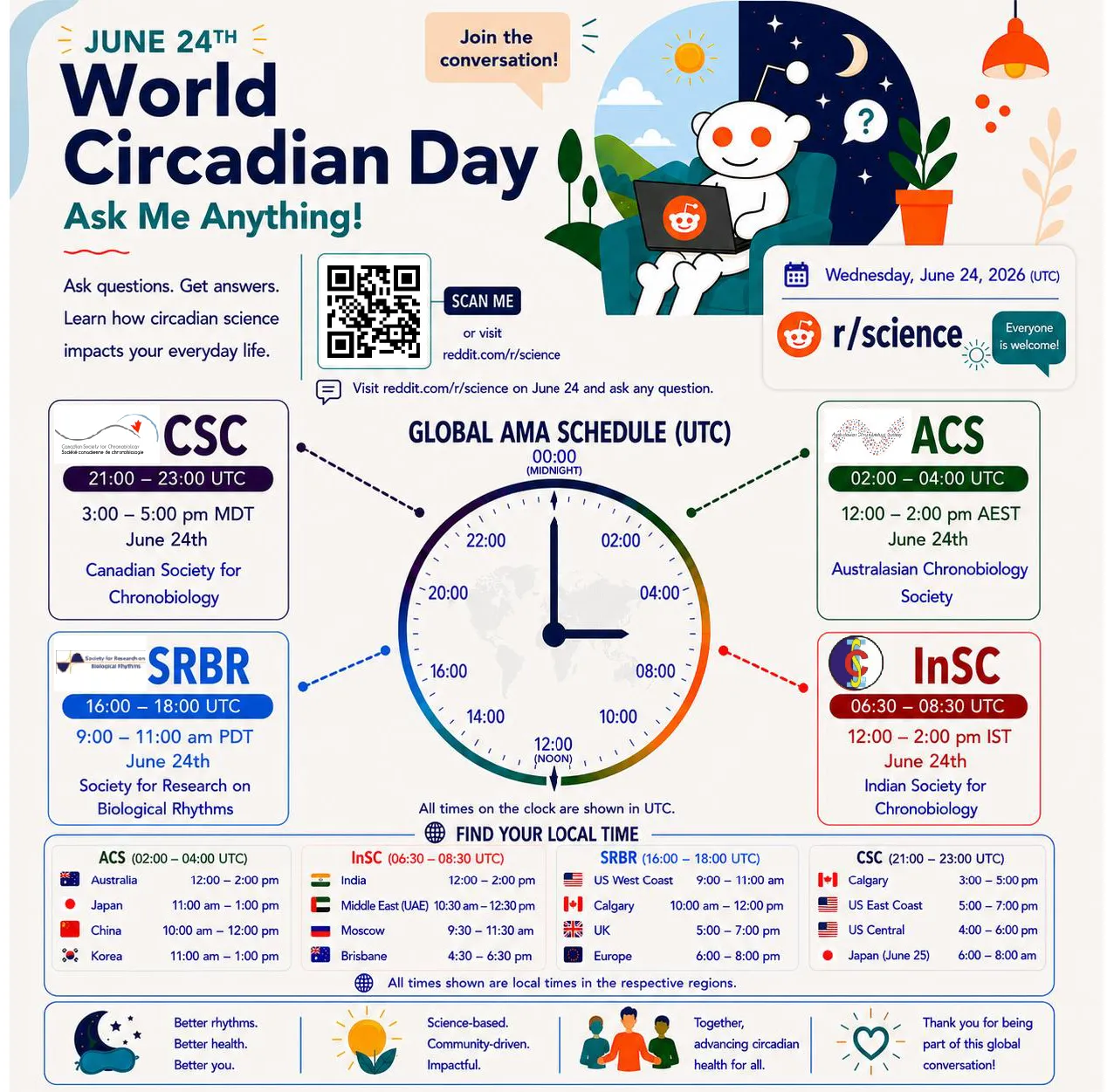

Mark your calendars!
The inaugural World Circadian Day, sponsored by the Society for Research on Biological Rhythms (SRBR), is Wednesday, June 24.
Joanna Chiu, professor and chair of the UC Davis Department of Entomology and Nematology, and president of SRBR, is helping to organize the event.
"We are organizing an 'Ask Me Anything' on Reddit to help the public learn more about circadian rhythms and health," said Chiu, whose lab studies circadian rhythms. "Circadian health and wellness are really important to human health."
"Most people ask about sleep and how they can sleep better," Chiu commented. "Some ask about timing of meals and whether that makes a difference. Or the impact of shift work."
SRBR is an international society established in 1986 to promote the advancement and dissemination of research in all aspects of biological rhythms.

SRBR panelists, in addition to Chiu, will include:
- Emily Manoogian, chronobiologist and clinical researcher at The Salk Institute for Biological Studies, San Diego County. A staff scientist and head of human research in Satchin Panda’s lab, she studies the "intricate interaction between our body’s biological rhythms and the timing of our daily habits, including when and how much we sleep, eat, and exercise."
- Erik Herzog, professor, Washington University, St. Louis. He studies "the cellular and molecular basis of circadian rhythms in mammals." His group uses techniques that include planar electrode arrays, cellular imaging, and genetic manipulations.
- Horacio Hacho De La Iglesia, professor, University of Washington, Seattle. He researches how "neural systems encode time and generate rhythmic physiological and behavioral outputs to adapt to the temporal structure of the environment."
- Michael Tackenberg, assistant professor of neuroscience, Department of Biology, University of Kentucky, Lexington. He studies circadian rhythms and data analysis techniques.
- Julie Pendergast, associate professor, College of Arts and Sciences, University of Kentucky, Lexington. She researches mammalian circadian rhythms and metabolism.