
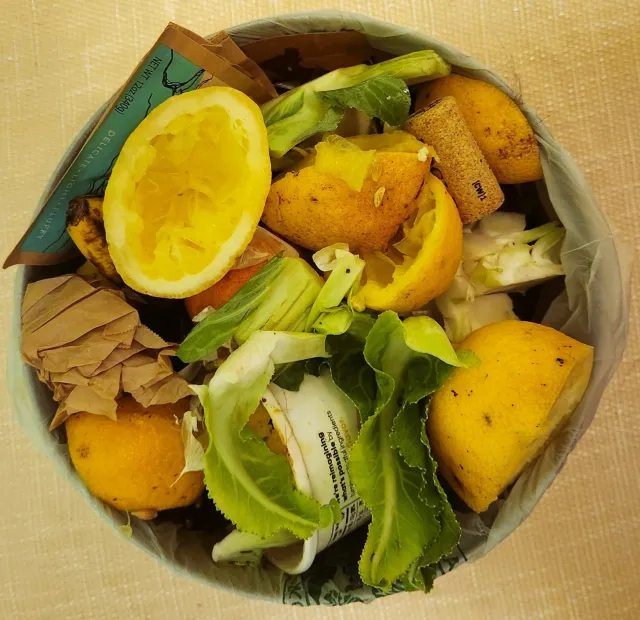
Every week, Yolo County residents set out food scraps, leaves, and yard trimmings in their organics bins. For many, it’s as routine as taking out the trash. But this simple act does more than just haul waste away. It helps close the loop in a local circular economy, turning common discards into resources that nourish and rebuild our soils.
Organic waste collected in Yolo County is processed through a combination of anaerobic digestion and aerobic composting. The resulting compost is made available to residents to use in their lawns and gardens and supplied to local growers who depend on the compost to maintain soil health and farm productivity. In fact, according to an article in the Davis Enterprise, local farmers urge Yolo County residents to utilize their organics bins: “We need the cycle of food scraps to replenish the soil and not have this beneficial matter buried in landfills forever. It is a simple solution, and everyone can participate and use it as a teachable moment for future generations.”
How Compost Improves Soil Health
One of the greatest benefits of compost as a soil amendment is its ability to increase soil organic matter. Organic matter helps maintain healthy soils by improving the soil structure, enhancing nutrient retention, and creating favorable conditions for plant growth.
Compost also supports diverse communities of beneficial soil microorganisms. These microbes help cycle nutrients, contribute to long-term soil fertility, and build that structure mentioned above. Another important benefit, especially in Central California, is improved water retention. By increasing the soil's ability to hold moisture, compost helps gardens and landscapes remain productive during the long, dry summers. Better water retention can also reduce irrigation needs, an important consideration here in Yolo County, where water conservation is a top priority.
In addition, compost helps stabilize soil (that structure again!), reducing erosion and improving overall soil health. Research from UCLA and UC Davis has also shown that compost can contribute to carbon sequestration, helping store carbon in soils rather than releasing it into the atmosphere.
Composting and the United Nations Sustainable Development Goals
Whether you’re composting organics through using the organics bin or applying compost to your lawn and garden, you’re helping tackle major challenges shared around the world and addressed in the United Nations Sustainable Development Goals (SDGs).
SDG 13: Climate Action: When mixed with trash, organic waste breaks down anaerobically (without oxygen) and releases methane, a greenhouse gas about eighty-six times more potent than carbon dioxide. When we divert organic waste from landfills in order to compost it, we reduce greenhouse gas emissions. For this reason, separating organic waste was mandated by law in California in 2022, when Senate Bill 1383, a landmark effort to keep organic waste out of landfills, was implemented. Utilizing your organic waste bin is a way that Yolo County residents can support global efforts to reduce greenhouse gas emissions.
SDG 12: Responsible Consumption and Production: Instead of treating food scraps and lawn waste as garbage, composting transforms them, keeping valuable nutrients in circulation to the benefit of local soils and ecosystems.
SDG 15: Life on Land: Healthy soils support healthy ecosystems. Amending your soils with compost can help improve soil biodiversity, strengthen soil structure, and reduce erosion, helping protect the land resources that sustain agriculture and wildlife.
SDG 2: Zero Hunger: Healthy soils are the foundation of productive food systems. Whether used in backyard gardens, community gardens, or agricultural fields, compost helps improve soil fertility and supports sustainable food production.
Closing the Loop in Yolo County
Whether you use your organics collection bin or apply local compost to your lawn and gardens, you are helping cycle what would otherwise be harmful waste into a valuable resource. By returning nutrients and organic matter to the soil, composting supports healthier gardens, more resilient agricultural systems, and a cleaner environment.
To learn more, click the links below:
The benefits of using compost
Acceptable organics and compostable materials for your organics bin
How to apply the compost to your lawn and garden
What compost is
Anaerobic and aerobic composting at Yolo County Landfill
Composting in Yolo County and where to get free compost products
Free compost for your lawn or garden
This is Part 2 of the series Global Impacts of Growing at Home. If you missed Part 1, you can find it here -
Global Impacts of Growing at Home - Soil Health as a Foundation to Global Sustainability (Pt. 1)
Photo by Kelly Mae Heroux, adapted