
In my Horticultural Therapy class, we develop “tool kits,” including plants we are comfortable using in therapeutic activities. My recent focus has been on activities that are portable and indoors, so I wanted to learn more about “houseplants.”
I was surprised to find that houseplants might simply be labeled as “tropical houseplant”! I imagine many people are shopping for interesting flowers or foliage, and I certainly found that! I wanted to know its name and how I should care for it.
I turned to Google ID and got results like “Prayer Plant” and then Calathea. Calathea is a popular plant with striking foliage, but some folks were adamant that Calathea was very difficult. Others, as is not unusual on the internet, were of a different opinion; one said, “I don’t know why everyone is calling this Calathea. It is Ctenanthe, which is easy.” Plantnet was a little better.
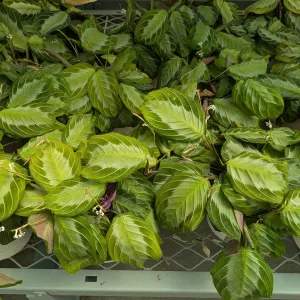
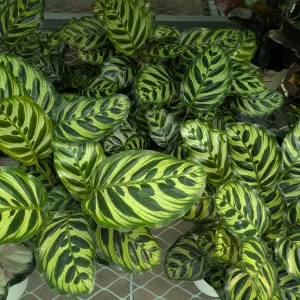
The markings are similar but different!
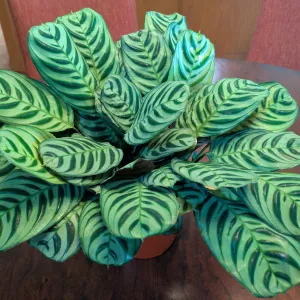
At the top is Ctenanthe; specifically, Ctenanthe burle-marxii, or Fishbone Prayer Plant. It has pale green oblong leaves, with tapering, dark green, curved markings that look like brushstrokes and are reminiscent of fishbones. It is easier to care for than similar-looking plants. It is often confused with the lovely but notoriously finicky Calathea (now Goeppertia) makoyana (Peacock Plant) and Maranta leuconeura (or “true” Prayer Plant). Many houseplants commonly known as Calathea were reclassified as Goeppertia. They all belong to the Tropical plant family Marantaceae, and all have bright, strikingly patterned foliage. They are often referred to as Prayer Plants because they fold up at night, a phenomenon known as nyctinasty.
Picture Maranta leuconeura (or “true” Prayer Plant).
Maranta leuconeura (or “true” Prayer Plant).
Calathea (recently reclassified Goeppertia) makoyana, or “Peacock Plant”