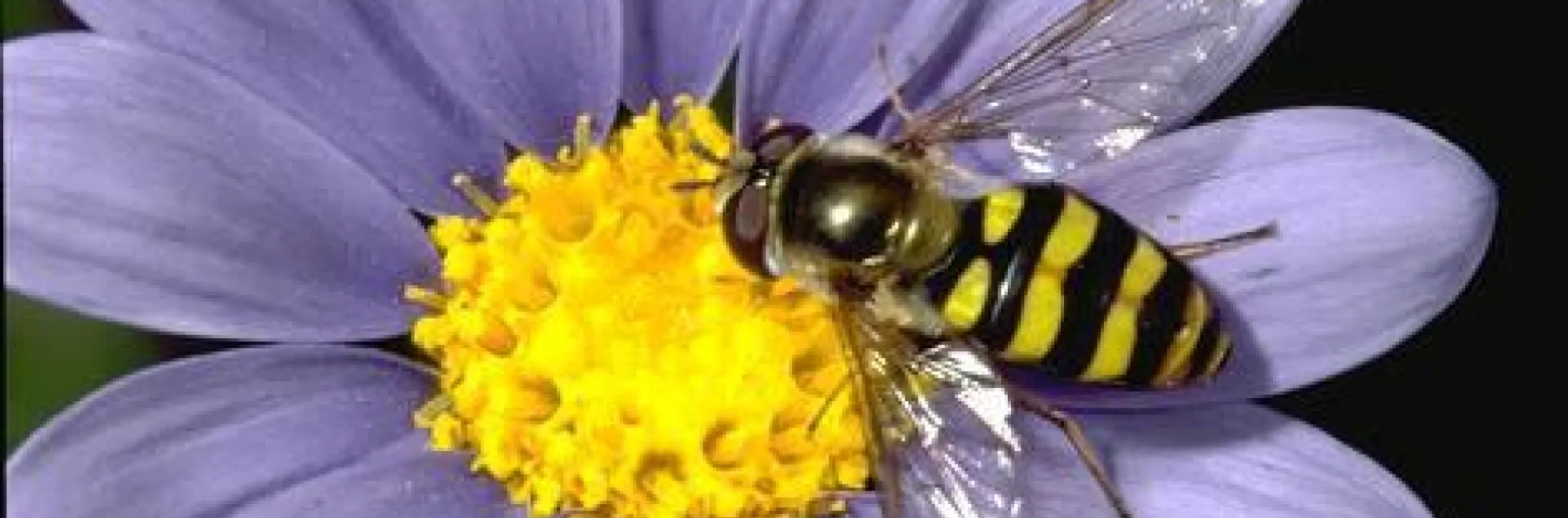
Most of us recognize Western honeybees (Apis mellifera) with their familiar yellow stripes foraging on flowers for nectar. But what about all those other yellow striped insects in our gardens? There are other beneficial insects who mimic honeybees with yellow and black bands to warn off potential predators. Here are a few who you may see in your garden and how they compare to honeybees:
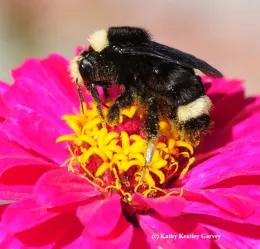
Bumblebees: Bumblebees (genera Bombus) are large, round and fuzzy in comparison to the smaller, slimmer, less hairy honeybees. Found across western North America, they nest in small, annual, underground colonies with about 100-250 bees in contrast to the large honeybee colonies which number anywhere from 20,000 – 80,000 bees. While honeybees overwinter in their hives, only the queen bumblebee survives the winter by hibernating, while the rest of the colony dies in the late summer. Honeybees produce 60-100 pounds of honey each year to feed themselves and their larvae year-round, while bumblebees produce honey only for daily consumption and to feed their larvae during the spring and summer. They are non-aggressive bees who rarely sting but can sting multiple times while honeybees can sting only once, dying afterwards.
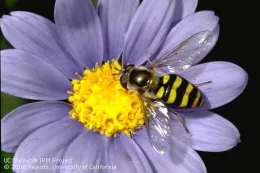
Hoverfly: While hoverflies (family Syrphidae) can sometimes be mistaken for honeybees, they are smaller and have smoother, thinner bodies and only a single pair of wings. They are called “hoverflies” because of their signature ability to hover over flowers before landing. Also called syrphid or flower flies, the adults feed on nectar and pollen. Found worldwide, with 200-300 species in California, they are generally solitary, but will sometimes congregate while foraging. Adult females will lay their eggs in or near aphid colonies since their larvae are voracious feeders of aphids. They are harmless, stingless insects.
Paper Wasp: Paper wasps are slender, shiny insects with narrow waists and long legs, in contrast to the robust, hairy, rounded honeybees. About 300 species are found globally with around 22 species in North America with the invasive European Polistes dominula being the most widespread. Paper wasps build nests with open grey paper-like combs created from fibers of dead wood and plant stems mixed with saliva, while honeybees make waxy, covered hexagonal combs for storing honey and pollen. Both make their combs to raise larvae. Their nests are in sheltered areas including under house eaves or door frames, or in shrubs with colony size anywhere from 20 to 300 adults. Their colonies last for a year, with only the queen surviving the winter to start a new nest in the spring. While they do not have specialized pollen-collecting hairs like honeybees, they are considered pollinators since they invertedly transfer pollen while foraging for nectar. Adults also feed on caterpillars, flies, beetles, aphids and spiders. They only attack if provoked, and their stings are known to be painful.
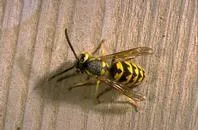
Yellow Jacket Wasps: Similar in appearance to paper wasps, but smaller with thicker waists, yellow jackets (genera Vespula) are found worldwide, nesting primarily underground in abandoned burrows, but also in eaves, wall voids, sheds and attics. Like paper wasps, yellow jackets feed on nectar as well as insects, including caterpillars, spiders and flies. Lake paper wasps, their colonies die off in late autumn, with just the queen surviving the winter to start a new nest in the spring. A colony can have up to 4,000 – 5,000 workers. They are attracted to food and sugary drinks so will scavenge for food from picnics and campsites, giving them the nickname “meat bees.” They are more dangerous due to their aggressive, swarming nature.
Mud Dauber: Mud daubers are slender, narrow-waisted solitary wasps, known for building their nests from mud. Their nests can look like tubes or lumps, often under eaves, in garages, sheltered spots or near water. Found in North America, Europe, Asia and Australia, a common one in California is the Black and Yellow Dauber (Sceliphron caementarium). Their life span is short, with adults typically living for a few weeks to a fewmonths, with 1-3 generations per year, depending on the species. In addition to feeding on nectar as adults, they are beneficial insects that control spider populations by paralyzing them and storing them in their nests to serve as food for their larvae. They are generally not aggressive towards humans but are known to sting if they feel threatened.
Pest Management
Bees and wasps can occasionally sting you or become pests in your home or garden. If a bee or wasp lands on you, don’t swat it or run. Wait for it to leave or gently brush it away. Don’t disturb wasp nests. Refer to the UC Integrated Pest Management (UC IPM) website for management and other information, including:
Removing Bee Swarms and Established Hives, https://ipm.ucanr.edu/home-and-landscape/removing-honey-bee-swarms-and-established-hives/#gsc.tab=0
Yellowjackets and Other Social Wasps, https://ipm.ucanr.edu/home-and-landscape/yellowjackets-and-other-social-wasps/#gsc.tab=0
UC IPM Quick Tips, Yellowjackets: https://ipm.ucanr.edu/QT/yellowjacketscard.html
Bee and Wasp Stings, https://ipm.ucanr.edu/home-and-landscape/bee-and-wasp-stings/#gsc.tab=0
Enjoy Yellow Striped Insects in Your Garden
To attract yellow striped and other beneficial insects to your garden, consider planting native plants, which generally produce more nectar than non-native plants and thus entice more insects. To keep beneficial insects thriving, avoid using pesticides which can be harmful to both the insects and creatures that feed on them.
If you spend time watching insects fly about your flowers, over time you should be able to identify what kind of yellow striped insects are hanging out in your garden!
Sources
UC ANR, The Real Dirt, Bumblebees in the Garden, https://ucanr.edu/blog/real-dirt/article/bumble-bees-garden
UC ANR, The Backyard Gardener, Wonderful Wasps, https://ucanr.edu/blog/backyard-gardener/article/wonderful-wasps
Denise Godbout-Avant has been a UC Master Gardener in Stanislaus County with UC Cooperative Extension since 2020.