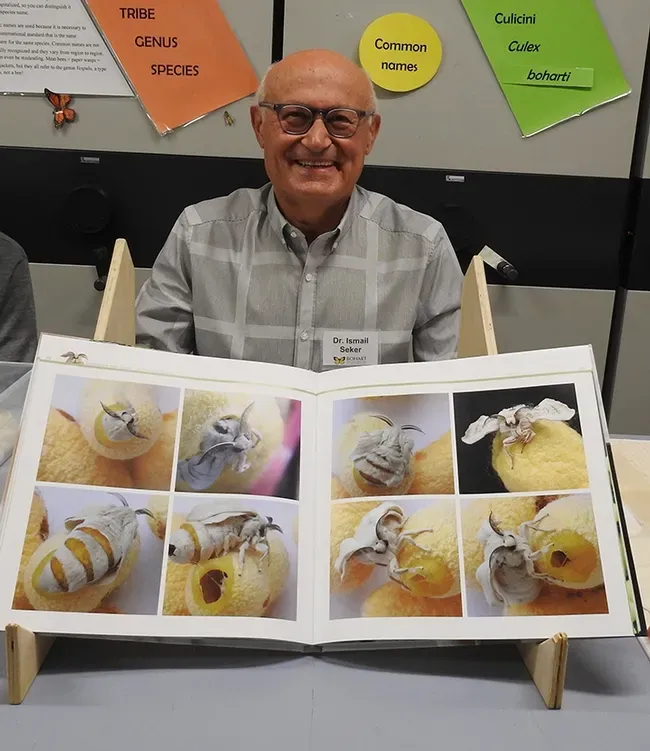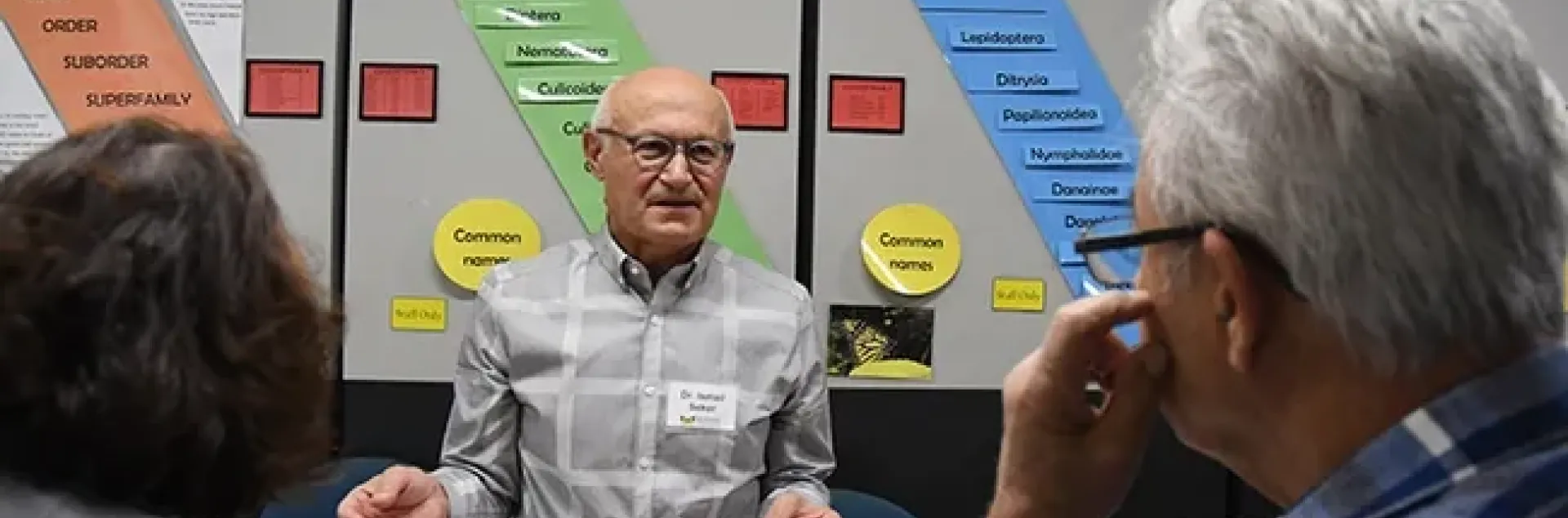
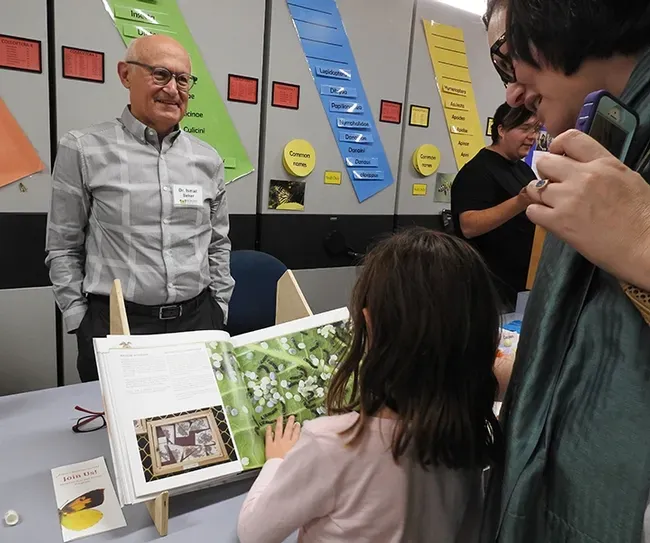
Dr. Ismail Seker, an expert on silk moths, and an author of a book showcasing his macro images of silk moths, will be among those participating in the Bohart Museum of Entomology's Moth Night, set Saturday, July 18 in Room 1124 of the Academic Surge Building, 455 Crocker Lane, UC Davis campus.
The event, from 7 to 10 p.m., is free and family friendly.
Seker, a Turkish medical doctor, displayed eggs, larvae, pupae, adults as well as silk fabric at a 2019 Bohart Museum open house.
The silk moth, Bombys mori, domesticated in China more than 5000 years ago, belongs to the family Bombycidae. Its food: mulberry leaves.
In a previous Bug Squad blog, we mentioned that the caterpillars are celebrated for spinning silk. Each cocoon is comprised of a single strand of rare silk from 1000 to 3000 feet long. It takes about 2000 to 3000 cocoons to make a pound of silk. Worldwide, silkworms produce some 70 million pounds of raw silk, requiring nearly 10 billion cocoons.
The adults cannot fly, and neither eat nor drink. They mate, lay eggs and the cycle continues.
Activities at Moth Night will feature blacklighting displays (nocturnal insects are drawn to a UV light on a white sheet). One will be set up just outside the Bohart Museum by John "Moth Man" de Benedictus from 7 to 11, and the other in the Shields Oak Grove, UC Davis Arboretum and Public Garden, from 9:30 to 11:30 by entomologist Joel Hernandez. Moth specimens from throughout the world will be displayed, and visitors can examine moths under microscopes. Chalk art (where attendees can draw moths and other insects) will take place outside the Academic Surge Building. The family arts and crafts activity will be making moth antennae headbands.
The Bohart houses the seventh largest insect collection in North America; it is the home of eight million specimens. It also houses a live petting zoo (Madagascar hissing cockroaches, stick insects, tarantulas and more) and an insect-themed gift shop.
More information on the Bohart Museum is available on the website at http://bohart.ucdavis.edu or by emailing bmuseum@ucdavis.edu.