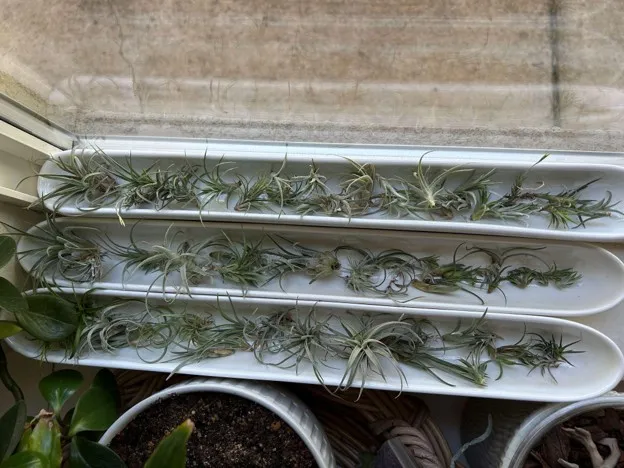
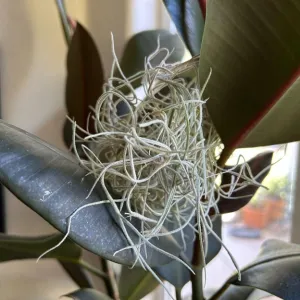
When perusing the indoor plants at nurseries and home centers, you can’t help but notice the increase in popularity of tillandsias, a genus of hundreds of species (650+) in the Bromeliad family, better known as air plants.
Air plants require no soil or medium of any kind - they just sit wherever you place them, literally, living on air - so no repotting necessary! The plants are found naturally in Central and South America but do quite well indoors in North America, requiring only good light, water, and air circulation.
There are two varieties of tillandsia, the thin, green-leaf varieties, and the thicker, grey-leaf varieties. These thicker grey leaves are covered in tiny, scale-like hairs (‘fuzz’) called trichomes, which act as a natural sunscreen for these varieties. With the right care, air plants will even flower and produce babies (‘pups’)! For flowers, I’ve had a purple flower, a hot pink, a red, and one that was yellowish-peach. The care of the two varieties is only slightly different, but caring for air plants is easy, fun, and means you can tend a garden all year long.
Bright, indirect light is best for air plants. While the thicker, grey-leaf varieties can take a small bit of direct morning, not afternoon, sunlight, the thinner, green-leaf varieties will not do well with any direct sunlight. In their natural habitat, tillandsia are mostly shaded by tall trees, so they receive only dappled sunlight; therefore, we need to mimic that environment. My plants are primarily in rooms with bright northern light from a large window, but I do have a few in rooms that are west- and south-facing, out of any direct sunlight.
Tillandsias need water but absolutely cannot remain wet, or they will perish from rot. I’ve used a few watering methods, and the best method has been to soak the plants in a bowl for about 30-60 minutes, gently shake out the excess water, and then dry completely upside down on a towel. In the hotter months, I do this every 7-10 days, but in the cold months, every two weeks is fine. If your tillandsia is flowering, keep the flower dry.
Air plants love ventilation, so make sure they get plenty of air. Sitting by our large window, they are very fond of our whole-house fan during the summer months, mimicking the tropical breezes of Central and South America.
While tillandsias do not need fertilizer to survive, it will increase the reproductive health and vigor of the plants. Use ONLY a fertilizer specifically formulated for tillandsia… I use a 16-9-25 (Nitrogen-Phosphorus-Potassium) Tillandsia liquid fertilizer in a spray bottle once a month. Apply monthly to the soak water or mist with water directly on the plants (as always, follow directions on the fertilizer label).
See the photos below for some of my plants and just some ideas. They even make wonderful bridal bouquets and wedding centerpieces. You can display air plants in so many ways!