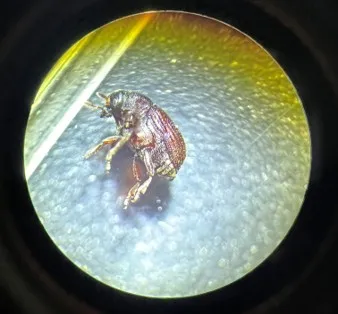
Pagiocerus frontalis in Ventura County Avocados
Background
Pagiocerus frontalis (Curculionidae: Scolytinae) is a native bark beetle that naturally reproduces in fruits of Lauraceae and in stored maize. In avocado (Persea americana), the beetle has been found completing its lifecycle inside of the fruit and fruit seed. Observations in Ventura County suggest that P. frontalis will make tunneling holes in the fruit flesh, and rarely penetrates to the seed itself.
Biology and Ecology
- Primary hosts include Lauraceae fruits (avocado, laurel) and maize.
- In avocado, beetles are only associated with fruit near or on the ground.
- Reproduction appears limited to mature fruit; immature fruit may be probed but not tunneled deeply
- The insect aggregates, with multiple beetles sometimes infesting the same fruit.
- Activity has been observed year-round in Ventura County, though we had a single grower with concerns about infestation in Reed avocado that peaked in late summer (August–September). This timing corresponds with the maturation of Reed avocados; Hass fruit at this stage is typically still immature and less susceptible.
Pest Status in Ventura County
To date, P. frontalis does not appear to pose a widespread or chronic threat to avocado production. Its damage is largely restricted to fallen fruit or fruit still attached but contacting the ground. Infestations appear sporadic, possibly driven by weather dynamics in a manner akin to other irregular pests (e.g., false chinch bug). Reports in Ventura County suggest that outbreaks may be rare but noticeable under certain seasonal or orchard conditions.
Management Considerations
Currently, no chemical or biological control programs are in place for P. frontalis in avocado. Cultural practices are the most relevant management tools:
- Tree skirt pruning: prevents fruit from touching the ground.
- Timely harvest: removing mature fruit reduces opportunities for colonization.
- Sanitation: removal of dropped fruit from the orchard floor may lower beetle breeding sites.
Knowledge Gaps
Several key questions remain unanswered:
1. Distribution and frequency – How widespread and consistent is this pest in California avocado orchards?
2. Damage potential – Under what conditions could economic losses occur?
3. Seasonal dynamics – Are there predictable seasonal peaks, or is the problem sporadic?
4. Attraction cues – Are beetles responding to fruit volatiles, degree of ripeness, or microbial activity?
5. Control efficacy – How effective are sanitation and skirt pruning across different orchard systems?
Summary
While P. frontalis has been confirmed on avocado fruit in Ventura County, current evidence suggests that its pest status is minor and opportunistic, largely associated with mature fruit in contact with the ground. Continued monitoring and collection of specimens will be important for determining whether this beetle becomes a recurring issue. For now, management is best achieved through orchard sanitation, pruning, and timely harvest of mature fruit.