
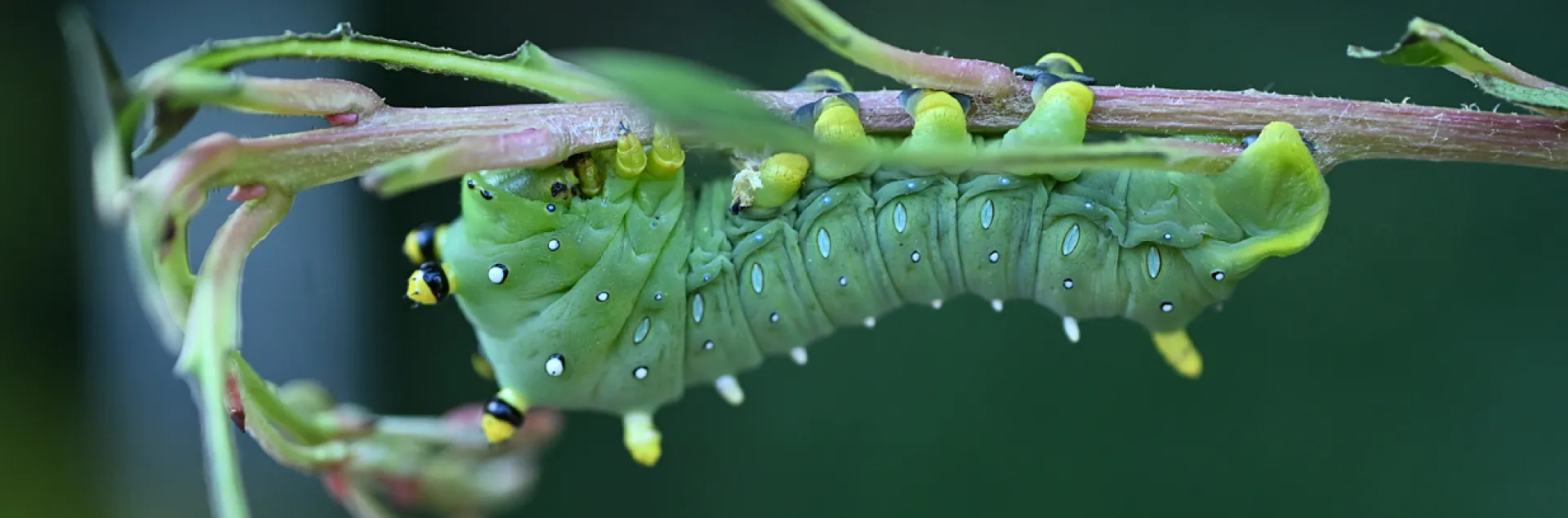

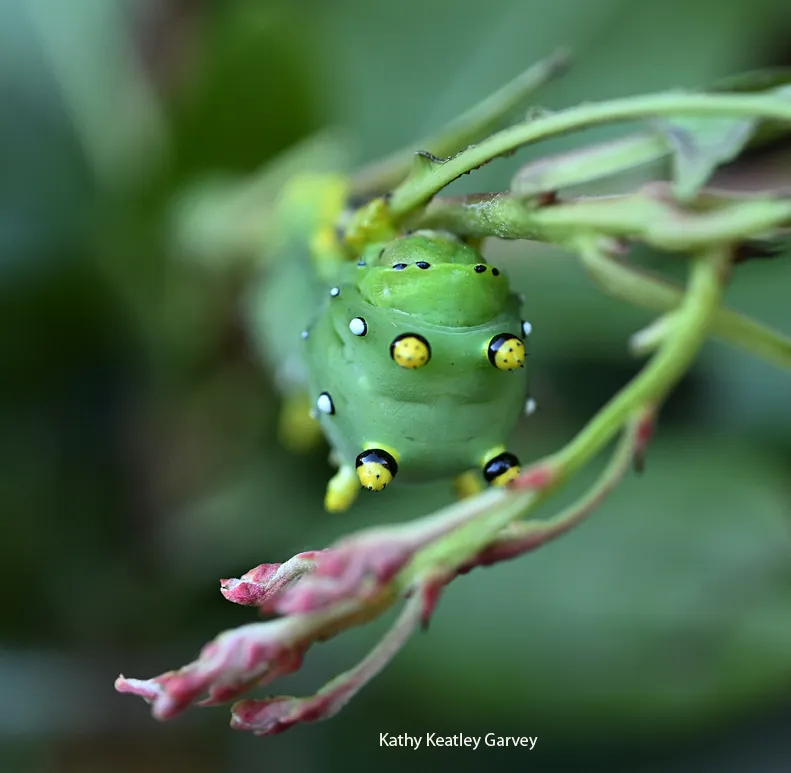
A Ceanothus silk moth caterpillar is munching away on manzanita in an enclosed habitat in the corner of our kitchen.
Seems like a good place to eat as any!
Our tuxedo cat, Miss Sarah Sylvia Cynthia Stout, does not know it's there. If she did, being a curious sort, she'd want to investigate.
When you attend the Bohart Museum of Entomology's Moth Night on Saturday, July 18, from 7 to 11 p.m., you can ask the scientists all about moths, including silk moths.
Turkish doctor Ismail Seker will be among those participating. He is a pro at rearing silk moths and photographing them in all life stages. He'll be setting up a display and showing his book.
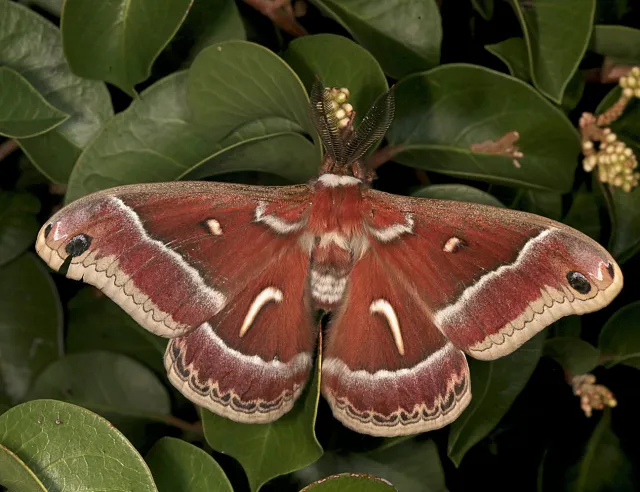
The scientific name of the Ceanothus silk moth is Hyalophora euryalus. It belongs to the family Saturniidae.
French lepidopterist Jean Baptiste Boisduval first described the species in 1855. Wikipedia says "It is found in the forests and valleys of the Pacific Northwest, but has been observed as south as Baja California."
The larvae or caterpillars feed on Ceanothus, Rhamnus californica, Prunus emarginata, Arctostaphylos, Alnus, Betula, Corylus, Ribes, Pseudotsuga menziesii, Arbutus menziesii, Liquidambar and Salix.
If the stars align and it keeps eating unabated without any feline disturbance, our Ceanothus silk moth caterpillar will turn into a reddish-brown moth. Then it will not longer eat; it has no functional mouthparts or digestive track. Then it's off to find a mate. The female will lay eggs (up to 200) on a host plant and the life cycle will continue.
How long will the adult live? About one or two weeks, unless a predator nabs it.
Our 'cat is now a fifth instar. It managed to develop through the first, second, third and fourth instars. Soon it will spin its cocoon.
Meanwhile, it's munching on the manzanita as if its life depends on it.
It does.
The Bohart Museum of Entomology open house will take place in Room 1124 of the Academic Surge Building, 455 Crocker Lane, UC Davis campus. It's free and family friendly. Parking is also free.
The event will feature two blacklighting displays; you can watch nocturnal insects head for the light at the John "Moth Man" de Benecticus display just outside the Academic Surge Building and head over to the Joel Hernandez' blacklighting display in the Shields' Oak Grove, UC Davis Arboretum and Public Garden, from 9:30 to 11:30.
At the open house, you can view a global collection of moth specimens, view moths under a microscope, meet and greet Madagascar hissing cockroaches and stick insects in the live petting zoo, and make a moth antennae headband in the family arts-and-crafts area.
And expect to see some Ceanothus silk moth caterpillars or cocoons from Bohart Museum associates.
Cover image: Side view of Ceanothus silk moth larva munching on manzanita. (Photo by Kathy Keatley Garvey)