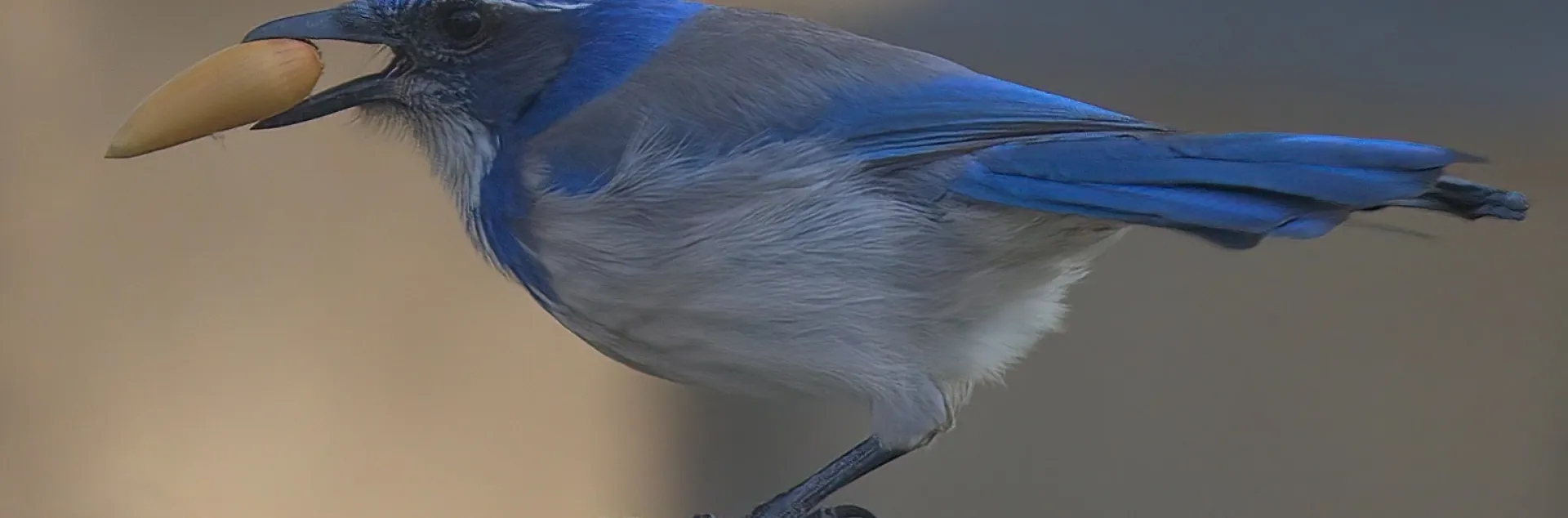
The California scrub jay aka the western scrub jay (Aphelocoma californica) is a familiar sight in Central Valley gardens. It is one of my favorite birds due to its outsized personality.
Description
Members of the same highly intelligent bird group (Corvidae) as crows and ravens, the California scrub jays are known for their exceptional problem-solving skills, food-hoarding habits, long-term memory, and complex social structure.
One of the largest songbirds in our area, adults generally run about 11-12 inches tall. Their distinctive bright azure blue head, wings and tail contrasts with a white throat and gray back, which make them easy to spot. Males and females display the same markings.
They are highly vocal birds with unmistakable loud, harsh raspy squawks. Their varied vocalizations include scolding, shrieking, weeping, rattles, clicking and whispering sounds.
While sometimes called a “blue jay” the California scrub jay it is not a blue jay (though it is blue!), nor is it a blue bird. Blue jays (Cyanocitta cristata) do not reside in California, though another jay, the Stellar’s jay (Cyanocitta stellari) can be found in mountainous areas with its distinctive black wings and crested head on a bright blue body. The Central Valley also has two blue bird species who are smaller (7-8 inches) than the California scrub jay, the mountain bluebird with a blue body and gray and white chest (Sialia currucoides) who winter here, and the western bluebird (Sialia mexicana) who is year-round and is easily identified by its blue body and russet color chest.
Where to Find Scrub Jays
Their native habitat is oak woodland, oak scrub, riverside woods, and foothill forests of pinyon pine. However, they have adapted well to suburban parks and gardens. Mostly a year-round resident ranging along from northern Washington to Baja California, it may disperse a bit in dry years, particularly when oaks produce poor acorn crops.
Food and Nesting
Scrub jays are omnivores whose diets varies with the season. They forage on the ground for acorns, nuts, seeds, fruits, berries, insects, and small vertebrates, along with eating other birds’ eggs and nestlings.
Typically, they produce one brood per year with about 3-5 light green, brown-spotted eggs in well-built, cup-shaped nests. Both parents care for and feed the young. The juveniles leave the nest in 18-22 days, but the adults continue to feed them for at least another month.
Personality Plus Characteristics
They plan for the future - Often seen foraging among leaf letter, the California indigenous people called the scrub jay the “gardener bird” because of its habit of storing hundreds of acorns in the ground and remembering their exact locations to retrieve later during the winter months when other sources of food are scarce. The occasional acorn that did not get retrieved would often grow to become an oak tree, helping replenish the oak forests. In areas with almond orchards, they have also been seen caching almonds.
Master thieves and paranoia - They love to steal acorns from acorn woodpeckers (Melanerpes formicivorus) and other jays. Being thieves themselves, they know how thieves think, so they will deliberately check to make sure no one is watching when they’re hiding their own food. If they think they are being watched, they will later secretly return to move their cache to another location.
They hold “funerals” – When a scrub jay discovers a dead member of its species, it will gather with other jays and call loudly for up to 30 minutes.
Mimicry – They are excellent mimics, mimicking predators like red-tailed hawks (Buteo jamaicensis) to warn other birds. They can also mimic other animals, or even mechanical sounds like a car alarm.
Use “tools”- Scrub jays often use a rock or concrete as an anvil to crack open the hard shell of acorns or almonds.
Pest control – They can be spotted on the backs of mule deer, picking off and eating ticks and other parasites, which the deer seem to appreciate.
Status
Due to their ability to adapt, California scrub jays have a healthy population overall, and in recent years the northern part of their range has been increasing. Since they eat insects such as snails and spiders, they are a beneficial species.
How to Attract Scrub Jays to Your Garden
To entice this colorful, noisy, entertaining bird to your garden provide the following:
Food - Offer unsalted in-shell peanuts (which they often stash for the winter), black oil sunflower seeds (a major draw), or raw almonds on large, sturdy cat/squirrel-proof platform or tray feeders which have plenty of room for them to grab their food. Add suet during the cooler months.
Plants - Plant dense native shrubs such as toyon, manzanita, or buckwheat to give them a place to shelter from predators which also provides berries or seeds. If you have the space and time, plant a valley oak tree (Quercus lobata). Leave some of the leaves on the ground for them to forage for insects.
Water - Scrub jays love splashing in water. Provide a large birdbath with a gentle fountain and sloping sides which they can drink from and bathe in.
Be patient and consistent! Scrub jays are observant birds that perch on tall trees or poles to monitor their territory. Put your treats outside consistently each morning. Once they find your yard, they will alert others and become daily visitors for you to enjoy.
Sources:
The Genus of Birds by Jennifer Ackerman
Birds of Northern America by David Fix and Andy Bezener
California Scrub Jay. https://www.allaboutbirds.org/guide/california_Scrub-Jay/id
Audubon Field Guide. https://www.audubon.org/field-guide/bird/california-scrub-jay
Denise Godbout-Avant has been a UC Master Gardener in Stanislaus County with UC Cooperative Extension since 2020.