

On California’s Central Coast, where grassland and oak savannas stretch across rugged rangelands, one ranching operation is helping redefine what it means to steward the land. Founded in the early 1880s, the T.O. Cattle Company has weathered generations of California ranching history. In 1991, Joe and Julie Morris took over with just 200 acres. Today, they manage nearly 15,000 acres of public and private rangelands across five ranches, using adaptive grazing, collaborative partnerships, and science-based management to restore ecological function while sustaining a working cattle operation. Their story offers a glimpse into how ranching can become a powerful tool for landscape resilience in the twenty-first century.
While some may view grazing narrowly through the lens of livestock production, TOCC approaches it as a web of social, economic and ecological relationships requiring continual engagement, planning and adapting management to the observed landscape and animal conditions. Joe says, “We are, in the end, all connected: people, animals and the land.” That belief shapes every aspect of their operation.
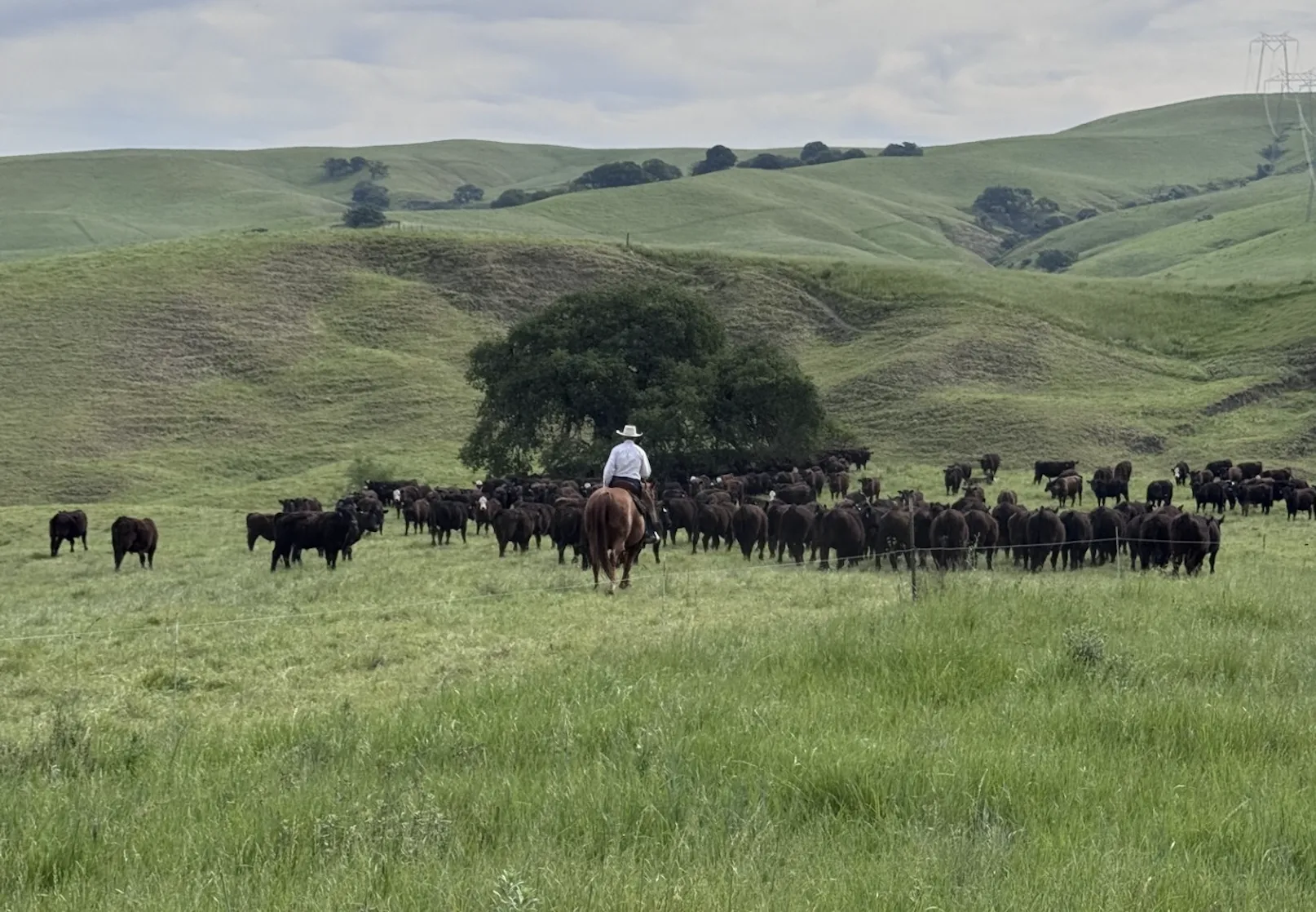
Large herds ranging from 400-900 animals are carefully moved across landscapes according to grazing plans that account for soil health, animal performance, plant recovery, water availability, weather, and rangeland condition, and on one ranch, even the needs of park visitors. The objective is not only to feed livestock, but to improve the land-based community itself, because “ecosystem sustainability allows our operation to continue long term and at desirable levels.” TOCC’s management philosophy focuses on creating what they describe as a “soil carbon sponge”: a soil that is healthy, captures and holds rainfall, stores carbon and supports diverse microbial, plant and animal life. The concept closely aligns with the goals of International Year of Rangelands and Pastoralists (IYRP) 2026, which recognizes rangelands as essential for climate action, biodiversity conservation and sustainable food systems.
Rather than allowing rainwater to rapidly run off slopes carrying sediment and nutrients away, TOCC’s grazing management is designed to slow water movement and increase infiltration into the soil through carefully timed grazing events of varied intensity and adequate recovery periods. The goal is to enhance plant photosynthesis, allow optimal root and plant growth, increase soil organic carbon, and life generally in the soil.
Joe states, “We seek to combine the traditional local knowledge with science-based knowledge learned together with other ranchers, and scientists around the world.” That innovation is backed by rigorous monitoring, recognizing that land management decisions must be continuously evaluated and adapted
to the changing ecological and climatic conditions. TOCC participates in two independent third-party ecological monitoring programs: Point Blue Conservation Science’s Rangeland Monitoring Network and the Soil Carbon Coalition’s Soil Carbon Challenge.
Point Blue monitoring revealed that TOCC’s Watsonville ranch supports more Grasshopper Sparrows, an indicator of healthy grassland ecosystems, than other ranches in their monitoring network. Similarly, the Soil Carbon Coalition measurements indicated stable or increasing soil organic carbon levels to a depth of 15”. Therefore, when done well, data driven adaptive grazing, can help restore ecological function. TOCC has also seen expanding populations of valley and blue oaks, native perennial grasses and highly functional riparian corridors rich with vegetation and wildlife habitat on the ranches they manage.
TOCC leases land for grazing, working collaboratively with landowners to align ecological, social and economic goals. Their philosophy recognizes that ranch resilience depends not only on productive livestock operations, but on healthy ecosystems capable of withstanding drought and other extreme weather stresses.
“Because we are managing complex ecosystems,” Joe notes, “to assume our decisions are without flaws is imprudent. We cannot know enough to assume our decisions are always correct.” Such thinking reflects a broader shift occurring within ranching communities worldwide; away from rigid management styles, towards adaptive and holistic management grounded in observation, monitoring and ecological responsiveness. This management style is rooted in the appreciation that rangelands are living systems capable of storing carbon, filtering water, supporting biodiversity and sustaining communities beyond the people that own and steward them.
As a founding member of the Rancher-to-Rancher project in the Central Coast, Joe believes in building social capital through peer-to-peer learning among ranchers. The project proposes the sharing of management experience among the ranching community through site trials, field demonstrations and facilitated gatherings, as a means of increasing the effectiveness of ranchers to steward the land in ways that increase its ecological functionality and the health of the ranching community. He also leads ranch field-days at the ranches, where people can come and learn about ranching, its benefits and challenges and the integral role livestock play in the health of rangeland ecosystems.