
Note: This was originally published in the Contra Costa Times. It has been updated.
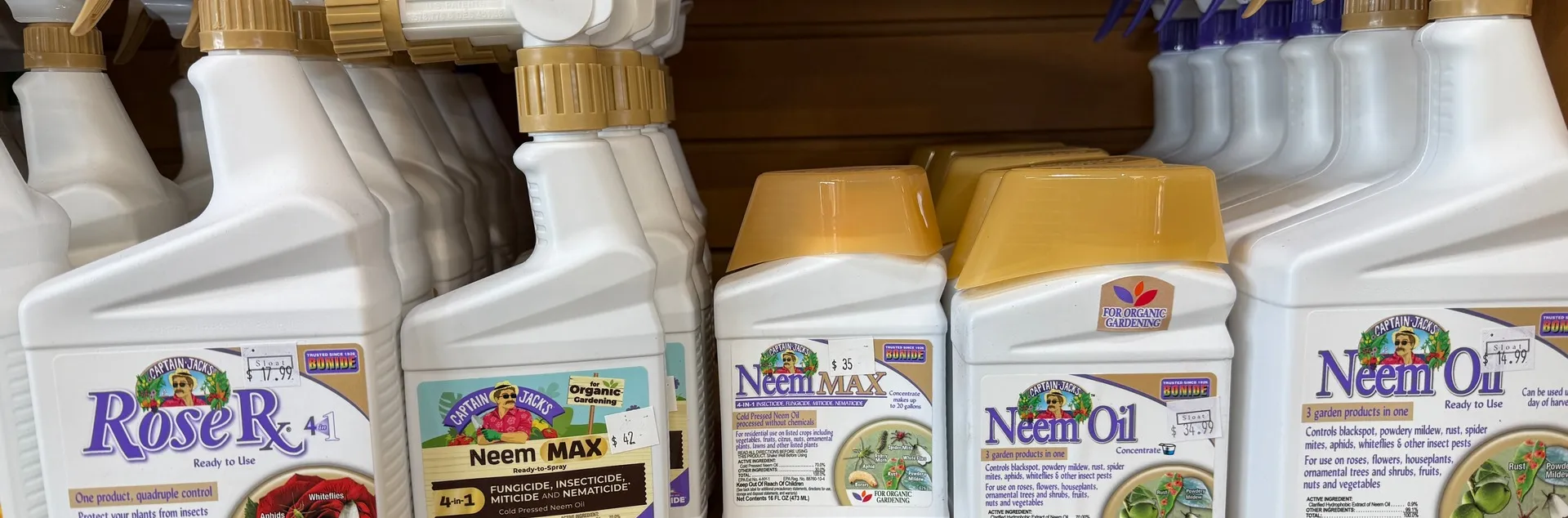
Horticultural oils are lightweight oils, either petroleum or plant based, that can be an effective and low toxic choice for managing certain insect and mite pests. What you find on the shelf of your local retailer may be referred to as insecticidal oil, narrow-range oil, summer oil, or dormant oil. Some plant-based oils (neem) contain naturally occurring insecticidal properties.
Oils are ecologically friendly and can be very effective when used to control soft bodied insects such as aphids, immature whiteflies, immature scales, psyllids, leafhoppers, thrips and some insect eggs as well as mites. The oils provide control primarily by smothering; blocking the air holes (spiracles) through which they breathe. In some cases, they can also act as poisons, interacting with the fatty acids of the insect and interfering with normal metabolism. It will kill only those insects, both bad and good, that come into direct contact with it at the time of application. There is no residual toxicity after drying. Application is important and you must thoroughly spray so that all insects are covered. Be aware that many insects prefer the undersides of leaves or may be under sepals or leaf buds where they are hard to reach. Dormant treatments are ideal of course because, with leaves removed from trees, coverage is much more effective. Horticultural oil is not just an insecticide but also acts as a fungicide helping to control powdery mildew, a common fungal disease on a number of ornamental plants.
Historically, oils were used primarily as a dormant season application (before bud swell and bud break) to kill over wintering insects and mites on fruit trees. They were originally referred to as dormant oil sprays and were heavier weight, less refined, and were unsafe to use on plants after they broke dormancy. Today’s horticultural oils are more refined, meaning that many key compounds in the oil that might cause problems to foliage have been removed.
Today, the term dormant oil refers more to the time of application than to any characteristic type of oil. Despite advances in refining, oils are not safe to use on all plants, particularly when applied during the growing season. Oil treated plants may burn in the hot sun, and a number of plants can’t handle oil at all. Always check the label for a list of safe target plants and/or oil sensitive plants. Most often they are used on woody ornamentals and fruit and nut trees, and to a lesser extent on vegetables.
If using an oil spray, read and follow all label instructions precisely. This is especially true for summer uses of oils. Sprays must be evenly applied at the correct temperature and only to healthy, unstressed plants. The appropriate temperature range for oil sprays is warmer than 40° F but no hotter than 90° F.
For more information about pesticides, see these links:
• https://ipm.ucanr.edu/home-and-landscape/warning-on-the-use-of-pesticides/#gsc.tab=0
• https://ipm.ucanr.edu/home-and-landscape/pesticide-active-ingredients-database/active-ingredient-details/?uaiKey=142#gsc.tab=0
Help Desk of the UC Master Gardeners of Contra Costa County (EDC)