
Have you ever thought about creating your own native habitat garden? Have you heard the term native habitat garden and wondered what exactly it was and how you could create one? If so, you’ve come to the right place!
A native habitat garden is a landscaped area that utilizes native plants to create a functional ecosystem that supports local wildlife. What wildlife, you might ask? A native habitat garden is likely to support birds, bees, butterflies, and more by providing food, water, shelter, and nesting sites. When building your own native habitat garden, something to keep in mind is that the most successful habitat gardens are built around a keystone species. Today, the keystone that I want to propose to you is the Western Sycamore or Platanus racemosa.
Platanus racemosa is a native tree with a variety of common names. These range from California Sycamore to Western Sycamore to California Plane. While the native Western Sycamore can be found as far north as Tehama and Humboldt Counties, it can also be found growing as far south as Baja California. In all areas in which it is found, however, the Western Sycamore prefers to grow in riparian areas, canyons, floodplains, and similar environments in which water is prevalent.
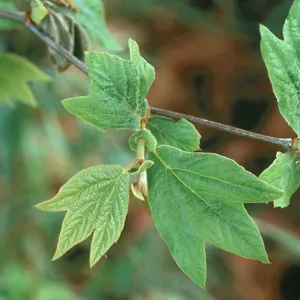
The Western Sycamore is a large and stately tree and can reach heights between ten and thirty-five meters (33 to 115ft) with a trunk circumference of up to ten and a half feet. As the tree ages and grows, it is common to find the trunk split into two or more large trunks, each trunk splitting into a multitude of branches, leading the tree to take on some truly unique shapes. These shapes, coupled with the patchwork-appearing bark which can range from white to beige to pinkish grey and even a soft brown, can lead to truly beautiful if not awe-inspiring sights. In contrast to the softer colors of the trunk, the sycamores’ deciduous leaves can range from a bright green color in the spring and summer to soft gold and orange-red color in the autumn as they fall.
It is easy to confuse our native Western Sycamore with a related and more commonly planted urban tree species, London Plane tree Platanus x acerfolia. Both the native Western Sycamore and the hybrid London Plane mature into stately trees. They can be differentiated in several ways. London Plane tree has two or more fruits per stalk versus one fruit per stalk on the native Western Sycamore tree. The leaves of London Plane tree have medium-depth lobes and the bark is less colorful. The London Plane tree has been planted in urban areas throughout California as well as worldwide. However, be assured that the native Western Sycamore is available through many nurseries. However, to date there are no known native stands of Western Sycamore found in Solano or Yolo counties. If you know of one, please contact the author!
The wood of the Western Sycamore is tough, coarse-grained wood and is notoriously difficult to split and work. Several mammal species utilize the twigs and bark as food. Some small bird species utilize the fruit and nest in the trees. The fruit that is not consumed by birds will break apart and scatter seeds for reproduction.
For most people, however, the Western Sycamore is often spotted in public and private landscapes as a shade tree. The Western Sycamore requires access to water and can be grown in a lawn. Once its roots reach groundwater, it is resistant to drought. The magnificent canopy provides shade that can protect shade-loving plants beneath it in the summer, while falling away in the fall and winter to allow for sunlight to pass through.
Are you looking for a large, architectural tree for your sustainable landscape? A tree that will grow to become drought-resistant with age and establishment. A tree whose unique coloration and shape could become the perfect focal point for your native habitat garden. If your answer to these questions is yes, then the Western Sycamore may be the perfect native tree for you. So, do you think that you’ll want to plant your own Western Sycamore to start your native habitat garden? There’s no better time to start one than the present. But whether you decide to start your native habitat garden now or simply continue to cultivate the garden you already have, good luck and happy growing!
Be sure to read more at Western Sycamore Platanus racemosa Companion Plants