
Nematologists aren't in the news much, but they should be!
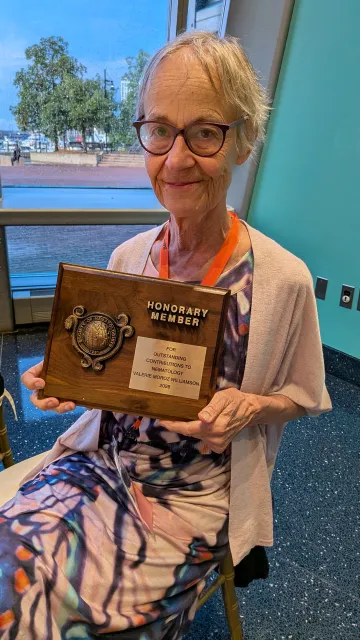
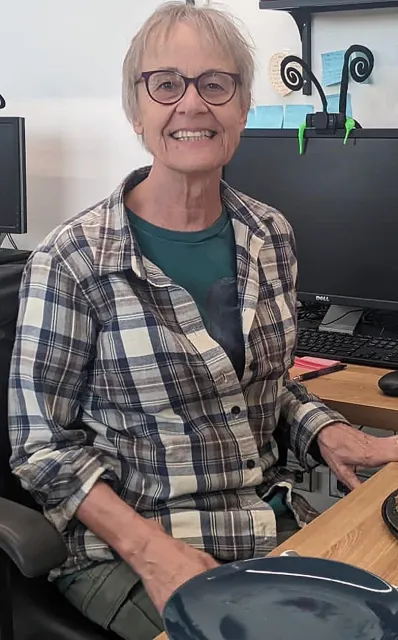
Take UC Davis Professor Emerita Valerie Moroz Williamson, a UC Davis alumna and 26-year UC Davis faculty member who just received the international Society of Nematologists' highest hor: Honorary Member.
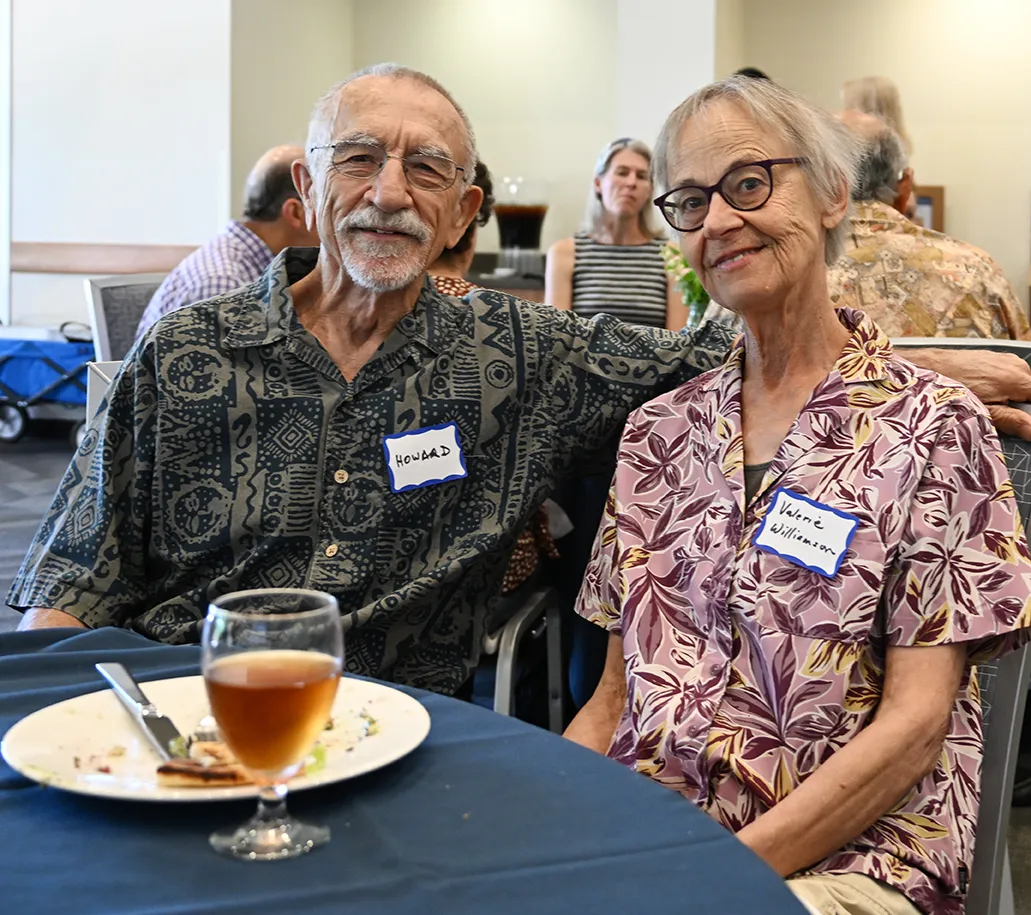
She received the award at the society's recent meeting in Baltimore. She joins UC Davis Distinguished Professor Emeritus Howard Ferris, internationally recognized for his “exceptional, wide-ranging and unparalleled contributions to nematology” over a 64-year career, who won the award in 2024.
Williamson received her bachelor's degree in biology from Northeastern University in Boston and worked three years at the Institute of Marine Science at the University of Alaska, Fairbanks, before seeking her doctorate. She obtained her PhD in biochemistry in 1978 from UC Davis, where she focused on RNA polymerase in Bacillus subtilis. She joined the UC Davis faculty in 1987 as an assistant professor, advancing to professor in 1997.
UC Davis Professor Shahid Siddique and Cynthia Gleason, associate professor, Washington State University, nominated her for Honorary Member.
"Since joining UC Davis in 1987, Valerie has dedicated her career to advancing the field of molecular nematology, making groundbreaking contributions that have shaped our understanding of plant-nematode interactions," the nominators wrote. "Following her doctoral studies, Valerie continued her work in biochemistry as a postdoctoral researcher at the University of Washington, studying alcohol dehydrogenase in yeast," the nominators related. "Her expertise in biochemistry then led her to a position as a research scientist and lab leader at the ARCO Plant Cell Research Institute. It was during this time that plants and nematodes entered her scientific portfolio."
Siddique and Gleason noted that "Valerie has openly shared that her early years as a female STEM faculty member in the 1980s presented unique challenges. As one of the few women in her field, she faced several challenges. Yet her perseverance and scientific excellence were recognized in 2009, when she was named a fellow of the American Association for the Advancement of Science (AAAS). Over her 26 years at UC Davis, Valerie established herself as a leading authority in molecular nematology, mentoring students, publishing influential research, and elevating the profile of the field." She retired in 2013, "leaving behind a legacy of innovation, leadership, and unwavering dedication."
Williamson's curriculum vitae shows more than 100 publications (95 peer reviewed) that have collectively garnered more than 11,000 citations. "Throughout her career, Valerie has consistently published in competitive, high-impact journals, including Proceedings of the National Academy of Sciences (PNAS), Plant Cell, Cell, Science, and Nature, solidifying her reputation as a leader in the field," Siddique and Gleason wrote. "Leveraging her biochemistry expertise, she integrated molecular biology with traditional nematology, establishing one of the pioneering labs in molecular phytonematology."
A hallmark of her career has been her groundbreaking research on the Mi-1.2 gene, a nematode resistance gene in tomato. Among her publications, 27 are dedicated to the cloning and characterization of this gene, a feat that represented a watershed moment in plant-nematode interactions. Her landmark paper in The Plant Cell, 'The Root Knot Nematode Resistance Gene Mi from Tomato Is a Member of the Leucine Zipper, Nucleotide Binding, Leucine-Rich Repeat Family of Plant Genes,' has been cited over 1,000 times, underscoring its profound impact on the field. Cloning Mi-1.2 in the mid-1990s, when molecular biology was still in its infancy, was an extraordinary scientific breakthrough and a testament to Valerie’s vision and determination. The significance of her work was further reinforced by subsequent studies, including her influential paper in PNAS, "The Nematode Resistance Gene Mi of Tomato Confers Resistance Against the Potato Aphid," which has been cited over 900 times."
"A similarly significant component of Valerie’s achievements is her pioneering work on understanding the genetics of root-knot nematodes. She was instrumental in establishing Meloidogyne hapla as a model root-knot nematode, highlighted by her seminal publication in Genetics, 'Meiotic Parthenogenesis in a Root-Knot Nematode Results in Rapid Genomic Homozygosity.' In this study, her lab developed a strategy for conducting genetic crosses between different M. hapla strains and generated novel markers to track segregation patterns. Building on this breakthrough, they published another landmark paper in G3, 'A Sequence-Anchored Linkage Map of the Plant–Parasitic Nematode Meloidogyne hapla Reveals Exceptionally High Genome-Wide Recombination,' in which they produced 183 F2 lines from a cross of two highly inbred strains and constructed a genetic linkage map that has been crucial for empowering M. hapla as a tractable model."
"In recent years, Valerie has returned to her biochemical roots, investigating plant attraction to nematodes and collaborating on research into nematode hormones that act as pathogen-associated molecular patterns," Siddique and Gleason wrote. "She has also pioneered the use of pluronic gel as a medium for dissecting the attraction of root-knot nematodes to their hosts and for studying additional aspects of nematode behavior. These assays, described in Nematology (2007), are now widely used worldwide to investigate nematode behavior, reflecting her continued leadership and innovation in the field. Even in retirement, Valerie has remained a prolific and innovative force, furthering her research into nematode attraction. Her transformative contributions have not only elevated the study of nematodes within plant pathology but have also left an enduring legacy of scientific excellence."
In her lab at UC Davis, Williamson mentored numerous students and postdoctoral researchers who went on to achieve successful careers in academia and industry. Many of her mentees now hold positions in academia worldwide, including Kris Lambert (University of Illinois), Cynthia Gleason (Washington State University), Eric Brenner (Pace University), Fiona Goggin (University of Arkansas), Chin-Feng Hwang (Missouri State University), and Congli Wang (Chinese Academy of Sciences).
"Others have excelled in the plant industry, such as Qingli Liu and V.P. Thomas," the nominators shared. They described her as a "strong advocate for international collaboration," that she has hosted and mentored scientists and students from India, Africa, and Europe, "demonstrating her deep commitment to advancing nematology on a global scale."
"She played a pivotal role in shaping the careers of many international researchers, including Danny Humphreys, who was inspired by her guidance to dedicate his career to studying nematodes."
"Even in retirement, Valerie remains an invaluable mentor, providing continued support to Shahid Siddique and his lab as he established his research group at UC Davis." Williamson serves as a co-principal investigator on two federal grants, "actively contributing to ongoing research, and is also a dedicated member of the guidance committee for three graduate students, offering mentorship and academic support. Her expertise and contributions, particularly in providing critical genomic resources for root-knot nematodes, have been instrumental in establishing and strengthening the Siddique lab’s research program."
Well done, Professor Valerie Williamson! Well done!
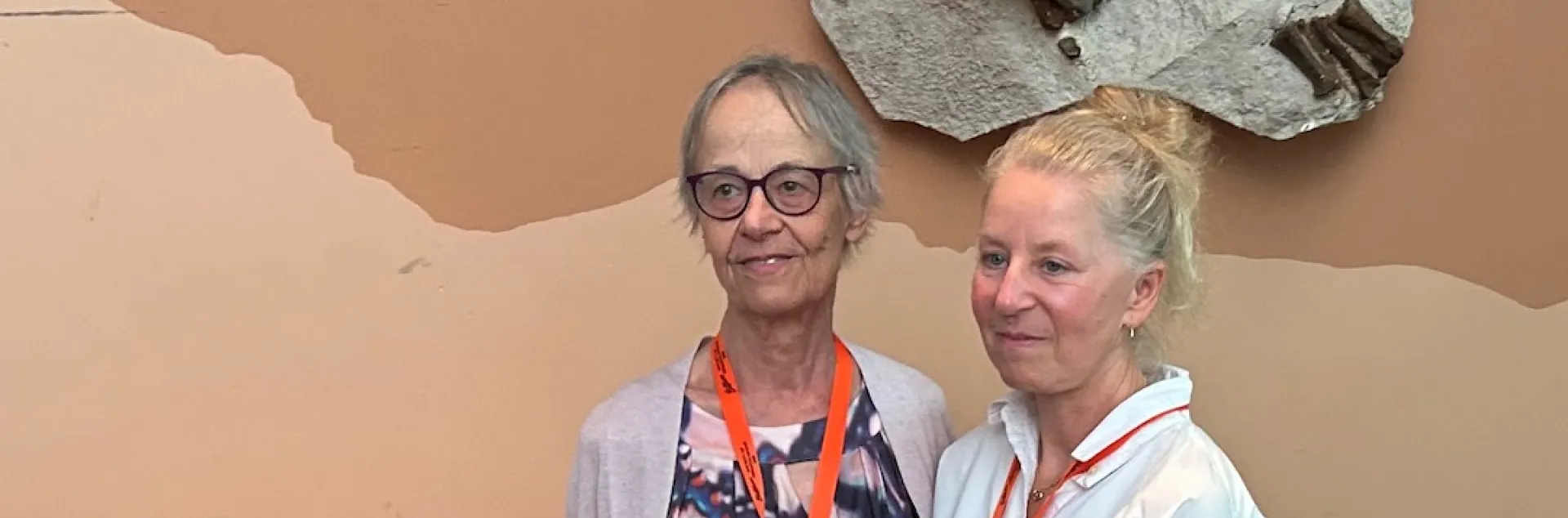
Cover image: UC Davis Professor Emerita Valerie Williamson (left) receives the Society of Nematologists' Honorary Member award from Dorota Porazinska, associate professor at the University of Florida and chair of the SON Awards Committee.