
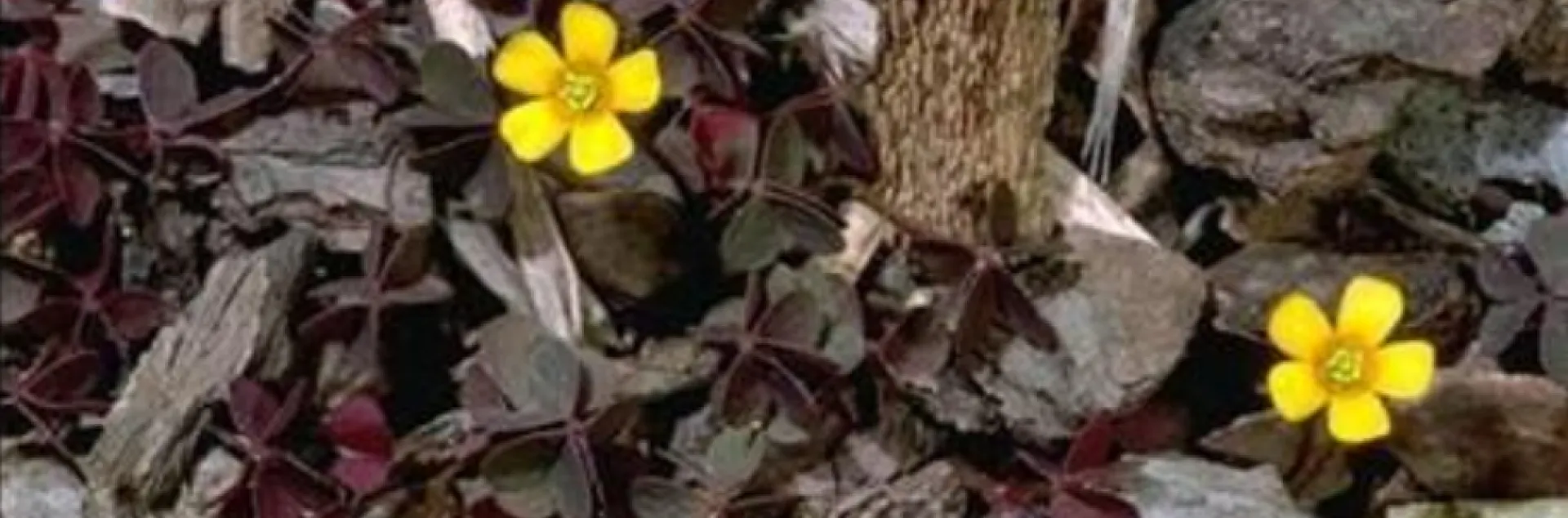

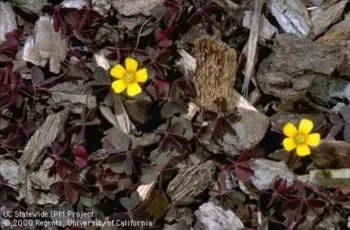
Question: Every spring I see a short plant with bright yellow flowers growing all over in fields, vacant lots, and residential yards. Can you tell me what that is?
Answer: You are probably referring to a non-native oxalis that grows wild in Sonoma County, as well as other areas of northern California. Although it’s a very pretty plant, it is highly invasive and considered a weed.
There are two types of yellow flowering oxalis common to our area: Bermuda buttercup (Oxalis pes caprae) and creeping woodsorrel (Oxalis corniculata). Both are perennial weeds.
Bermuda buttercup originated from South Africa as an ornamental plant. It prefers full sun in cool coastal areas and semi-shaded sites inland. It grows upright and is larger and showier than creeping woodsorrel.
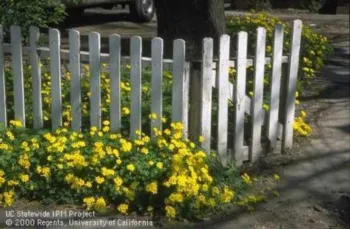
Bermuda buttercup develops from tiny bulbs that sprout and grow in the fall. Its leaves grow in a rosette shape on the soil surface and are comprised of three heart-shaped leaflets, often spotted with purple dots. Bright yellow flowers, 3/4 to 1 1/2 inches in diameter, appear in late winter or early spring on top of tall leafless stalks. When temperatures rise in late spring and summer, the foliage dies and the bulbs become dormant.
Bermuda buttercup does not produce seed but reproduces by forming new bulbs underground. It can also produce a lateral runner to form a new plant above ground. It’s a difficult weed to eliminate. Over time, you can reduce this weed by persistently digging up the bulbs and pulling up the top growth to help weaken the bulbs. Herbicides are only effective at killing the top growth but do nothing to affect the bulbs, so the plants tend to grow back.
Sheet mulching and solarization are two non-chemical methods you can use to control both Bermuda buttercup and creeping woodsorrel, as well as other weeds that are growing in large unplanted areas. With sheet mulching, you completely cover the weeds with a layer of compost, topped with cardboard plus 2 to 3 inches of mulch to block out all sunlight. Within 5 feet of your home or other structure, make sure the mulch is a non-flammable product, like gravel or other stone. To solarize weeds, cover the area with clear plastic for 4 to 6 weeks during a hot, sunny period of the year to heat the soil to up to 140 degrees. For more information, see the links at the end of this article.
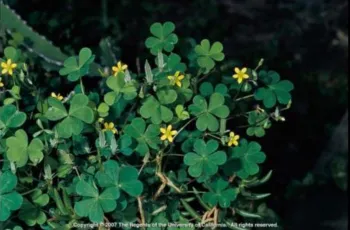
Creeping woodsorrel grows in both full sun and shade if the area receives adequate moisture. True to its name, it grows in a low creeping manner and forms roots and stems where nodes contact the soil. Its leaves are comprised of three heart-shaped leaflets, are green to purple and often close and fold downward in intense light and at night. If these plants are stressed due to drought or intense heat, the leaves sometimes turn reddish and wilt.
Creeping woodsorrel can bloom almost any time during the year, although spring is a time of heavy flowering and seed formation. The flowers, with five small yellow petals, are about 1/4 to 1/2 inch in diameter on the ends of short stalks.
This type of oxalis can produce more than 5,000 seeds in hairy, cylindrical pods up to an inch long. When seedpods mature, they rupture, and seeds are forcefully expelled, landing up to 10 feet from the plant. Because these seeds are rough, they can stick to tools and clothing and thus be moved to other areas.
Extremely cold or hot temperatures reduce growth but don’t kill creeping woodsorrel. This plant has a long taproot. If you pull it up from the ground, the taproot often breaks off and remains in the soil, allowing the plant to regrow. Solarization and sheet mulching are both effective ways to help control this weed.
Although it may seem contradictory, you could water and encourage creeping woodsorrel to grow and then pull up all the seedlings as they emerge. But this method requires persistent attention. You will probably need to repeat this process several times to completely remove the plant.
As a last resort, herbicides can be effective on creeping woodsorrel. Chemicals used for preventing seed growth, also known as pre-emergent herbicides, can be applied twice, about eight weeks apart, in early fall. If you choose to use an herbicide, carefully read the instructions to be sure it’s safe and the appropriate product for your situation. Once you’ve eliminated weeds, maintaining a healthy 2-to-3-inch-layer of mulch is an effective way to help keep most weeds suppressed as part of ongoing yard maintenance.
For more information on managing oxalis in gardens and landscapes:
Contributors to this week’s column were Wendy Stern, Karen Felker and Kim NielsenGlynn.