
In August 2025 I had the opportunity to visit with Guido Frosini from True Grass Farms, on a 400-acre private ranch north of Bodega Bay, in Sonoma County. At this site, he is experimenting with cattle grazing to control coyote brush (Baccharis pilularis) in a coastal prairie grassland. Coastal prairie grasslands are in decline, yet they support a diversity of native plants and wildlife, including several special-status species (Ford and Hayes 2007). Coyote brush is a dominant species in northern coastal scrub habitats. While it is a native plant, expanding coyote brush populations are one of the threats to coastal prairie grasslands.
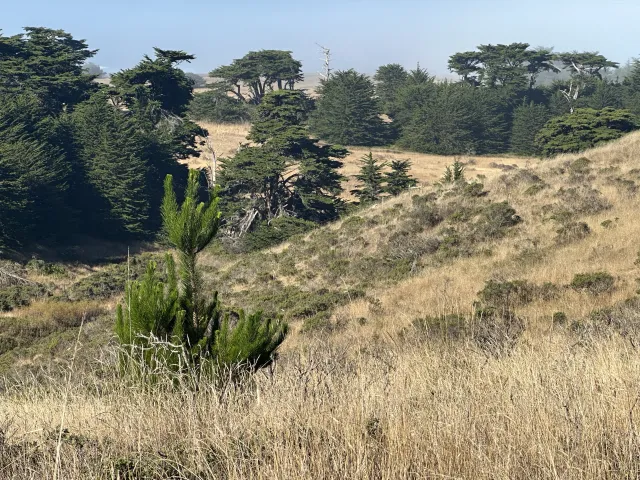
In addition to coyote brush, Guido is seeing pine and fir trees coming into the grasslands (Fig. 1). And as temperatures get warmer on the coast, he’s noticing encroachment of scotch broom. Guido’s work is helping to support grasslands in a coyote brush-grassland mosaic.
Why Cattle
Most people who use livestock to reduce shrubs use goats because goats are browsers and prefer woody vegetation. But, Guido’s approach is different. He is using high density cattle grazing. Cattle are grazers and tend to focus on grasses, which adds challenges to using them for woody vegetation control.
Guido’s goal with this approach is to use livestock he already has to generate income and increase the amount of forage on the property to make it more productive. Other benefits are restoring coastal prairie grassland and reducing fire fuels. One thing that made the project possible was a Natural Resources Conservation Service (NRCS) Environmental Quality Incentives Program (EQIP) contract. Guido explained that the NRCS has a cost share practice for high density targeted grazing for shrub control. The practice is designed specifically for goats and sheep, but NRCS made an exception for cattle in this case, as a pilot program. So, he was able to get paid by NRCS for this practice over a 3-year period.
Management Approach
Operational Strategy
Guido started testing out using high intensity cattle grazing in 2020. When I visited in 2025, he was going into his fifth year. He manages about 20 acres per year using intensive cattle grazing. One year he tried 43 acres, but that was too much. His stocking density is about 30 animal units to cover approximately 15 acres. He recommends not trying to graze more acres than you have the right density for. Timing of his contract grazing goes from spring to September. He says that spring is the best time to graze because coyote brush is most palatable and soils are not too wet, which also reduces the potential for soil compaction and erosion. Guido found that his best results were when cattle densities were 150,000 - 200,000 pounds/acre. He harvests animals May 1 – November and calves in spring. It takes 2-3 years to finish their animals.
Body Condition
Body condition scores (BCS) indicate relative fatness of an animal and can help producers understand the animal’s nutritional status (Ingram 1998). BCSs are ranked from 1-9, with 3 being quite low and 9 being the highest. Scores between 5 and 7 are optimal. When targeted grazing for shrub reduction, Guido has noticed cattle body condition may go down to a 4 or 3 because you want to keep the cattle hungry enough to eat the coyote brush, but make sure they are healthy enough at the same time. If he starts seeing animals with a BCS of 3, he stops the contract. In addition to reduced BCS, he has observed a reduction in calving rate with this intensity of grazing. Because of these challenges, his high intensity grazing contracts don’t last more than two weeks at a time, typically around ten days. Then the cattle are given a breaks for up to two weeks, one week on average, to eat higher quality forage and improve their BCS. He does provide supplemental protein when on a contract, but has not needed to provide mineral.
Guido has found that dry cows are easiest to use for this type of intensive grazing because they will perform better than other classes of cattle. For example, yearlings will not have adequate weight gains in these grazing conditions. The cows are bred while on contract since they are bunched so close to each other in small areas. The bulls are in with them all the time. He does wonder though if contract grazing impacts the last trimester of pregnancy and birth weight of the calves.
Results
Based on his grazing contracts, Guido has seen that when you begin a project in a field that is dominated by coyote brush, it can take three or four years to start seeing a reduction in coyote brush and an increase in forage. The cattle create a coyote brush savanna.
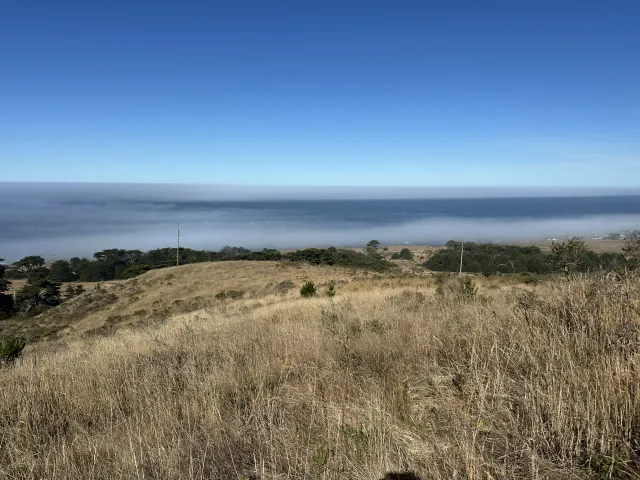
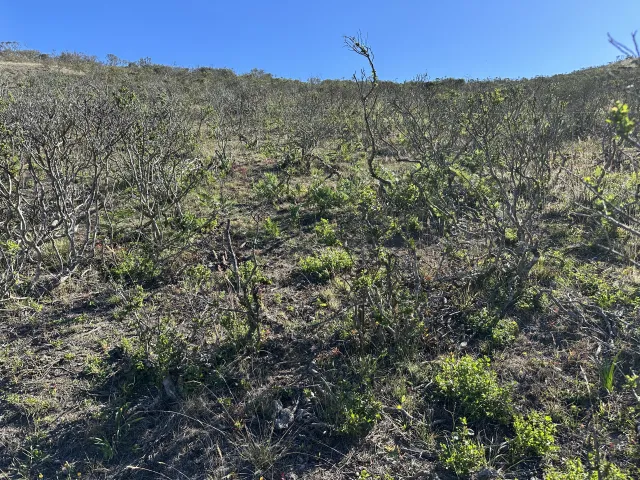
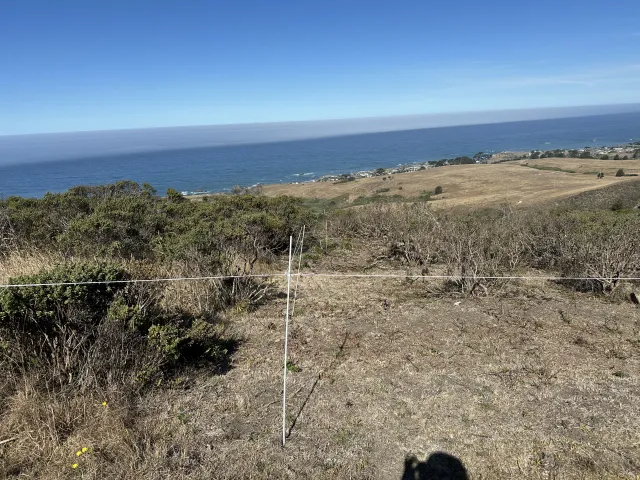
Guido has seen an 80% reduction in coyote brush at some of his sites with corresponding increases in native and forage grasses (Fig. 2). Figure 3 shows a site after two years of grazing and Figure 4 shows a fenceline comparison with no grazing on the left side of the fence and cattle grazing on the right.
Guido has observed an increase in overall grass biomass, which helps compete with coyote brush and minimizes its spread. Also, with reduced shrub cover, he noted that more sunlight hits the ground and is better for grass germination.
In the end Guido thinks it makes most sense to have a mosaic of habitats (both grassland and shrubland) and only do high density grazing in targeted areas as it is expensive in equipment, time, and labor. He also recommends working with a partner like Point Blue to do vegetation monitoring and photo monitoring to better understand changes over time.
References
Ford, L.D. and Hayes, G.F., 2007. Northern coastal scrub and coastal prairie. Terrestrial vegetation of California, pp.180-207.
Ingram, R. Body Condition Scoring, Livestock and Natural Resources Publication Number 31-619, Winter 1998, last accessed 7/21/2026. https://ucanr.edu/sites/default/files/2017-04/261263.pdf