
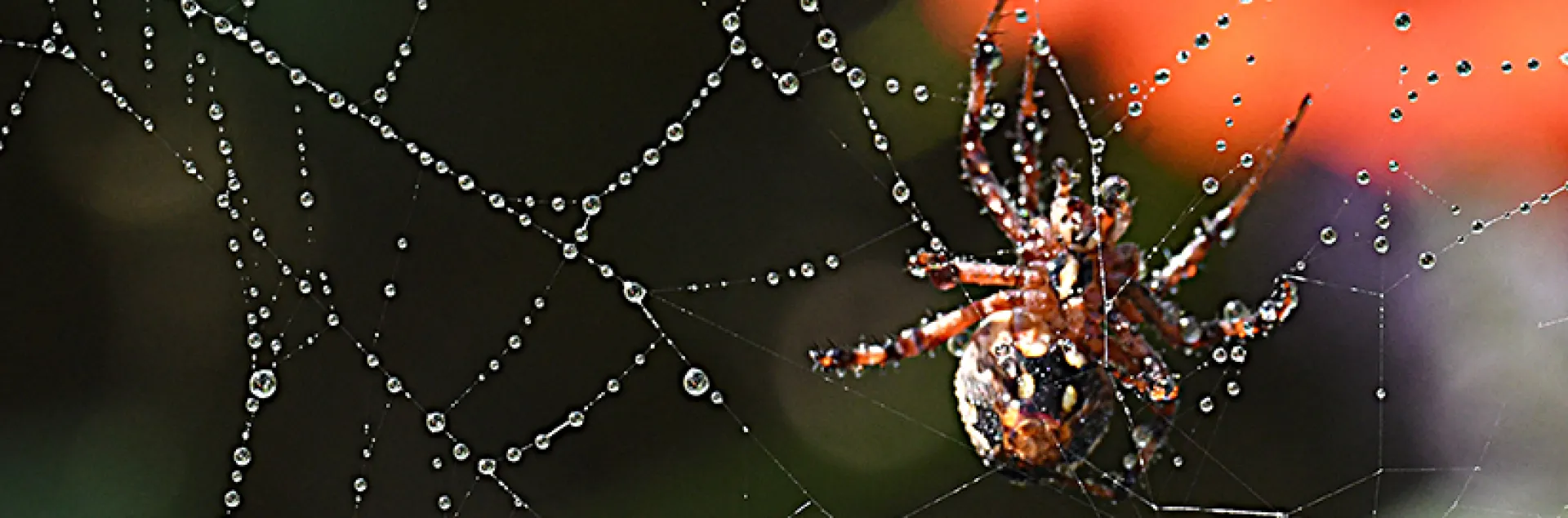
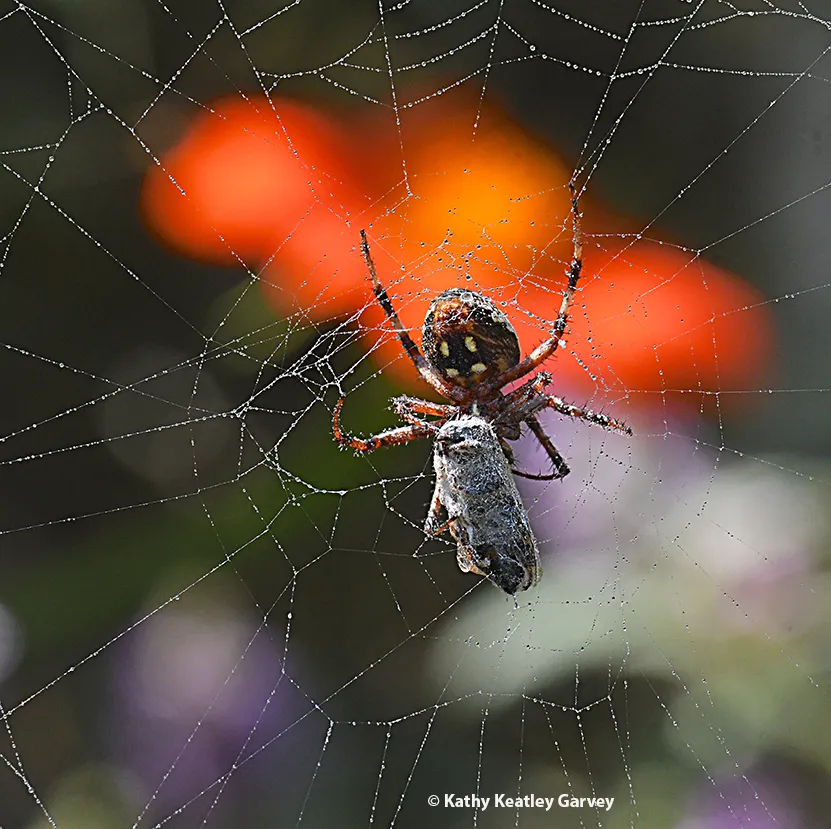
The spider and the bee...
Or technically, an orb weaver and a honey bee.
"Orb" is an old English word meaning "circular." Thus, the word, in reference to an orb weaver, refers to the classic, round, wheel-shaped spiral webs that these spiders build.
The orb weaver is skilled in web design and development. Such intricate work it does! It quickly but meticulously weaves its orb, anticipating that a bee or other prey will be caught in its sticky web.
The orb weaver, family Araneidae, is a clever spider. It starts a framework of nonsticky silk and then, in a finishing touch, adds a final spiral of silk covered in sticky droplets.
When an unsuspecting bee lands in to the sticky web, it cannot free itself.
The orb weaver is an ancient pro. Indeed, scientists say, the evolutionary lineage of orb weavers dates back at least 110 to 140 million years to the early Cretaceous and Jurassic periods.
"The oldest known true orb-weaver is Mesozygiella dunlopi, from the Lower Cretaceous," according to Wikipedia. "Several fossils provide direct evidence that the three major orb-weaving families, namely the Araneidae, Tetragnathidae, and Uloboridae, had evolved by this time, about 140 million years ago. They probably originated during the Jurassic (200 to 140 million years ago million years ago). Based on new molecular evidence in silk genes, all three families are likely to have a common origin."
Spiders usually gain a bit of prominence and notoriety in October, when they become iconic symbols of Halloween.
Meanwhile, everything eats in the garden. Today the spider eats a bee. Tomorrow a wren may eat the spider. And the next day, a hawk may eat the wren that ate the spider that ate the honey bee.
Bon appétit!