
Getting more out of your enterprise
Building farm resilience is more important than ever, yet there is limited practical guidance out there on how one might make a resilient farm. The old adage of “don’t put all your eggs in one basket” is great in theory but what other “baskets” are out there for farmers? Agricultural diversification refers to developing multiple streams of revenue rather than relying on a single product or output. In general, diversification strategies fall into three categories, and each approach can help manage risk and build long-term resilience. There is no one-size-fits-all approach and strategies must be adapted for your individual operation.
Crop or livestock diversification
When people think farm diversification, this is often what comes to mind: producing more than one crop or livestock instead of operating as a monoculture. In practice, this might mean converting parts of your vineyard into olive orchards or integrating chickens.
These decisions depend heavily on the specific conditions of a property, including climate, soil, water availability, and infrastructure. Crop options are constrained by environmental factors, while livestock enterprises can require significant upfront investment, regulatory compliance, and management expertise.
Service- or experience-based diversification
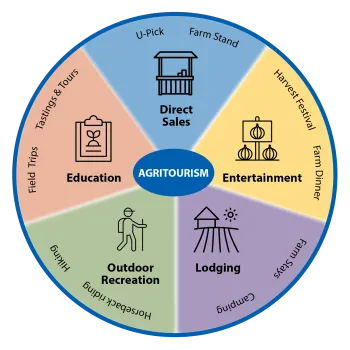
This approach centers on your operation providing an experience or a service on site. We are talking agritourism! Agrotourism is often grouped into five categories: direct sales, entertainment, education, outdoor recreation, and lodging.
This form of diversification has grown in popularity, but can come with complications like having liability insurance, providing ADA accessible accommodations, and local rules and regulations. More information on agrotourism can be found at www.sarep.ucdavis.edu
Market or Product-based diversification
This type of diversification focuses on creating new products or entering new markets using existing farm outputs. For example, a vineyard might use byproducts of wine production—such as grape seeds or pomace—to produce grapeseed oil, distilled spirits (where legally permitted), or vinegar. Other farms might develop value-added goods like jams or dried products.
This strategy leverages existing infrastructure and production systems but often requires market research, branding, and sometimes new certifications or processing facilities. These products are frequently targeted at niche or specialty markets, where differentiation can command higher prices.
Diversification as a Path to Long-Term Stability
Farming and ranching are inherently risky; a late frost could destroy your apple crop, or avian flu could wipe out your poultry flock. Diversification helps spread that risk and provides a safety net in the face of uncertainty. However, there isn’t a silver bullet that will work for everyone and diversifying beyond a manageable scale can spread an operation to thin. Successful diversification strategies must be carefully tailored to the unique conditions, resources, and goals of each individual operation. Discussing diversification options with your local UCCE farm advisor or agricultural commissioner can provide insight into options that may work for you.