
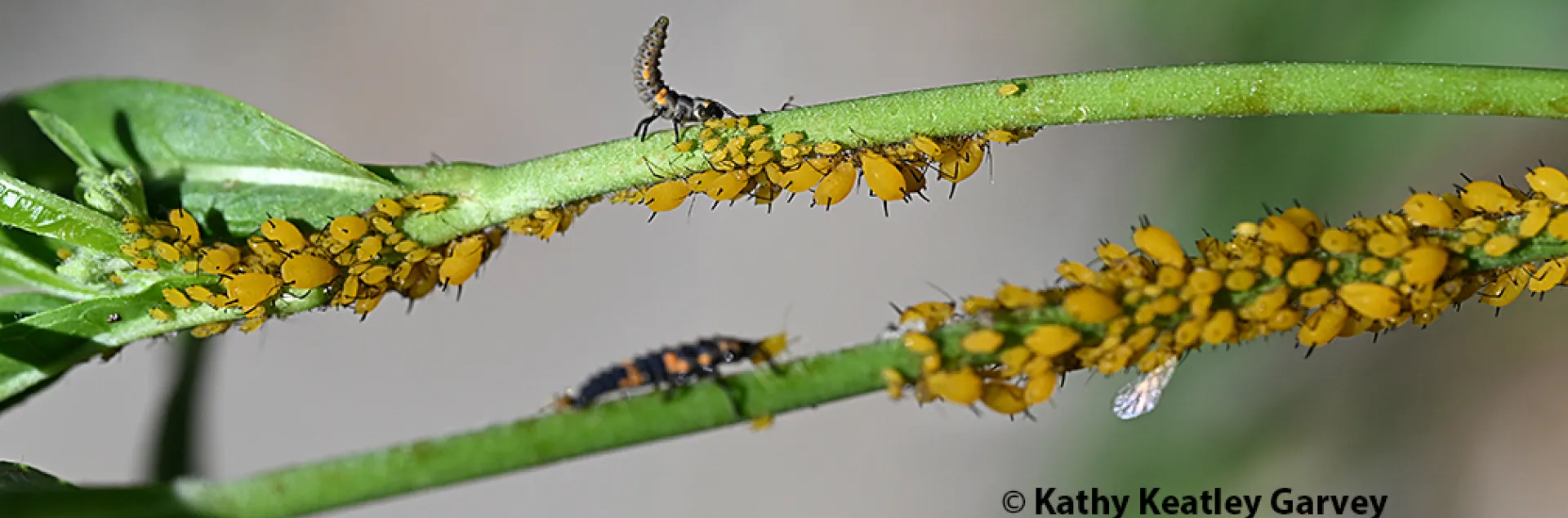
For decades, we've watched oleander aphids infest our milkweed.
Like many folks, we grow milkweed for the monarchs, but aphids insist on having their share, too.
Guess who's coming to dinner? Aphids.
Guess who's NOT invited? Aphids.
Guess who's coming anyway? Aphids.
Fast forward to the newly published research in the lab of community ecologist Louie Yang, professor, UC Davis Department of Entomology and Nematology.
Those aphids infesting your milkweed plants offer a surprising benefit.
The newly published UC Davis research suggests that the honeydew produced by aphids on milkweed plants increases plant growth.
“We found that the addition of honeydew at accumulated levels reduced total inorganic soil nitrogen by 48.8 percent relative to controls,” Yang said. “Unexpectedly, milkweed seedlings were 90 percent taller and had 4.2 times greater dry biomass in honeydew-conditioned soil than in the control group.”
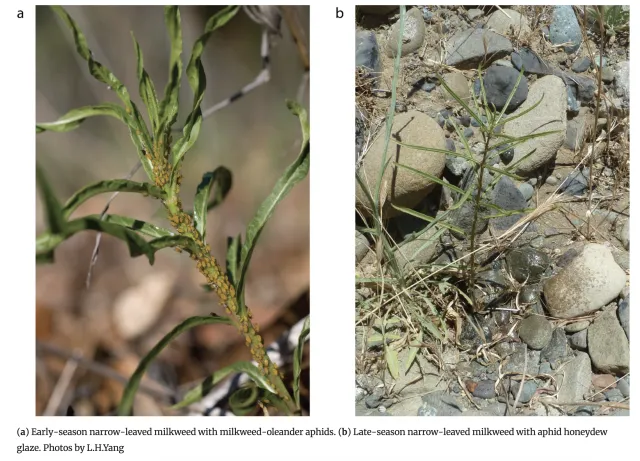
The Louie Yang lab set out to answer whether “seasonal pulses of accumulated aphid (Aphis nerii) honeydew reduce the availability of soil nitrogen below milkweed (Asclepias fascicularis) host plants, and how honeydew-conditioned soil affects the relative seedling growth of host plants and other, potentially competing plant species.”

The team, which included three UC Davis student researchers-- Lizbeth Gonzalez, Sarah Solis and Prabhjot Singh--hypothesized that: “(1) honeydew would reduce plant-available nitrogen in the soil, reflecting the expectation for increased microbial immobilization in response to high carbon inputs, and (2) reduced nitrogen availability would have a greater negative effect on the growth of cheatgrass (Bromus tectorum) and yellow star-thistle (Centaurea solstitialis) than milkweed, reflecting the expectation of greater nitrogen limitation in disturbance-adapted, non-native, annual plant species compared with native, perennial plants.”
The scientists, however, did not observe any effects on the growth of cheatgrass and yellow star-thistle seedlings. “These results suggest the possibility of a positive plant-herbivore-soil feedback for milkweeds, mediated by aphid honeydew,” they wrote.
The research, “Aphid Honeydew Reduces Soil Nitrogen and Increases Host Plant Growth,” is published online in the journal Oecologia, an international journal dedicated to publishing innovative ecological research of broad interest.
“This study contributes to our understanding of plant-herbivore-soil interactions,” Yang said. “Previously, aphids in this system were known for their direct effects on host plant traits and aboveground, plant-mediated indirect effects on other members of the milkweed-associated arthropod community. However, our results indicate that aphids may also affect their host plants and the surrounding community through a belowground, honeydew-mediated pathway. More broadly, this work underscores the potentially important role of herbivore-soil interactions on community and ecosystem processes.”

The authors noted that “Few studies have examined honeydew as a potential mechanism of plant-soil (or plant-herbivore-soil) feedbacks. In the context of multispecies plant-soil feedbacks, a focal plant could potentially benefit from reducing nutrient availability in the soil if competing plants experience stronger negative effects than the focal plant.”
In their abstract, the team pointed out that “Plants are known to affect their soils in ways that can have positive or negative effects on themselves and other plants,” a process known as plant–soil feedback. “However, less is known about the potential for herbivores to change the soil in ways that affect plant growth.”
The research began with the researchers germinating narrow-leafed milkweed seeds under controlled conditions in a UC Davis Orchard Park Research Facility.
The work was partially supported by a National Science Foundation Ecological and Evolutionary Response to Rapid Environmental Change (EERREC) Research Experiences for Undergraduates (REU) traineeship, awarded to Gonzalez, and a National Science Foundation award to Yang.
Cover image: Lady beetle larvae eating aphids in a pollinator garden. (Photo by Kathy Keatley Garvey)