
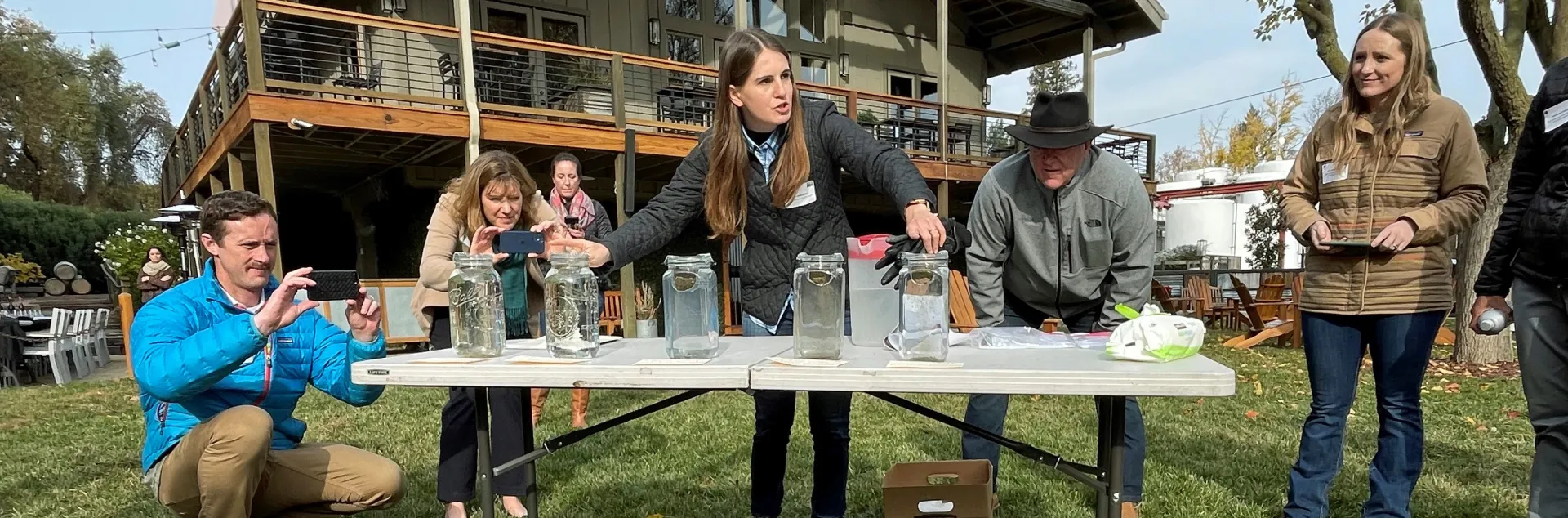

Hope Zabronsky's path to climate-smart agriculture began early, inspired by her mother's career in environmental policy. Hope studied environmental science at the University of Vermont, working on sustainable food systems and water quality, before her job in California doing youth sustainability education planted the seed to a deeper calling: to lead teams doing meaningful work.
That calling sharpened during her master's research at UC Davis, when she collaborated with partners in Malawi to study its agricultural extension system. She saw how vulnerable smallholder farmers are to climate change, and how resourcefully they adapt. "That experience taught me how much we can learn from other cultures and other parts of the world," she says.
Before working at UC ANR’s California Institute for Water Resources as associate director for climate smart agriculture, Hope directed programs for a food systems nonprofit in San Diego. A move back to Northern California brought her to UC ANR. She found value being a mentor and someone who supports a team of people. “Extension is so unique.” While she always wanted to work in a university, she longed for a role that balanced applied research with extension, mentorship, and community engagement. At UC ANR she found “a perfect intersection” of place-based education, research, and community.
In April 2025, that early Malawi research came full circle: Hope presented her climate-smart agriculture findings alongside collaborators at a conference in Scotland and won Best Oral Presentation from the International Association for Agricultural and Extension Education (AIAEE).
Closer to home, she has navigated a difficult funding landscape to keep her 10-person team's work secure. Supporting a team of 10 through an unpredictable funding landscape takes real determination, and her success in doing so speaks to her commitment to the work. A mission driven by the urgency of the climate crisis – droughts, floods, wildfires, water shortages – and by a desire to advance climate adaptation and mitigation through food systems.
“We need to adapt, to think outside the box,” she says, with a simple goal: leaving the next generation a world with clean air, clean water and a livable climate.
What brings her the most joy is watching her team succeed – building farmer networks and growing into their own expertise, “like a proud pseudo mom.” She also treasures the moments she gets to collaborate directly with farmers, including Hmong and Lu Mien growers, watching a project come full circle.
Outside the office, Hope is a rock climber – a pursuit that mirrors her professional philosophy. Climbing demands strategy, willpower and the mental fortitude to push past self-imposed limits.
As her team begins a new four-year California Department of Food and Agriculture contract, Hope's vision is clear: helping each person build deep expertise to support California farmers and ranchers in adopting climate-smart practices for the long term. “The relationships we build with communities are at the heart of why our team is so successful.”
This story was originally published in the Climate Smart Agriculture blog.