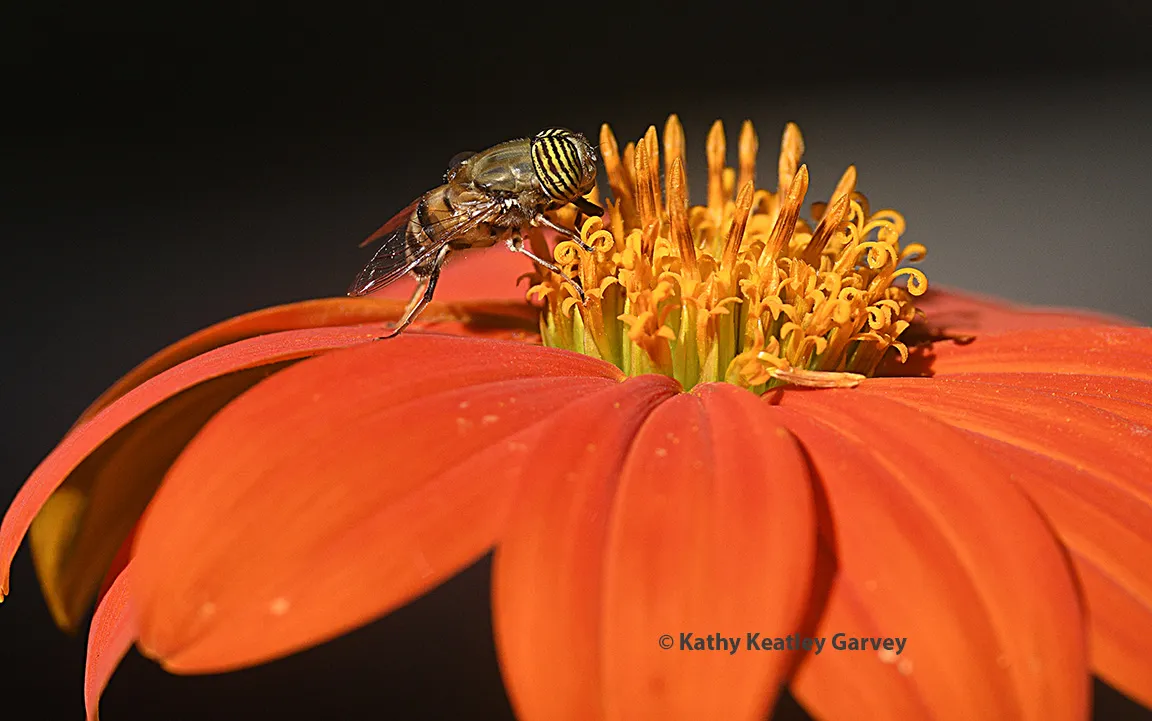
Who am I?
In her children's book--"Am I Even a Bee?"--UC Davis bee researcher Felicity Muth, associate professor in the Department of Neurobiology, Physiology and Behavior, College of Biological Sciences, writes about an Osmia bee, aka orchard mason bee, that wonders if she is a bee.
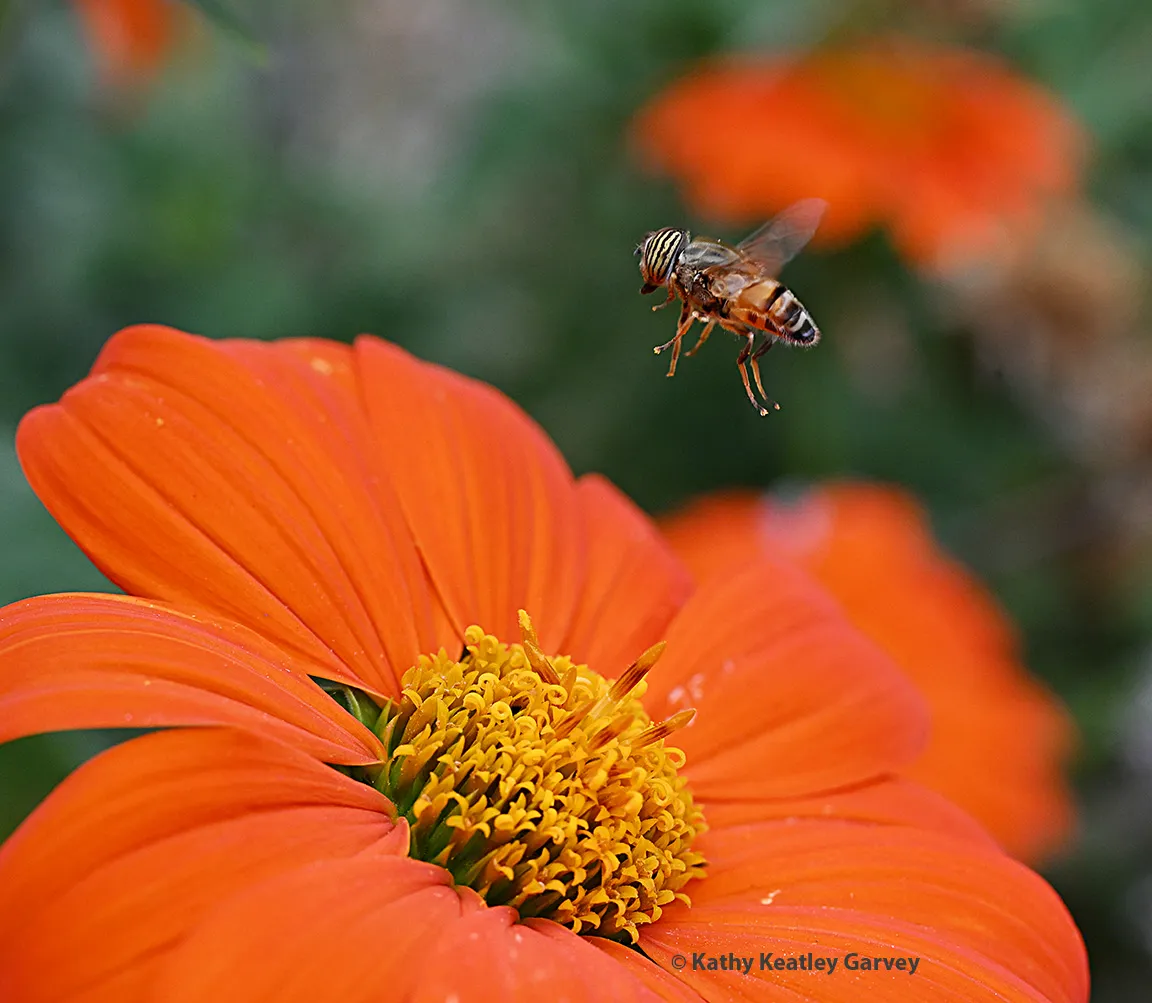
Well, a visitor to our pollinator garden today looked like a honey bee, acted like a honey bee, and mimicked a honey bee, but...drum roll...is not a honey bee.
It never will be a honey bee, even an honorary bee. Sorry, buddy!
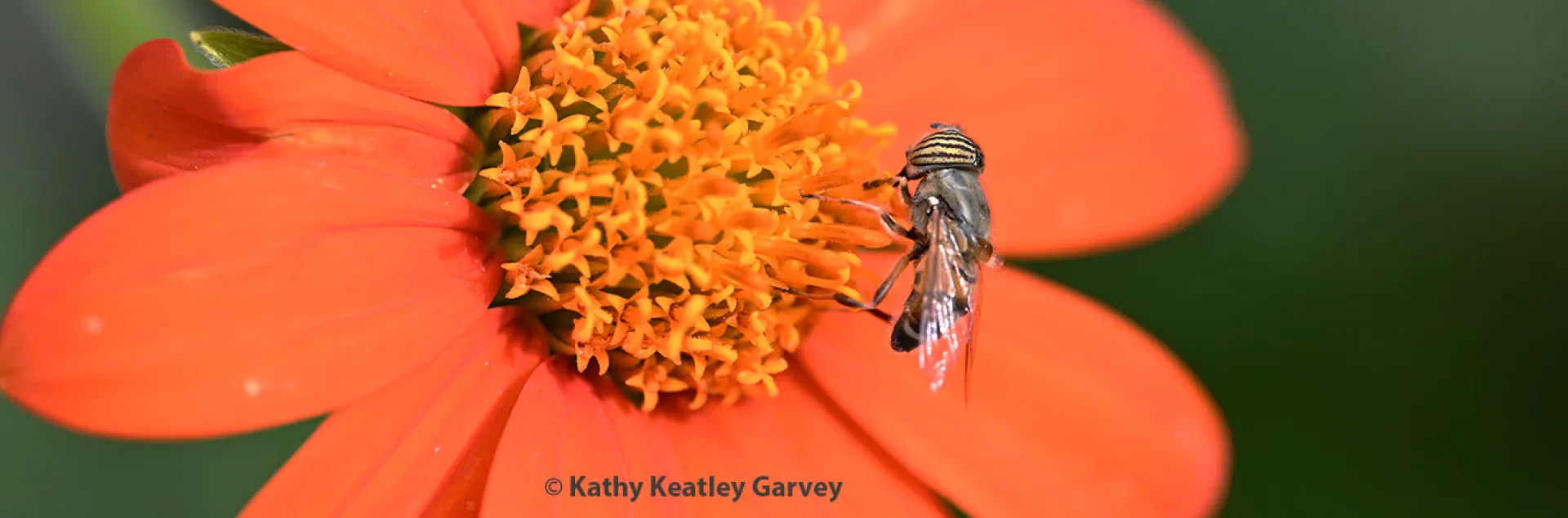
It’s actually a drone fly, Eristalinus taenliops, a species of hoverfly. It’s also known as "the striped-eye lagoon fly," "striped-eyed flower fly," and "band-eyed drone fly." In its adult stage, it's a pollinator. In its larval stage, it's a rat-tailed maggot.
It's apparently a native of Africa and inhabits parts of Europe (including France, Greece, Italy and Spain), the near East (including Turkey, Lebanon and Israel), and now South America (including Brazil and Argentina). It was first detected in California (Orange County) in 2006.
Some folks describe it as "an ugly duckling in the entomological world of flower flies."
No, it's adorable. Those zebra-striped eyes are utterly mesmerizing.
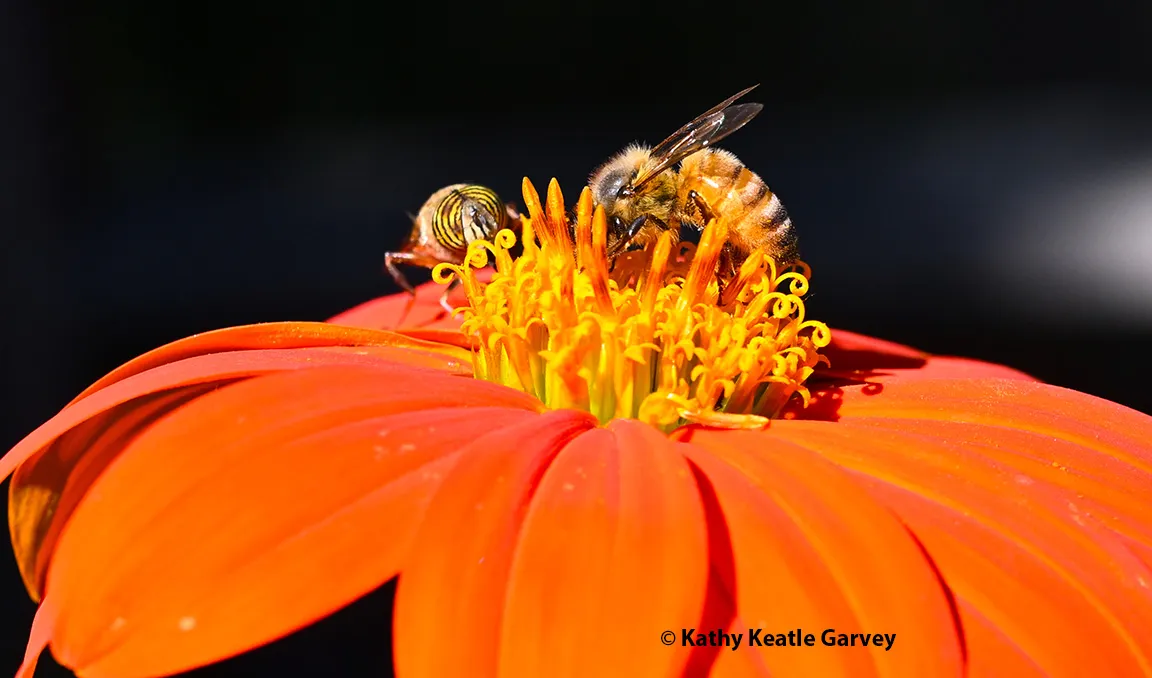
Then we saw a honey bee touch down on the same Mexican sunflower, Tithonia rotundifola. Sharing and staring.
"Are you my sister? Are you even a bee?"