
Drone spraying is becoming more common in the Salinas Valley and across the United States, bringing greater interest in how to use this technology safely and effectively. To help growers, spray pilots, and pest control advisers, the Unmanned Aerial Pesticide Application System Task Force (UAPASTF) released best management practice guidelines covering application planning, equipment setup, weather conditions, and pesticide handling. The task force also provides research and resources on spray drift, worker exposure, and pesticide residues on crops. This article introduces the task force and highlights practical recommendations from its guidelines.
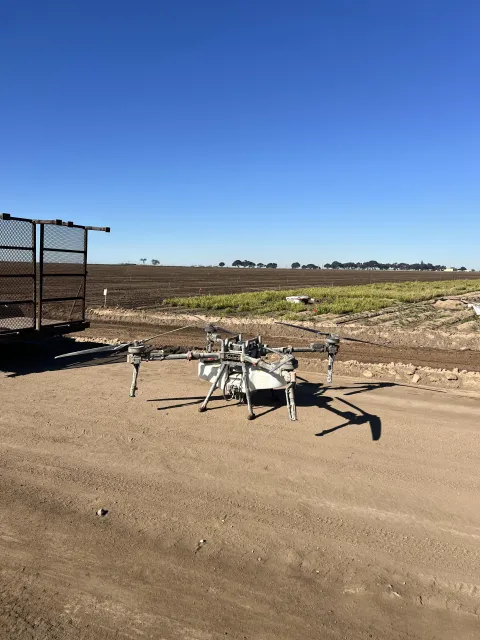
A successful drone spray starts before takeoff. The product, weather, equipment settings, and field conditions all affect how much spray reaches the target. Drawing on the UAPASTF best management practices, the guidance below is designed to help stakeholders plan the job that can improve coverage while minimizing spray drift and pesticide exposure.
Start with the label and a shared plan
Confirm that the pest needs treatment and that the product and application method are allowed for the crop and location. Check the pesticide rate, minimum spray volume, droplet requirements, protective equipment, and required distances from sensitive areas. Confirm the pilot and operation have the required pesticide and aviation permissions. Best practices supplement the label and local requirements. In the United States, pesticide label directions are legally enforceable. Read EPA guidance on pesticide labels.
Check the weather throughout the job
Calm air does not always mean good spraying conditions. The task force recommends avoiding applications below 3 mph or above 10 mph, subject to label directions. Wind within that range does not guarantee safe conditions. Follow all label restrictions and aircraft limits, and stop if wind could carry spray toward people, nearby crops, or water. Measure wind speed and direction at the site, preferably at spray release height. Keep checking during the application. In hot, dry weather, droplets shrink faster and may drift. Any change to droplet size or water volume must fit the label and be checked through calibration. Increasing water volume does not mean increasing the pesticide rate per acre.
Watch for temperature inversions
An inversion occurs when cooler air near the ground sits beneath warmer air. This limits air mixing, so fine spray droplets can remain suspended and move away from the field. Inversions often develop toward evening and can persist after sunrise. Watch for dust or smoke hanging low and moving sideways, ground fog, and very light or shifting winds. These are warning signs, not a complete test. Do not spray during an inversion. If conditions are uncertain, wait and reassess.
Check how evenly the drone sprays
The advertised spray width may be wider than the width that gives even coverage. Check the effective swath width: the spacing between flight passes that gives an even application when their spray patterns overlap. Calibrate with clean water and use water-sensitive cards across a test pass to see where droplets land. Check both spray output and coverage at the planned speed and height. Card patterns help reveal gaps and uneven coverage; a calibration specialist can help determine suitable pass spacing. Recheck when the equipment or application setup changes.
Plan flight passes around the field
Map power lines, trees, field boundaries, waterways, nearby crops, and areas where people may be present. Set the route using wind direction, required buffer distances, and the measured spray width. Where the field allows, long, straight passes reduce turns and battery use. Check spray shutoff at turns and boundaries to avoid treating the same area twice. Keep people outside the application area and brief the crew on communication and emergency procedures. Stop spraying if people enter the area, the weather changes, or equipment develops a problem.
Protect the crew when handling equipment
Pesticide residue can remain on batteries, landing gear, and other surfaces that look clean. Wear the label-required protective equipment, including appropriate chemical-resistant gloves when handling contaminated parts. Keep contaminated gloves away from phones and controller screens. Wait until the rotors have stopped and follow the manufacturer’s shutdown procedure before approaching. The task force recommends changing batteries before refilling the spray tank to reduce the chance of splashing liquid onto power connections.
Mix carefully and clean after use
Check whether the drone tank provides the agitation the product needs. An external mixing tank, often called a nurse tank, can help keep mixtures evenly mixed before loading. It does not replace any agitation needed inside the drone tank. Follow the label’s mixing order and agitation instructions, and check compatibility before combining products. After spraying, clean the tank, lines, nozzles, and exterior according to the pesticide label and equipment instructions. The task force describes several small rinses as more effective than one full-tank rinse. Follow product-specific cleaning directions and dispose of rinse water as the label and local rules allow. Avoid power wash the drone exterior; water can damage electronics.
Who is behind the task force
The Unmanned Aerial Pesticide Application System Task Force (UAPASTF) is an industry group formed in 2021. It is based in the United States and supports research worldwide. Its nine member companies are BASF, Bayer, Corteva Agriscience, FMC, Gharda Chemicals International, Gowan, Nufarm, Syngenta, and Valent U.S.A.
Its work focuses on spray moving outside the treatment area, exposure of people who handle and apply pesticides, residues on crops, and best practices. It provides data to help government agencies assess risks and make regulatory decisions. The task force does not issue pesticide or pilot approvals.
Academic and government experts, application specialists, and drone manufacturers contributed input to the guidance. That input does not mean those organizations endorse it; the document is approved by the task force itself. Learn more about the members and their work.