
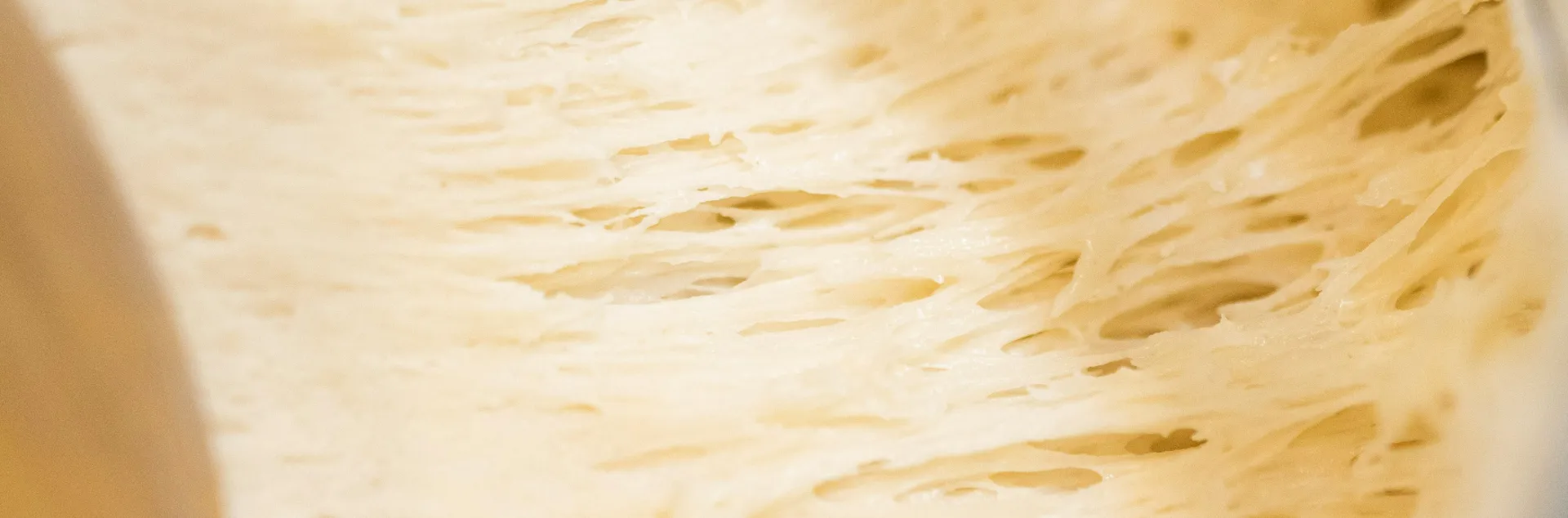
There’s nothing like the satisfaction that comes from making your own sourdough bread start to finish; and that means creating your own starter from scratch. With our simple directions your success is pretty much guaranteed. The ingredients couldn’t be any simpler: just flour and water. We strongly recommend using a scale to measure the ingredients for better results.
Yield: Enough to maintain in a quart jar
Prep: ~ 7 days for starter to be ready
Processing: Not required
INGREDIENTS (SEE TIPS BELOW):
• All-purpose (AP), or
• Whole wheat, or
• Pumpernickel flour
• Water
DIRECTIONS:
Prep:
• Day 1: Combine 113g (a generous 1 cup) AP flour, or pumpernickel flour, or 113g whole
wheat flour with 113g room temperature water in a non-reactive container (a 1-quart jar
works well). Stir everything together thoroughly; make sure there is no dry flour anywhere.
Cover the container loosely and let the mixture sit at warm room temperature (70°F) for 24
hours.
• Day 2: You may see no activity at all in the first 24 hours, or you may see a bit of growth or
bubbling. Either way, discard half of the starter (113g, about ½ cup); you’ll be left with about
113g (½ cup starter). Add to this 113g (a scant cup) AP flour and 113g (½ cup) cool water (if
your house if warm) or lukewarm water (if it’s cold). Mix well, cover, and let the mixture rest
at room temperature for 24 hours.
• Day 3: By the third day you’ll likely see some activity – bubbling; a fresh, fruity aroma, and
some evidence of expansion. It’s now time to begin 2 feedings daily, as evenly spaced as
your schedule allows. For each feeding, weigh 113g starter (a generous ½ cup once it’s
thoroughly stirred down). Discard any remaining starter. Add 113g AP flour and 113g water
to the 113g starter. Mix the starter, flour and water, cover, and let the mixture rest at room
temperature for approximately 12 hours before repeating.
• Day 4 and 5: On Day 4, weight out 113g starter, and discard any remaining starter. Repeat
feeding routine from Day 3. On Day 5, weigh out 113g starter, and discard any remaining
starter. Once again, adding 113g AP flour and 113g water to the 113g starter. Mix, cover,
and let rest for 12 hours. By the end of Day 5, the starter should have at least doubled in
volume. You’ll see lots of bubbles; there may be some little “rivulets” on the surface, full of
finer bubbles. Also the starter should have a tangy aroma – pleasingly acidic, but not
overpowering.
• Day 6 and 7: If your starter hasn’t risen much and isn’t showing lots of bubbles, repeat
discarding and feeding every 12 hours on Day 6 and 7, if necessary – as long as it takes to
create a vigorous (risen, bubbly) starter. Conditions vary so widely that 7 days can actually
be too little. The key is to watch for a dramatic and consistent rise in the container – at least
doubling between 6 and 8 hours after feeding. This could be 7 days or less after you begin,
or it could be up to a couple of weeks. Watch for this benchmark, rather than watching the
calendar. Once the starter is ready, give it one last feeding: the standard 113g starter +
113g water + 113g AP flour.
Cook:
• If you plan to continue following the guide to bake Naturally Leavened Sourdough Bread,
you’ll need to bulk up your starter.
• Discard all but 189g , then feed it 189g of water and 189g of AP flour. However much you’ve
fed it, let the starter rest at room temperature for 6 to 8 hours; it should be active, with
bubbles breaking the surface.
• Remove the amount of starter you need for your recipe. For the jar or whatever you’d like to
store it in long-term; the container does not need to be airtight. Feed this reserved starter
with 113g flour and 113g water and let it rest at room temperature for several hours, to get
going, before refrigerating it.
• Store this starter in the refrigerator, and feed it regularly; we recommend reserving 113g of
starter and feeding it with 113g flour and 113g water once a week. Discard remaining starter
or use it as suggested below.
Other/Tips:
• For greatest accuracy and best results, we suggest you use a scale to weigh your
ingredients – preferably one that measures in grams.
• We like to start with whole grain flour (whole wheat or pumpernickel). The wild yeast that
gives sourdough starter its life is more likely to found in the flora- and fauna-rich environment
of a whole grain flour than in all-purpose flour.
• As for water, unless your tap water is so heavily treated that you can smell the chemicals,
there’s no need to use bottled water; tap water is fine. For best result, use room-
temperature water, 68°F to 70°F. If your house is chilly, use lukewarm water, if it’s hot, use
cool water.
• Glass, crockery, stainless steel or food-grade plastic all work fine for this. Make sure the
container is large enough to hold your starter as it grows – we recommend at least 1-quart
capacity.
• The colder the environment, the more slowly your starter will grow, If the normal
temperature in your home is below 68°F, we suggest finding a warmer spot to develop your
starter. For instance, try setting the starter atop your water heater, refrigerator, or another
Sourdough Starter appliance that may generate ambient heat. Your turned-off oven – with the light on – is also
a good choice.
• Place the jar or container on a tea towel or trivet – kitchen counters can be chilly!
• Why discard so much starter? Unless you discard starter at some point, you’ll quickly end
up with a very large container of starter. Also, keeping the volume down offers the yeast
more food to eat each time you feed it. Finally the feeding process works well when the ratio
of starter-to-flour-to water is 1:1:1 – equal parts by weight.
• You don’t have to discard starter if you don’t want to. You can give it to a friend or use it to
bake. You can use “discard” starter in pizza crust, pretzels, waffles, and even chocolate
cake. See the Sourdough Starter Discard Recipe Collection: https://www.kingarthurbaking.com/recipes/collections/sourdough-discard-recipes
Source:
https://www.kingarthurbaking.com/learn/guides/sourdough/create