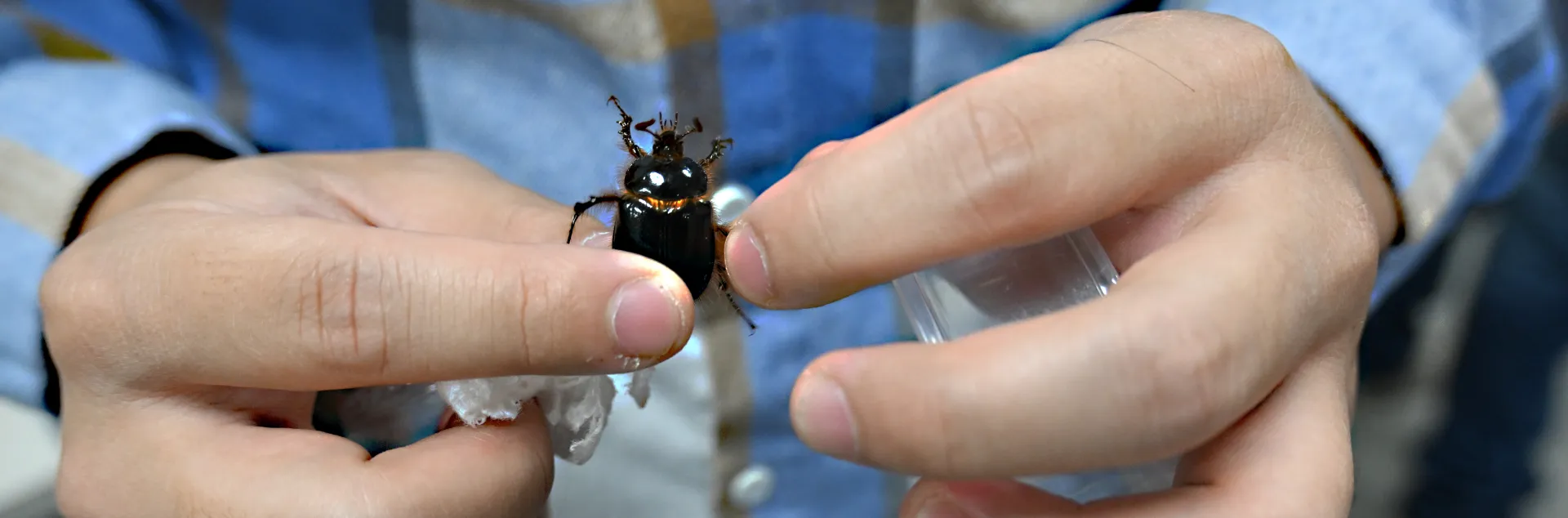

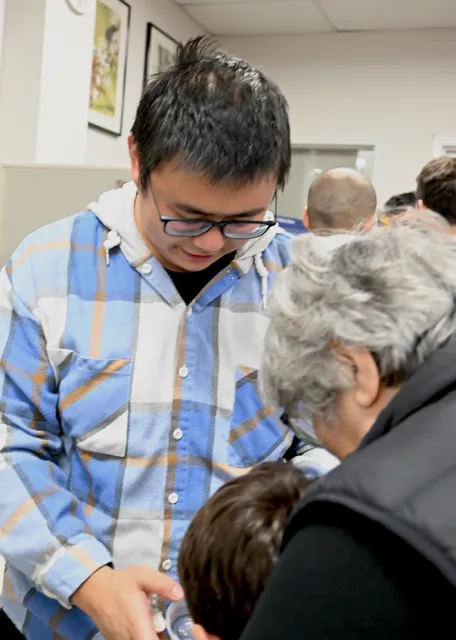
While you're sleeping soundly through these rainy nights and mornings, UC Davis doctoral student Kaitai Lai is out collecting rain beetles.
He recently traveled to Napa at 3 a.m. to search for--and find--the elusive rain beetles, genus Pleocoma, family Pleocomidae.
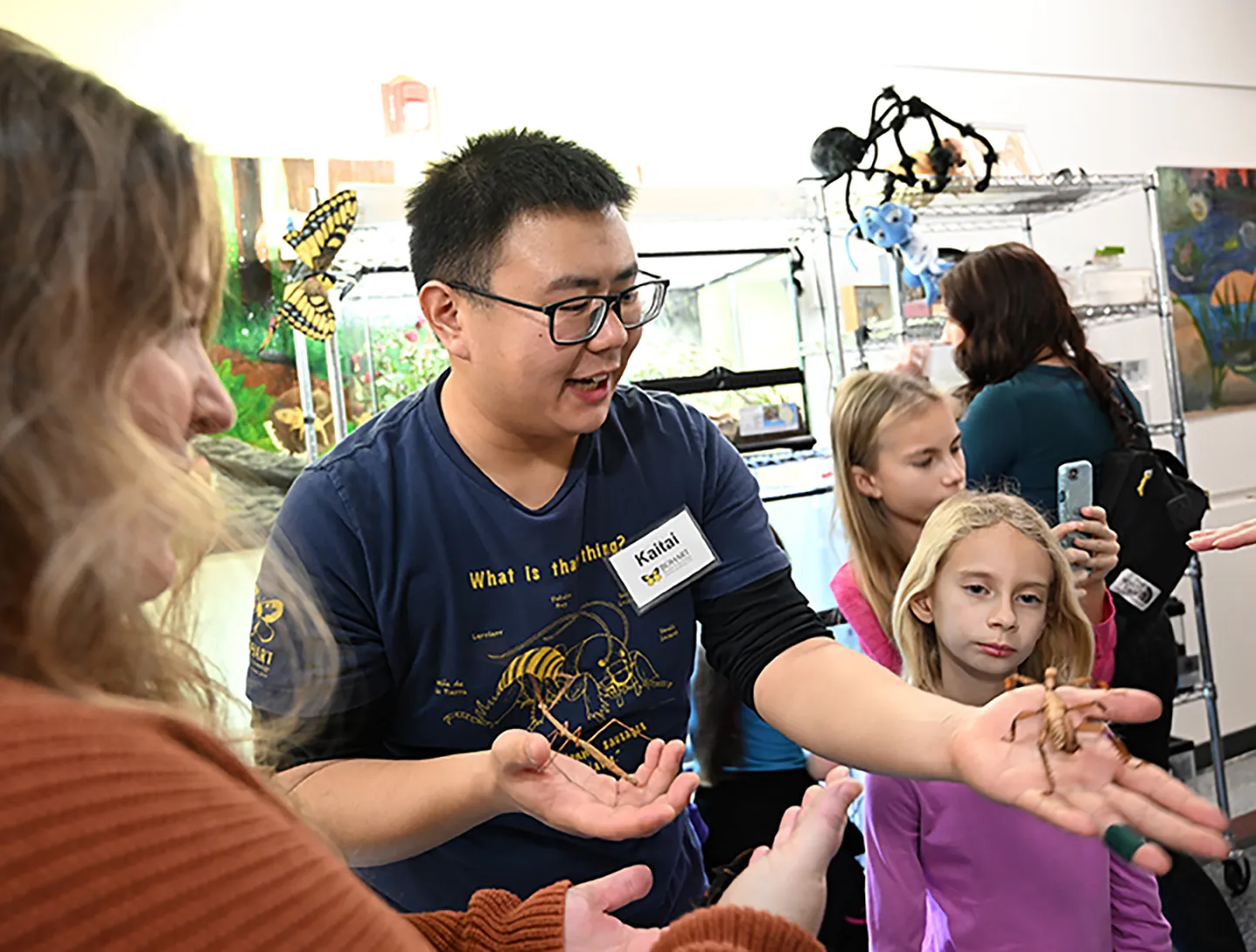
Kaitai showed one of the rain beetles to attendees at the Nov. 7th Bohart Museum of Entomology open house, which featured the research of UC Davis graduate and undergraduate students. He also shared his expertise on the insects.
Rain beetles, often described as odd-looking critters that are "large, robust and shiny," spend most of their lives in immature stages beneath the ground, and that can total a decade or more, scientists estimate. The adults surface when the ground is soaked, thus the name, "rain beetles." The adults do not feed; they have no mouthparts or digestive tracts. They rely on the fat stored from their larval stage. The females are flightless.
Kaitai studies with Professor Jason Bond, the Evert and Marion Schlinger Endowed Chair of Systematics, Department of Entomology and Nematology, and the Bohart Museum director.
Dissertation
Kaitai hasn't finalized the title of his dissertation, but it will comparable to "Using Phylogenetic Approaches to Resolve the Evolutionary Relationships and Species Diversity of Rain Beetles (Pleocomidae)."
"I've collected rain beetles in the Bay Area, Sonoma County, Lake County, Santa Cruz, and multiple places in the Sierra Nevada," he said, adding "basically all around the Central Valley. There are currently 28 described species, 21 of which can be found in California."
Kaitai, who received his bachelor's degree in entomology in 2025 from UC Davis, is an alumnus of the campuswide Research Scholars Program in Insect Biology (RSPIB), which provides "academically strong and highly motivated undergraduates with a closely mentored research experience in biology." As a RSPIB scholar in the Bond lab, he was featured in a UC Davis piece on “Student Entomologists Gain Hands-on Skills in Insect Biology.” Kaitai went on to win the coveted Dr. Stephen Garczynski Undergraduate Research Scholarship from the Pacific Branch, Entomological Society of America.
Arthur Evans and James Hogue, authors of Introduction to California Beetles (University of California Press, Berkeley) say that “on average, males of some rain beetles have only enough energy stored as fat to give them about two hours of air time and live only a few days. The more sedentary females require less energy and may live for months after fall and winter storms...California's rain beetles occur throughout the mountainous regions of the state, except in the deserts. Small, isolated populations also occur in the Sacramento Valley and the coastal plain of San Diego County."
We remember seeing our first-ever rain beetle in October of 2012. That was when UC Davis entomology graduate student Kelly Hamby, showed us several that a friend had collected in the Shenandoah Valley of Plymouth, Amador County.
"If you've never seen a rain beetle (genus Pleocoma) no worries," we wrote in an earlier Bug Squad post. "Most people haven't, either. You have to be in the right place at the right time, which amounts to being in a fall or winter rainstorm in their habitat before sunrise or just after sunset. And you have to work quickly. The males can fly only a couple of hours before they die."
UC Davis Distinguished Professor Emerita Lynn Kimsey, director of the Bohart Museum for 34 years before her retirement Feb. 2, 2024 (she continues to do research and write the Bohart Museum Society newsletter), fields many a question about rain beetles.
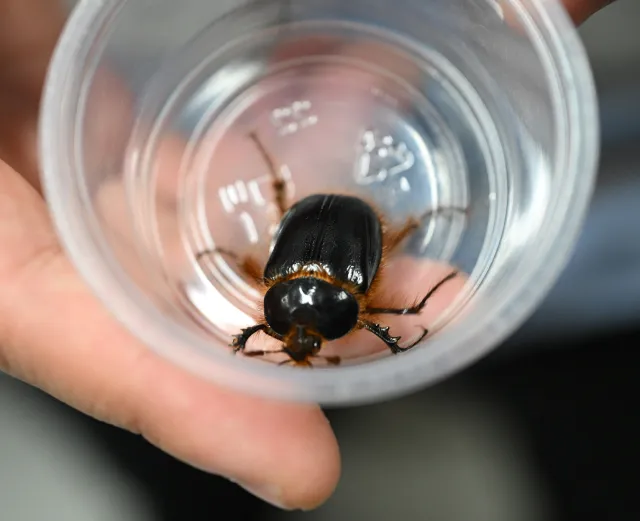
"In California, Pleocoma is found only in foothill and mountain habitats, never on the valley floor that I know of,” Kimsey earlier told us. “A lot of the populations have been extirpated by housing developments. When I was a kid living in the Berkeley Hills in El Cerrito we had lots of males flying after every rain but once the neighborhood was built up they vanished.”
The females emit a pheromone so the males can locate them.
Evans and Hogue say the males fly low to the ground searching for females. They are often attracted to lights (including porch lights) and pools of water. “Females crawl back down their burrows and may wait up to several months for their eggs to mature. The female eventually lays 40 to 50 eggs in a spiral pattern at the end of the burrow as much as 3 m (10 ft) below the surface. The eggs hatch in about two months.”
You can find more information about these fascinating insects on Wikipedia, BugGuide.net, Washington State University, and YouTube, including:
Cover image: A rain beetle held by UC Davis doctoral student Kaitai Liu.