
Three UC Davis scientists and a UC Davis doctoral alumnus will be among those speaking at the Orchard Bee Association (OBA) annual conference, set Thursday, Oct. 22 through Saturday, Oct. 24 at the University of California, Davis.
The deadline to register to attend is Tuesday, Oct. 20.
The Thursday and Friday sessions, Oct. 22-23, will take place in the Harry H. Laidlaw Jr. Honey Bee Research Facility, located at 1 Bee Biology Road. The Grower Day on Saturday, Oct. 24 will be in the Bowler Hall teaching garden. (See schedule)
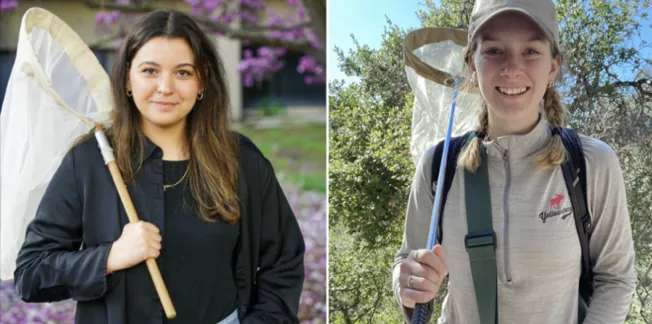
Among the speakers at the annual conference will be Professor Neal Williams, pollinator ecologist, UC Davis Department of Entomology and Nematology; doctoral candidates Abigail "Abby" Lehner and Alexia "Lexie" Martin; and UC Davis doctoral alumnus Michael Branstetter of the Pollinating Insect-Biology, Management, Systematics Research Unit (PIRU) of the USDA's Agricultural Research Service.
Branstetter will speak at 12:50 on Thursday, as part of Session 1: "Built to Thrive: Biology and Propagation Strategies for Osmia." His title is to be announced.

Friday morning is Session 2, "Osmia Resilience Across Changing Landscapes." Professor Williams will discuss "Summer Heatwaves Affect the Survival and Subsequent Reproduction of Surviving Blue Orchard Bees at 9:05 a.m.
Friday afternoon is Session 3, "Pest and Pathogen Disturbances and Distribution." At 1:15 p.m., Abigail Lehner, a member of the Williams lab, will present a talk on "Establishment Potential of the Houdini Fly across the United States." At 1:35, Lexie Martin, of the lab of community ecologist Rachel Vannette, professor and vice chair of the department, will discuss "Non-Native Horn-Face Bees (Osmia cornifrons) as Possible Disease Reservoirs for Native Blue Orchard Bees (Osmia lignaria)."
Grower Day on Oct. 24
Saturday, Oct. 24 is Grower Day, an event to take place in the Bowler Hall teaching garden.
The schedule:
9 a.m. President's Welcome
9:15 a.m.: Talk: Why support pollinators? Regenerative Ag Benefits
Talk: Alternative pollinators
Activity: Gallery walk, drawers of curated specimens from the Bohart Museum of Entomology, UC Davis
10 a.m.: Break
10:15 a.m.: Talk: What are mason bees?
Talk: Pollination benefits of mason bees
Activity: Questions and answers with panel of mason bee producers
11 a.m.: Break
11:15 a.m.: Talk on how to implement and manage mason bees in an orchard or garden
Activity: Demonstration for implementing a mason bee nest
12 p.m.: Lunch provided
1 p.m.: Talk: Types of nesting materials
Talk: Importance of cleaning nesting materials; common pests and pathogens
Activity: Demonstration of cleaning option
2 p.m.: Break
2:15 p.m.: Talk: The future of bees and agriculture
Final Questions and answers
2:45 p.m.: Closing remarks
Great Native Bee Count
Members of the California Master Beekeeper Program (CAMBP) will be among those attending Grower Day. The UC Davis Bee Haven, together with the California Master Beekeeper Program and the E. L. Niño Bee Lab, are planning "The Great Native Bee Count: Mapping California's Bee and Plant Connections." A UC Davis Crowdfund campaign is underway through Oct. 31 to raise funds for the project. The Great Native Bee Count will engage Californians as community scientists documenting which bees visit which flowers, where, and when. Donations may be made here. The goal is $3000; as of Friday at 5 p.m., the amount donated is $1700.
"Your support will help put practical tools and science-based guidance into people’s hands while contributing to a growing understanding of California’s bees, flowering plants, and forage landscapes," according to the donation site. "This knowledge can benefit pollinators, native bee stewards, beekeepers, growers, researchers, land managers, educators, and communities statewide."
California is home to more than 1600 species of native bees.
About Osmia
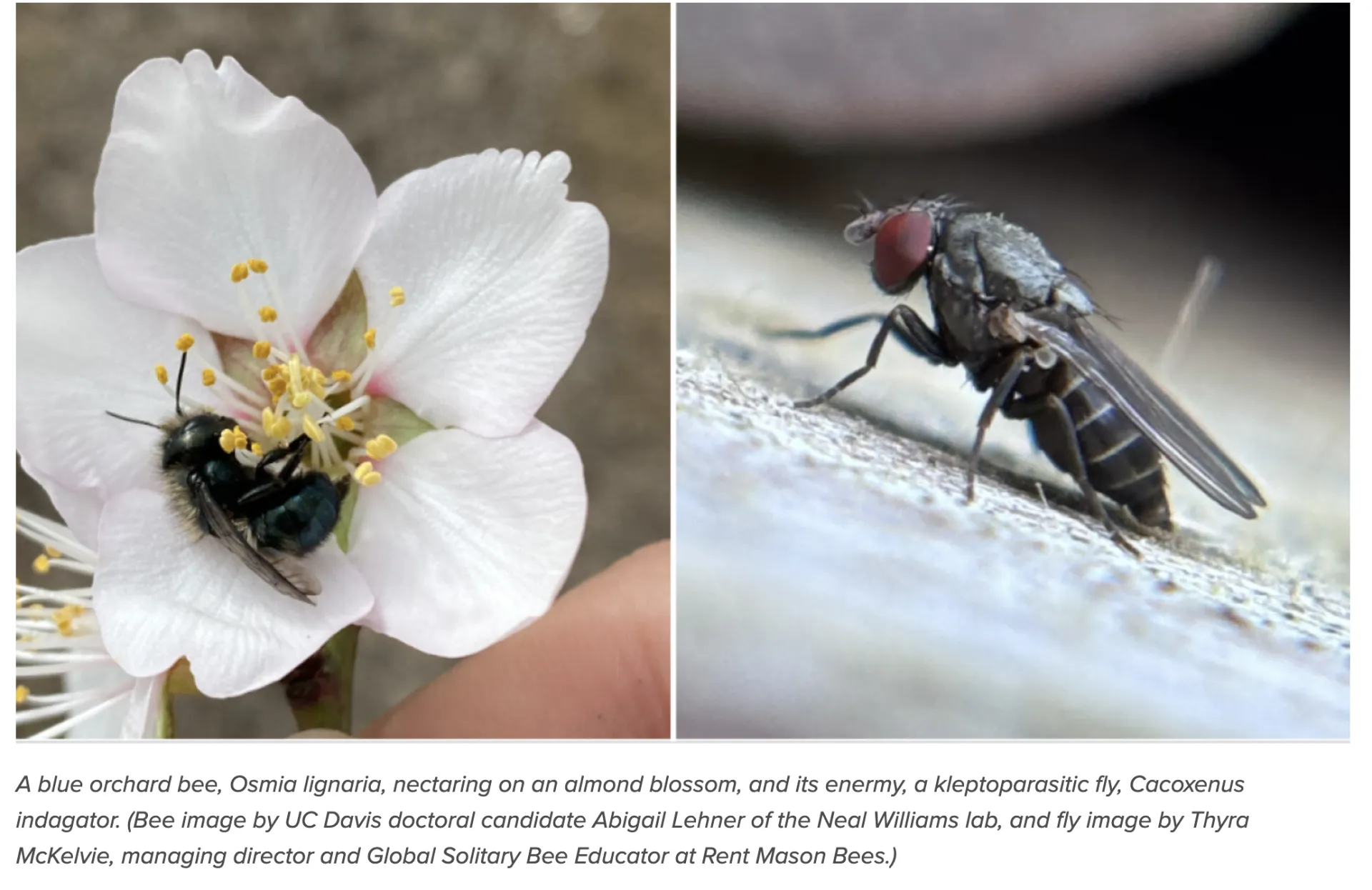
Osmia lignaria, commonly known as the orchard mason bee or blue orchard bee, is among 4000 native bee species in North America. It nests in reeds and other tubelike natural structures. The bee pollinates almonds and blueberries, and a variety of stone fruits, including apples, pears, cherries, apricots, and plums. Osmia is used commercially in agricultural operations, especially in almonds and early blooming-fruit trees, and occupies handcrafted "bee blocks." Considered efficient pollinators, they are able to forage in cooler temperatures than honey bees. Gardeners often set up "bee condos" or "bee hotels" for them in their landscapes.
About the Houdini Fly
The Houdini fly, the kleptoparasitic fly, Cacoxenus indagator, is a species of fruit fly native to central and southern Europe. The adult lays its eggs in the stored pollen of a mason bee's newly constructed nest. The fly larvae feed mainly on stored pollen, but may also eat the bee larvae. This fly is commonly known as the Houdini fly for its ability to escape through the mud wall of the cell. The small brown fly (wing length 2.5mm) has clear wings and large red eyes.
OBA was launched in 2011 by a team of independent businesses, orchard managers, and researchers "to accelerate the production and use of orchard mason bees (specifically, Osmia lignaria, O. cornifrons, O. cornuta, and O. rufa) in various spring crops and orchards."
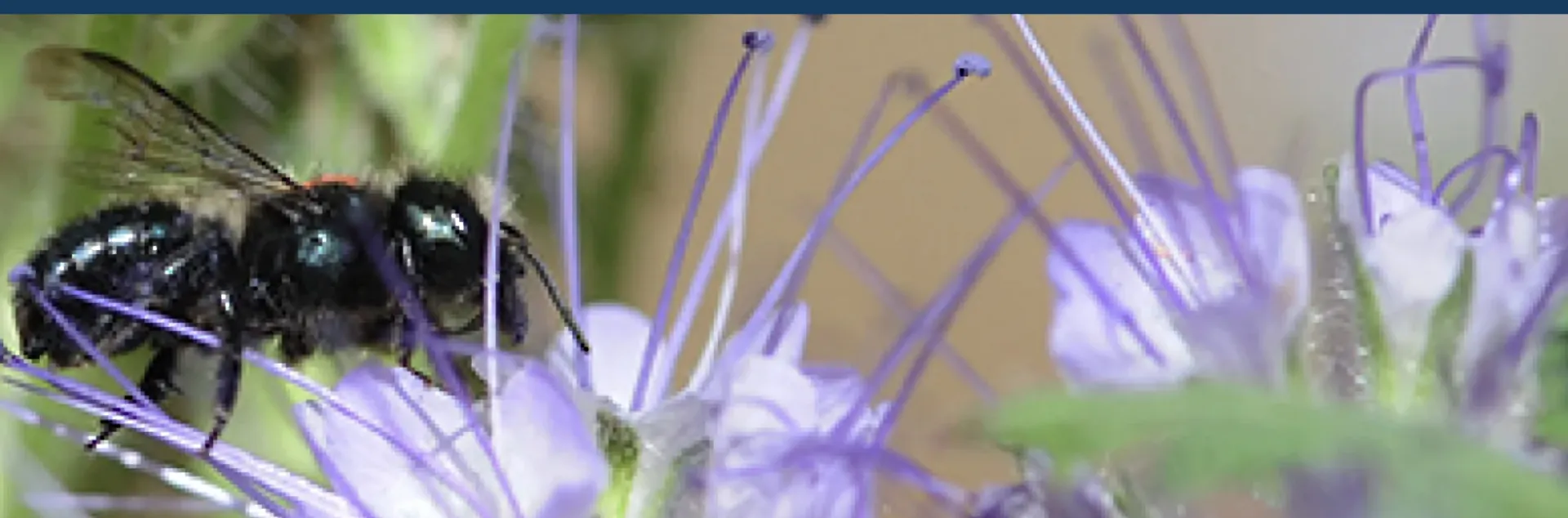
Cover image: Osmia lignaria. (Photo by Kathy Keatley Garvey)