
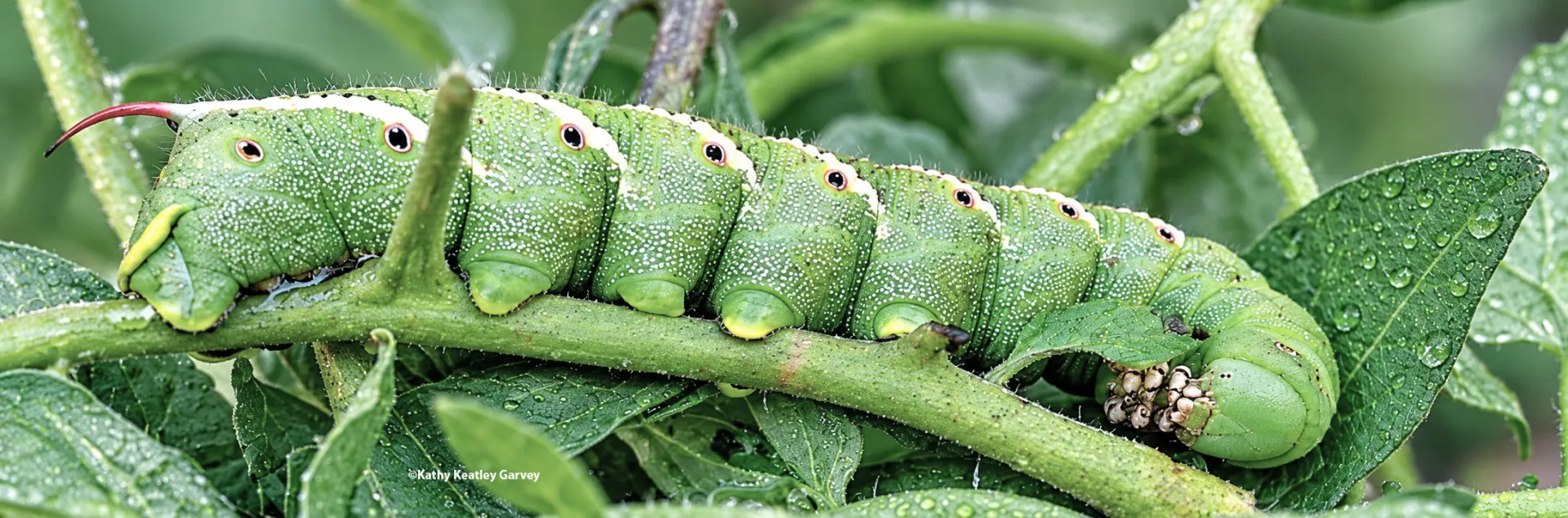

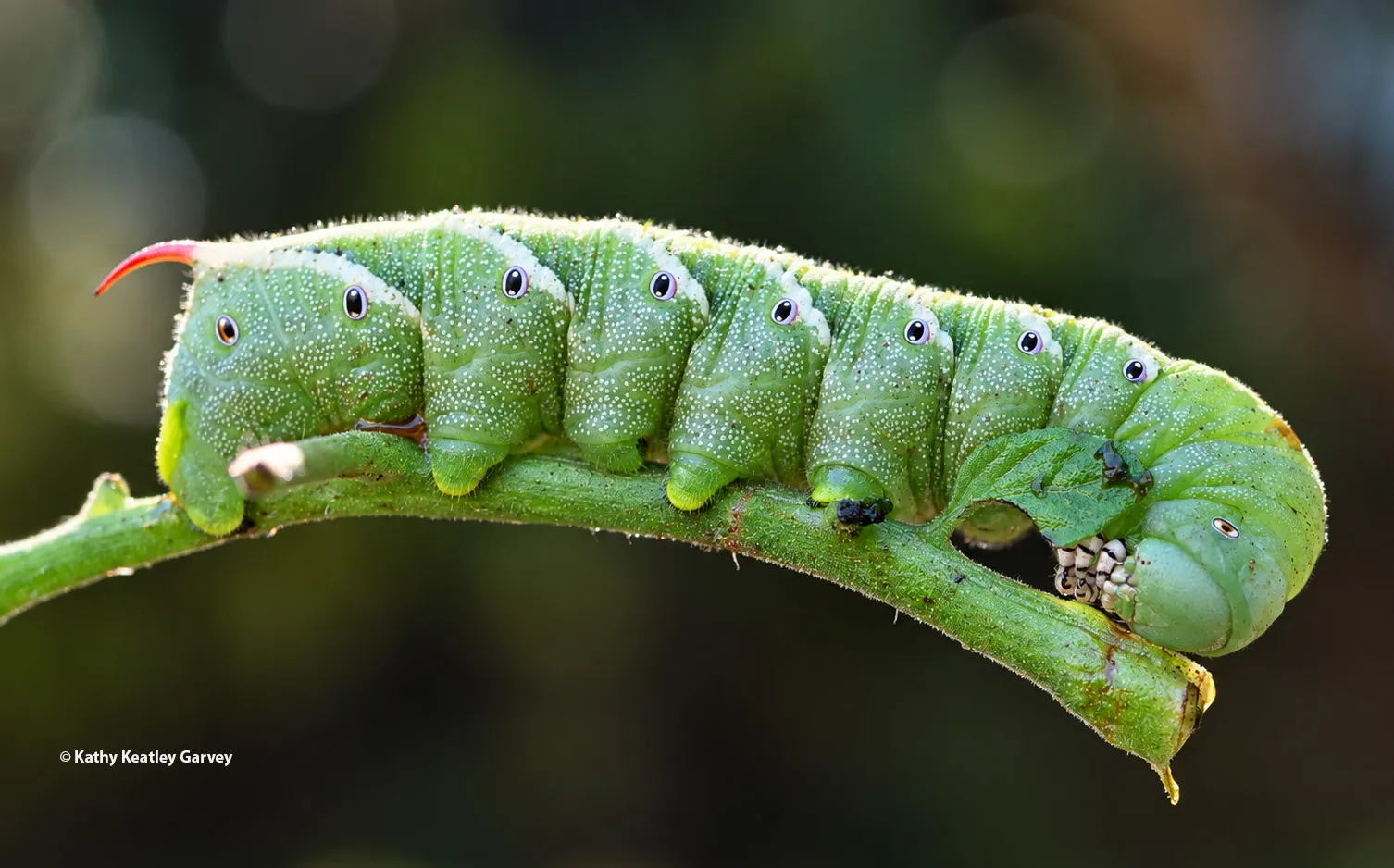
If you're a tomato or tobacco hornworm, you go through your larval stage with a horn on your posterior.
You don't get to toot your horn. You use it to deter predators.
You'll find a horn on both the tobacco hornworm (Manduca sexta) and tomato hornworm (Manduca quinquemaculata), family Sphingidae. The two are easily distinguishable. The horn on the tobacco hornworm is bright red, while the horn on the tomato hornworm is blue, black or dark green. In addition, M. sexta has seven diagonal stripes on each side, while M. quinquemaculata sports eight V-shaped white markings.
The caterpillars (larvae) feed on tomato or tobacco plants (family Solanaceae) for about three or four weeks, rapidly grow to about 100 millimeters in length, and then burrow into the soil to pupate.
We "borrowed" a tobacco hornworm from a neighbor who was about to send it off on its not-so-merry way. It's for a TV producer who seeks to video a hornworm eating a tomato plant. So, it's a temporary tenant in our home, with an appetite comparable to that of Joey "Jaws" Chestnut.
More tomato leaves! I want more tomato leaves!
We named it "Joey."
Unfortunately, "Joey" is on a mission to become a Carolina sphinx moth or tobacco hawkmoth, as quickly he can. He's no longer eating like "Jaws." He's not eating.
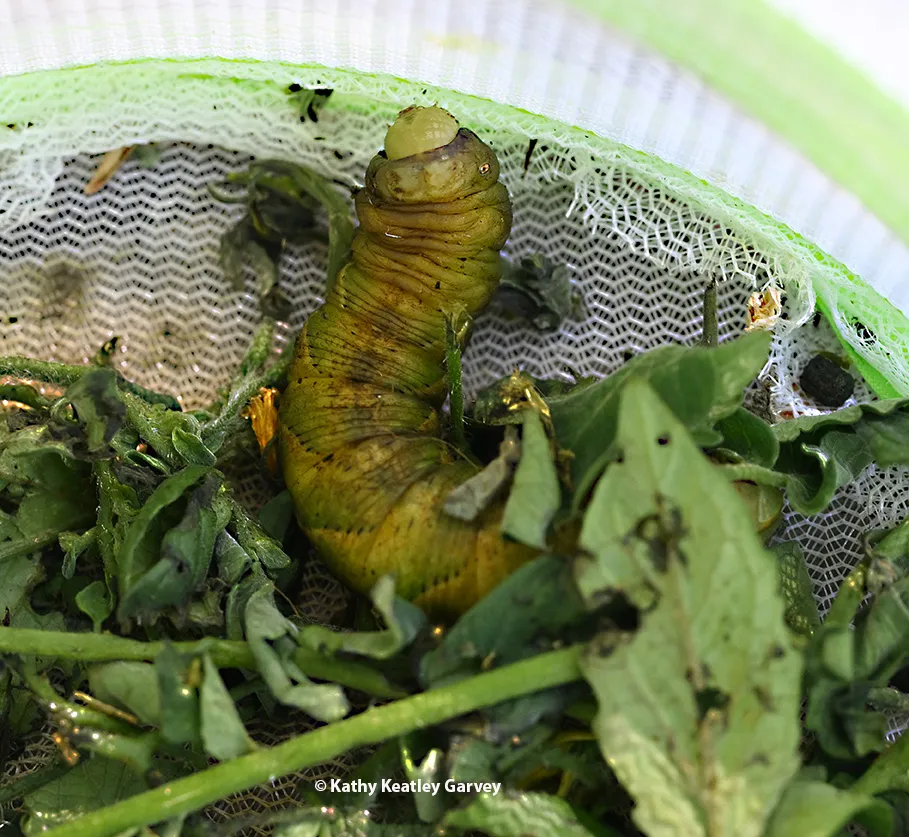
Joey is in the pre-pupa stage, shrinking, turning brown, and preparing to pupate. The pupal stage lasts about one to two weeks in warm weather, or hornworms can enter a prolonged dormancy (diapause) over winter
"The adult moth is a strong flier with a wingspan up to 5 inches (12 cm)," according to the UC Statewide Integrated Pest Management (UC IPM) website. "Development takes about 2 months in summer; the winter is passed in the pupal stage. There are two generations a year in most areas; larvae are usually most common in midsummer."
"Hornworms feed on blossoms, leaves, and fruit," UC IPM says. "At high populations they can extensively defoliate plants and scar the fruit. They are rarely a problem in the warmer interior valleys unless natural enemies are disrupted, in which case, they can do serious damage. They are mostly problems in garden situations."
Hornworms are not short of enemies. The eggs? Lady beetles (aka ladybugs) and green lacewings devour them. The larvae? Paper wasps grab them to feed their young. Braconid wasps parasitize them. Birds and poultry gorge on them. And reptile owners rear them for food. (You can buy hornworms in pet stores.)
Meanwhile, Joey has turned from a bright green to mottled brown. I don't think the neighbor wants it back. A no-return policy of sorts...
Cover image: A tobacco hornworm chomping away. (Photo by Kathy Keatley Garvey)