
Part I
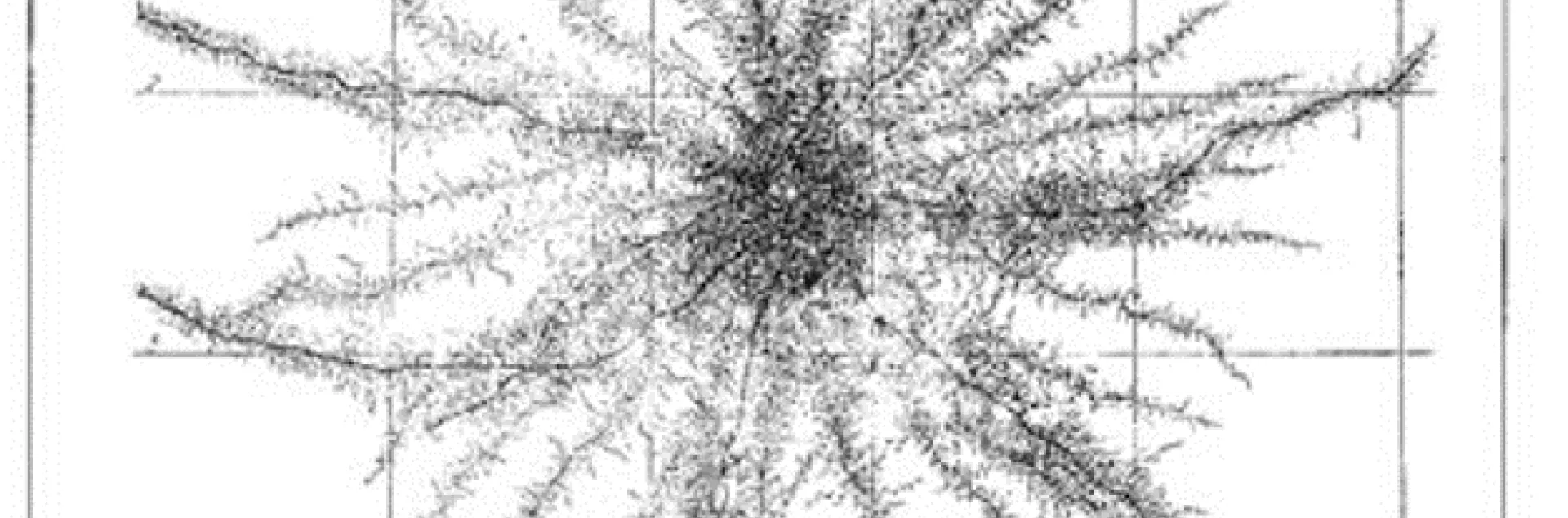
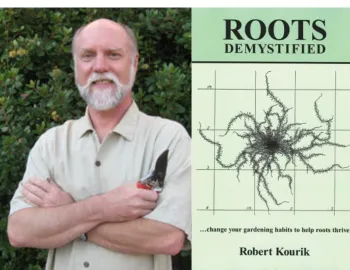
Robert Kourik entertains the reader with one hundred forty pages divided into sixteen chapters dedicated to generic issues and then to plant groups (e.g., shrubs, vegetables, fruit, trees, and lawn), plus six supplemental appendices focused on helpful advice, a forty-resource-rich reference bibliography, index, etc. The author, a professional gardener and journalist, has done a nice job of breaking down scientific technical horticulture jargon. The text, quite readable for the layperson, offers practical information seasoned with insight and humor. He enriches the text with a plethora of supplemental visuals, such as charts, graphs, schematics, sketches, and illustrations. Although not a long book, the plethora of information requires a two-part review to do the book justice.
In Mr. Kourik’s introduction to Roots Demystified, he informs the reader that about one-third of the globe is land and that eighty percent of the land’s biomass is vegetation. Roots are often half a plant organism’s physical mass and can sometimes represent more than five times the foliage. Ninety percent of roots are within the top eighteen inches of soil. Roots are not visible, considered aesthetically unattractive, and often misunderstood. Soil feeds roots, and in turn, roots deliver moisture and nutrition to the world’s largest life form, plants. By sustaining plant life, roots underwrite/support our planet’s human life. As an aside, the term “root” comes from the Germanic Saxon “rut” meaning “origin”. Over time, this morphed into our Olde English word.
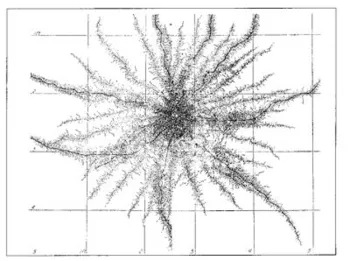
Chapter 1, “How Roots Grow” provides some basic information to help the reader comprehend the rest of the chapters. Seeds sprout into a meristem. Some of the meristem shoots develop above ground and specialize in photosynthesis. The rest of the meristem develops below ground, specializing in the absorption or transport of the soil’s sustenance. Root hair fibers, on the outside of the root, especially at the tip, are instrumental in the absorption and transport of sustenance. Root hairs mine the soil, excreting chemicals like carbonic acid, to dissolve minerals for assimilation. Roots love layered compost. Compost around roots invites worms, who digest the decomposed matter from the roots, creating fertilizer with their castings. The process encourages microbes, bacteria, and fungi to interact with and enrich the soil. Given the texture and compactness of the soil, roots may elect to grow vertically/obliquely or laterally/horizontally to the surface of the ground.
In the second chapter, “Humus and Mulch,” the author explains not only what humus and mulch are, but also how they interact with roots. Fertile soil is the key to plant/root health. Fertile soil requires good pore spacing and humus. Humus is the dark organic component of soil formed by the decomposition of plant and/or animal matter. Humus increases both the nutrient content and water retention of soil. This dark upper layer, found in topsoil, is a vital food source for microorganisms. Humus is the product of decaying/rotting compost. Right below the layer of undigested plant debris, sometimes called “duff,” found on the ground itself, one can usually observe humus.
Humus and roots are partners in plant well-being. Their collegial interaction catalyzes biochemical activity whereby soil nutrients are transposed into soluble substances, which can then be absorbed by the roots and then transferred to the above-ground plant. Compost and humus are words often used interchangeably, but gardeners know that organic materials like food waste and yard clippings are combined by humans (often with a little help from worms) into the decomposed substance called compost. Depending on the method used to create compost, it can take up to a year for the raw materials to become a viable garden additive. Humidity, moisture, and heat speed up decomposition. Aged compost has no steam and no smell. Hummus, on the other hand, is the final stage of compost decomposition. It is a highly stable, dark, spongy substance that remains after all of the organic material has broken down.
Meanwhile, pore space refers to the labyrinthian maze of channels in the soil’s upper layer. These channels, facilitating the passage of air/water, correlate with the soil structure. Soil structure or texture relates to both the soil’s mineral content and texture. Soil made mostly of particles of sand is loosely packed, while clay soils are rather compressed, and silt soil is usually somewhere in between. Loam represents an ideal mix of sand (45%), silt (40%), and clay (15%). Loam allows ideal water/gas traffic as well as moisture retention.
Mulch refers to leaves, needles, wood chips, stones, newspaper, cardboard, straw, fabric, etc., that can help to create a moisture-retaining barrier on top of the soil. Mulch seems more effective with transplants rather than seeds. A mulch depth of two inches seems good. Keep mulch from the base of shrubs, stems, and trees to prevent upper root rot. Mulch and compost complement each other in the suppression of weeds, conservation of moisture, and enrichment of soil.
Areas of cropped grass are the epicenter of much outdoor activity these days. Thus, the author makes “Lawn” the topic of his third chapter. Lawn, or turf, requires less maintenance time and effort than other landscape options such as flowers or gardens, and is uniquely suited for many athletic games, children and pet games. Although taking less maintenance than other landscaping options, caring for turf requires knowledge of the microclimate, root depth, and soil type interaction to determine both irrigation and fertilization needs. Again, most roots are to be found in the top 6 - 12 “of the earth. Subterranean or soil-level drip irrigation is favored over above-ground fixed sprinkler heads for efficiency. Local county cooperative extensions, such as the Master Gardeners Hotline, can help determine irrigation frequency. If footprints remain depressed or if grass looks wilted, water cycles may need adjustment.
Prairie plants, the topic of chapter 4, (“Weaver’s Lone Prairie, or God’s Very Own Lawn”), are significantly different than residential lawns or turf. A dry climate with a wide temperature range favors prairie grass. The Great Plains’ grassland root systems exemplify resilience in such conditions.
Chapter 5 discusses “Shrubs.” Shrubs or bushes are woody perennial plants with multiple stems, a smallish stature, and deep root systems (a tap root plus laterals). The usual properties of shrubs include low maintenance and drought tolerance, which make them a wise choice for arid zones.
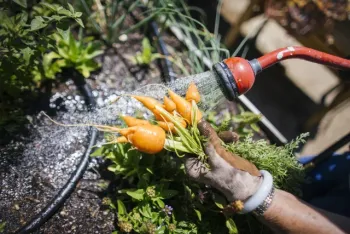
“Vegetables” are discussed in Chapter 6, where the author has devoted twenty-six pages to twelve different crops;
Asparagus is perennial. While roots absorb water and nutrition note that their roots can extend horizontally to eight feet and vertically to eleven feet.
Beans’ taproot and laterals reside within the top ten inches below the surface. To grow from seed, apply a deep mulch of four to six sheets of wet overlapping newspaper covered with straw and poking holes in the mulch for seeds.
Cabbage roots are shallow, just four to six inches below the ground.
Cauliflower has a massive rooting network up to four feet across and three feet down, depending upon climate, soil, and irrigation.
Carrots make use of a prominent taproot, which, in fact, is the part we eat.
Corn, planted on mounds forty-two inches apart, has lateral roots half the length of the stalk and vertical roots arranged in a mandala pattern, which are the length of the stalk. Scrape off weeds with a hoe, disturbing as little soil as possible.
Lettuce has extensive vertical roots. The interesting thing about lettuce is that it can be harvested in sections multiple times if the crown is left when harvesting. If a mix of greens is desired, plant small amounts separately since varieties mature at different rates. Use mulch to suppress weeds. Upon germination, water weekly and thin and weed as needed.
Onion, a bulb like turnips, beets, or garlic, can be crowded as it possesses a meager root. Plant legumes (as green manure) nearby to enrich the soil with needed nitrogen and phosphorus.
Peas’ taproot can descend two feet, and laterals can extend four feet, although most are within the top six inches of soil.
Peppers have a profuse, dense network of lateral roots going down four feet, though most are within the top twelve inches of the surface.
Rhubarb is a perennial with amazing roots. While foliage can extend seven feet to the outer edge, both lateral and vertical roots can reach eight feet. They appreciate loamy soil, manure with fertilizer, and irrigation provided at the root perimeter.
Tomatoes, usually transplanted from seedling trays, can have both lateral and vertical roots that exceed five feet.
The remaining chapters of this fascinating book will be reviewed in the Fall issue of the Master Gardener Blog. Look for it during the first week of October.