
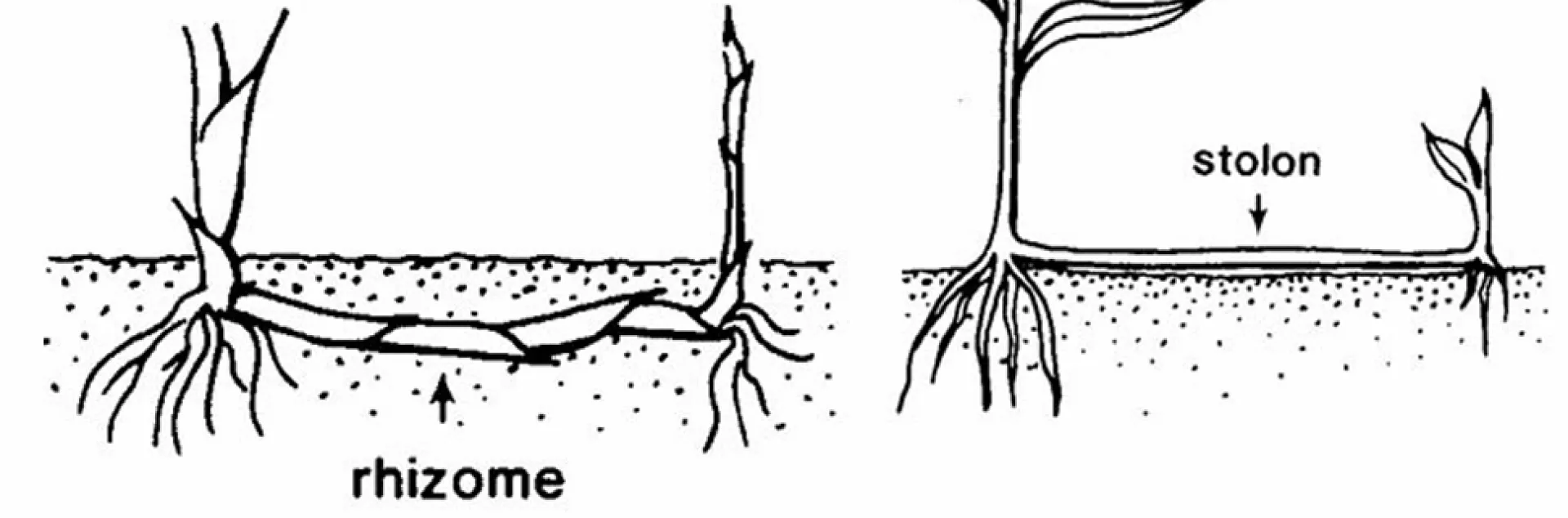
All plants want to propagate. Most commonly, we think of seeds of all kinds as the primary mechanism of propagation, but some plants have developed underground and above-ground means of reproduction. This article will explore these vegetative propagation factors.
Stolon: noun: a horizontal branch from the base of a plant that produces new plants from buds at its tip or nodes. Also called a runner. Stoloniferous, adj, bearing or producing stolons. 1
Rhizome: noun: a somewhat elongated horizontal subterranean plant stem that is often thickened by deposits of reserve food material, produces shoots above ground and roots below ground. It is distinguished from a true root in possessing buds, nodes, and scale-like leaves. Rhizomic, adj. Rhizomatous, adj.1
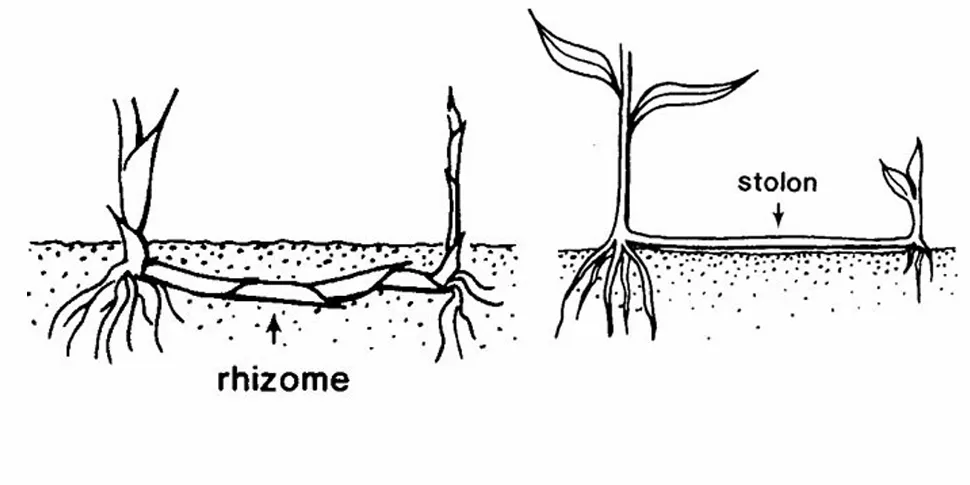
I’m gardening in the Midwest this month. As a Master Gardener, I am always curious to see that the lives of plants here, where the winters are freezing, and rain is more plentiful, express the same biological traits that plants do in the Central Valley heat and arid conditions. Some plants are designed to self-seed to propagate, some are sterile but broaden at the plant base, some are annuals with rare viable seeds, some have stolons, and some have rhizomes. I chose these two words because I mistakenly planted a rhizomatous plant in a flower bed that is now a nightmare! I needed to educate myself about the realities of this reproduction process.
In simple terms, stolons are stems that grow above ground (or barely below ground), and rhizomes are stems that grow below ground. They both send out new plants with roots at the second node segment from the mother plant. The resulting plant is a clone.
The most common stoloniferous plant is the strawberry. It’s cute and expands easily with stolons growing through other plants, and all of a sudden, you have a new plant feet away from the original planting. They are easy to pull out, and many people just let them meander through a garden plot. Other examples are: Bermuda grass, blue grass, ajuga, creeping jenny, and spider plants with all the tiny babies dangling from the mother plant. The best stoloniferous plant is the potato!
Common rhizomatous plants include: California Purple Aster, Western Goldenrod, Bermuda grass, ginger, running bamboo, some ferns, lily of the valley, mint, and Johnson grass. These plants may have a place, but not in the home garden. Their rapid spread and dense underground structures make them very difficult to manage and nearly impossible to eradicate.
Let’s take mint as an example: The roots of the mother plant may stand still but the plant develops many rhizomes that grow twelve + inches per month during the growing season (twelve months in the valley), and each joint in the rhizome produces a new plant. When you expend the energy to dig it out, any minuscule piece of rhizome will happily continue to grow and produce more plants!
Looking closely at the lists, you will see that Bermuda Grass is both Rhizomatous and Stoloniferous. No wonder it is so hard to manage. Ever had a small patch in your lawn or garden and pulled it out by hand? It is a satisfying experience to see how long a runner you can unroot without breaking the stolon. EXCEPT the underground rhizomes are still growing, and a new plant will appear with a smile. Like mint, the underground rhizomes are vigorous and prolific.
References:
1. Webster’s Ninth New Collegiate Dictionary, 1990.
2. Guo, Lei, Plunkert, Madison, Luo, Xi, Liu, Zhongchi: Developmental regulation of stolon and rhizome. Science Digest, Volume 59, February 2021.
3. Marino, Max: Stolons vs rhizomes. Lawnphix, May 3, 2026
4. Rhizomes and Stolons. Forage Information Systems, Oregon State University, 2026.
5. Bermuda grass Control. Pests in the Urban Landscape, 07/17/2025. UCANR.edu.
6. Bermuda grass. the Savy Sage, 02/09/2024. UCANR.edu.