
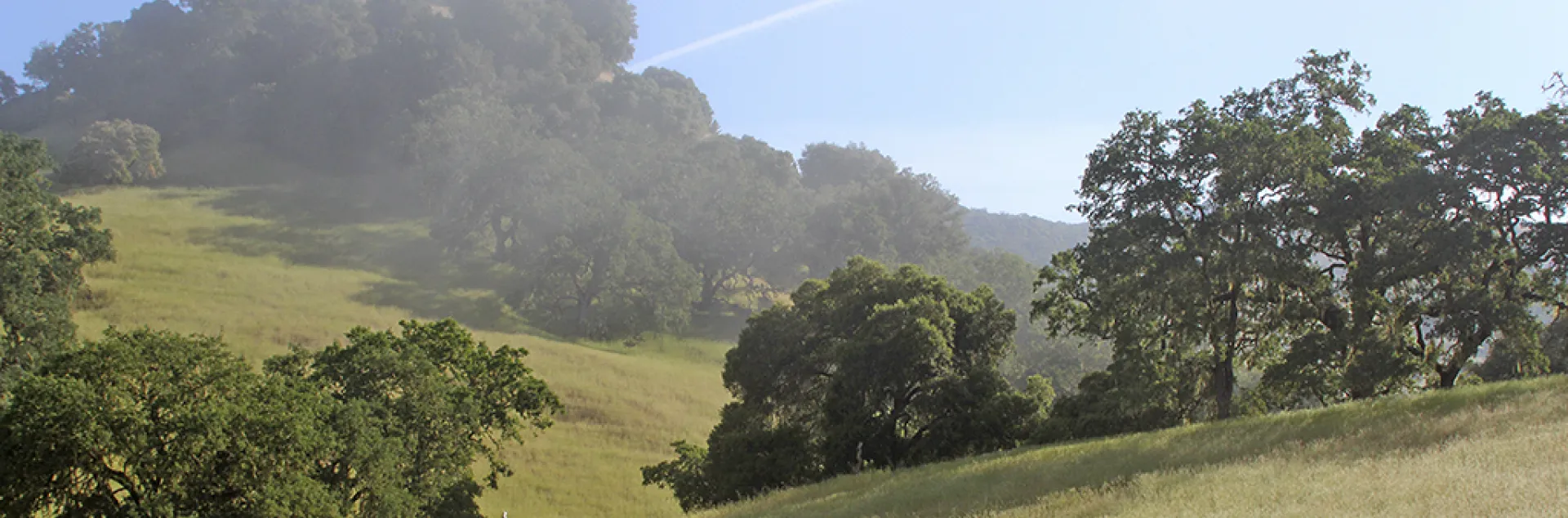
Blue oak (Quercus douglasii) is a deep-rooted deciduous tree species that dominates low elevation woodlands and savanna across California. While blue oaks are known for their high drought-tolerance, many blue oaks died during the record breaking drought in 2012-2026. As climate change drives more severe drought events, predicting where drought-induced blue oak mortality may occur is important for conservation planning.
A new study published in New Phytologist found that blue oak’s maximum drought stress is decoupled from aboveground climate, leaf allocation traits, and annual growth rates.
The team surveyed drought stress, stem water stable isotopes, growth and leaf allocation traits of blue oaks across 15 sites including the Hopland Research and Extension Center.
They found that aboveground climate or soils are not predictive of maximum water stress of blue oaks. The water stable isotopes revealed that trees relying on deep water reservoirs recharged by large winter storms stayed hydrated longer than those dependent on shallow soil moisture. They also found that prior growth (measured from tree rings) and allocation to leaf tissue are disconnected from end-of-season water stress.
These results highlight that there is more to uncover in the deep soil to forecast which blue oak woodlands will survive future droughts and which will remain vulnerable.