
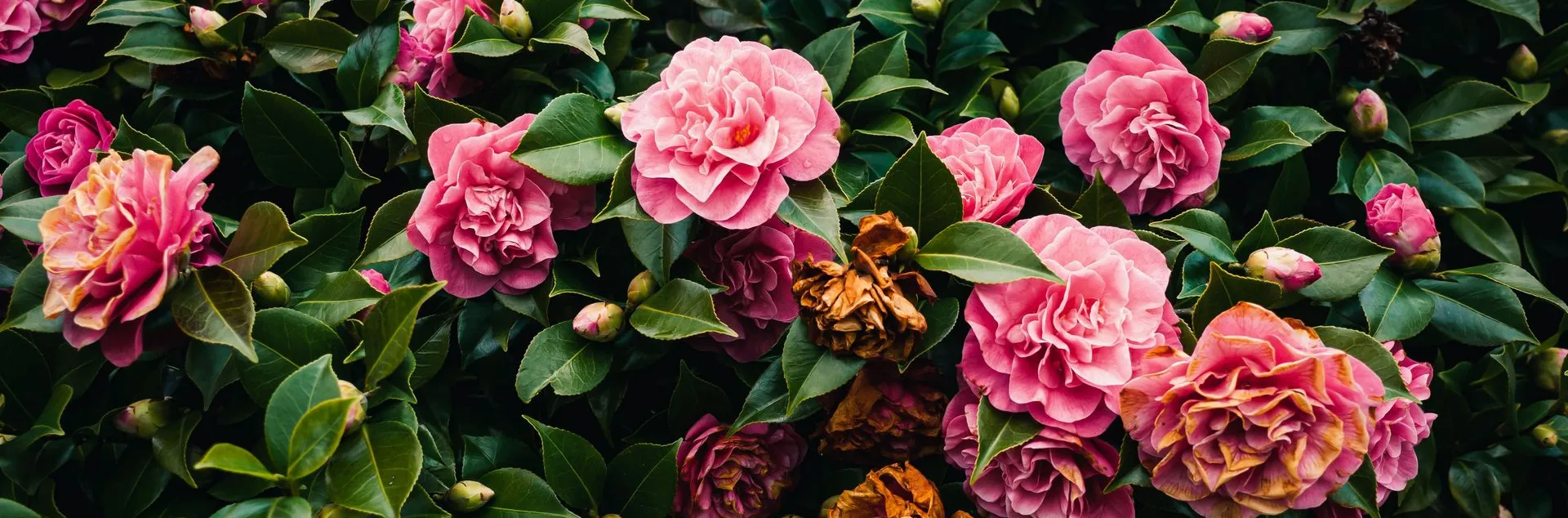
Camellias are some of our most reliable shrubs for producing winter blossoms. Unfortunately, the flowers are easily infected with disfiguring petal blight, caused by the fungus Ciborinia camelliae. This disease infects all cultivars of Camellia japonica. Camellia sasanqua is also susceptible, though less often in California.
The first signs of camellia petal blight are small, brown irregularly shaped specks caused by airborne spores which germinate on the petals. Threadlike filaments invade the flower tissue, giving infected petals a netted look. As it rots, the entire flower turns brown, dies, and falls to the ground.
If the infected flower remains on the plant, the fungus continues to grow and forms small black bodies called sclerotia at the flower’s base. Sclerotia are fungi’s survival structures. C. camelliae sclerotia can lie dormant in soil or mulch for several years, waiting to be activated by winter and spring rains. They then forcibly discharge structures called apothecia that can be carried by the wind, sometimes for up to a mile, to infect blossoms.
Environmental conditions that favor the development of Camellia petal blight are frequent rain showers, high humidity, and mild temperatures (about 59 to 70 degrees F) during bloom. If your camellias had this in the past, now is the time to act. With plentiful rains and mild temperatures forecast for the coming winter months, camellia petal blight will be a common sight.
What to do now:
• Prevention is the best control. Once the disease is established, it cannot be eradicated.
• Right now, remove the top layer of mulch and rake up any fallen leaves. Apply a fresh layer of organic mulch under the tree and somewhat past the edge of the plant, maintaining 4 inches of mulch. Keep the mulch several inches away from the trunk. Do this every year before winter rains.
• Prune the lower branches of the plant to increase air flow. This will also make it easier to pick up fallen flowers.
What to do if you see evidence of petal blight despite taking the steps above:
• Remove infected flowers as soon as they appear.
• Discard fallen blooms and other plant debris by bagging and disposing of them. Do not compost them.
For more information about camellia petal blight and other pests and diseases that affect camellias, see these websites:
• https://ipm.ucanr.edu/home-and-landscape/camellia-petal-blight/#gsc.tab=0
• https://ipm.ucanr.edu/home-and-landscape/camellia/#gsc.tab=0
Photo credit: https://www.pexels.com/search/?q=camellia%20petal%20blight
Help Desk of UC Master Gardeners of Contra Costa County (SEH)