
By Corinne Yoshihara, UC Master Gardener of Napa County.
Monkeyflowers are one of my favorite native plants. They have cheerful colors, are very resilient and have great ecological value. In my garden, they thrive mostly on their own. Their seeds scatter serendipitously, and their flowers add lovely splotches of yellows, oranges and reds to the dry landscape.
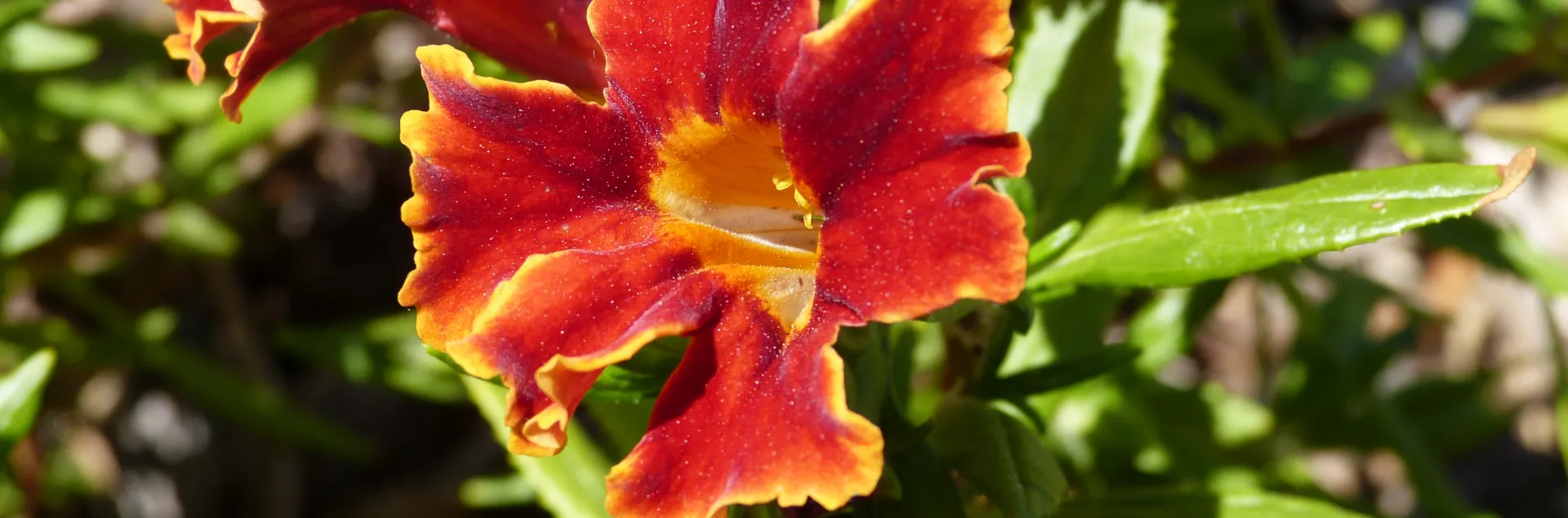
Monkeyflower blossoms are tubular, with petals that have fused to form two lips and edges that are sometimes notched, giving the flowers a ruffled appearance. Their bright, showy flowers pop.
As California natives, they require little maintenance if planted in the appropriate habitat. If pruned in the spring and watered during the driest summer months, they will bloom profusely from March to August.
Monkeyflowers benefit our California gardens by luring pollinators. The specific pollinators attracted depend on flower colors: yellow, pink and purple draw bees and butterflies; pale shades and white attract nocturnal moths; and red and orange lure hummingbirds.
The bush monkeyflower is a larval host for certain specialized butterflies. Its narrow, elliptical, glossy green leaves secrete a sticky protective resin that deters over-feeding by herbivores and inhibits water loss.
All monkeyflowers once belonged to the genus Mimulus, which has since been taxonomically reclassified based on DNA information and its species divided among different genera. Still, many scientists continue to use Mimulus to refer to all monkeyflowers.
Native to southern Oregon, California and northern Baja California, monkeyflowers can be found in habitats that range from hot and dry to moist and shady. Of the four genera that include California native monkeyflowers, the two main ones are Diplacus and Erythranthe. The majority of monkeyflowers in genus Diplacus are perennial woody shrubs that grow in low-water, well-draining areas of California. Their common name is bush monkeyflower. Monkeyflowers in the genus Erythranthe are perennial and annual herbs that prefer moist areas.
There are many regional variants with intergrading varieties that are usually distinguished by flower color. Fortunately for us gardeners, there are also many species, subspecies and hybrids derived from these variants (think Jelly BeanTM series) resulting in a range of hues. Changing flower color is one way plants adapt and respond to changing local conditions.
The scarlet monkeyflower (Erythranthe cardinalis or Mimulus cardinalis) is the focus of a recently reported study in Science on climate change response. This perennial herb requires moist conditions. Yet, remarkably, some scarlet monkeyflowers survived California’s most severe drought of the last 1,200 years, one that even some drought-tolerant species did not. The researchers attribute its survival to a process called rapid evolution.
We tend to think of evolution as occurring over thousands to millions of years, but these researchers looked at evolution during a sudden environmental stress: extreme drought. They found that scarlet monkeyflowers with 90 percent declines in population rebounded in two to three years.
They refer to this swift adaptation as rapid evolution and to the reversal of population decline as evolutionary rescue. They define rapid evolution as the change in DNA over a short period, and evolutionary rescue as the demographic outcome of rapid evolution when surviving plants have the genetic makeup to do better under conditions that killed others.
Although evolutionary rescue has been shown to work in theory and in lab settings, this observation is the first documented in the wild. It is the first study of a natural population to decline, evolve and recover in response to climate change. Have I mentioned how resilient and special monkeyflowers are?
The researchers studied the scarlet monkeyflower from 2010 to 2018. They monitored 55 populations across 19 sites spread across southern Oregon, California and northern Baja California, in Mexico. The team visited the plants yearly, noting survival and population size, and they collected seeds. They grew the seeds in a lab, extracted DNA from the harvested leaves and sequenced the DNA.
They looked for changes in the plant’s DNA, focusing their attention on regions of DNA that were known to be climate related. By comparing the DNA at the climate-related sites year to year, they could see rapid evolution over seven years. The genetic mutations the plant used to resist drought developed over time starting long ago. When extreme drought occurred, plants that possessed DNA with many positive changes or adaptations responded and survived while the majority of plants died off. Survivors passed the advantageous genes to offspring through seeds.
The authors found that populations having higher levels of diversity in their DNA at climate-associated genes before the drought also had higher population recovery after the drought. This highlights the importance of diversity, which likely extends to other plants and even animals. They propose that we try to improve genetic diversity by maintaining widespread plant populations, providing connections between populations and restoring or maintaining plant habitats.
One example of diversity the authors saw as a positive adaptation to drought was the change in the opening and closing of stomata, the microscopic openings on the underside of plant leaves. Stomata balance the plant’s competing needs to take in atmospheric carbon dioxide for photosynthesis and prevent excessive water loss through evaporation. A change such as this one would certainly be a beneficial step toward survival.
Until I read this article, I was unaware that monkeyflowers were so widely studied scientifically. I have a newfound appreciation of monkeyflowers not only as beautiful, low-maintenance, wildlife-friendly native plants (as if these reasons are not enough), but as model systems of study across genetics, evolution and ecology.
Hmmm, now where can I plant these moisture-loving Erythranthe? I have just the spot!
Workshop: Join UC Master Gardeners of Napa County for a workshop on “Succulents: Out of the Pots, Into the Ground” on Saturday, July 25, from 10 am to noon, at University of California Cooperative Extension, 1710 Soscol Avenue, Napa. Learn how to design, plant, and maintain a sustainable garden in your own landscape. Register here.
Library talk: Join UC Master Gardeners of Napa County and Napa County Library for a free talk on “Be a Butterfly Angel” on Thursday, August 6, from 7 pm to 8 pm via Zoom. Learn how to help support our declining population of Western Monarch Butterflies. Register to receive the Zoom link.
Tree walk: Join UC Master Gardeners of Napa County for a docent-led tree walk through historic Fuller Park in Napa on Friday, August 7, from 10 am to 11:30 am. Discover some of the many exotic and native trees in this 120-year-old arboretum. Meet at the corner of Oak and Jefferson Streets. Space is limited and registration is required for each participant.
Help Desk: The Master Gardener Help Desk is available to answer your garden questions. Use our online Plant Problem Help Form or email us at mastergardeners@countyofnapa.org. Include your name, address, phone number and a brief description of the problem. You can also visit us in person on Mondays and Fridays from 10 am until 1 pm at the University of California Cooperative Extension Office, 1710 Soscol Avenue, Suite 4, Napa.
Photo courtesy of Corinne Yoshihara