

Following the August 20th webinar, Rose Cultural Practices, Abiotic Disorders and Disease, our presenter, John Karlik, answered questions from participants. Below are some additional questions John didn’t have time to answer during the live session. Keep in mind that some of the questions below were related to content shared during the live presentation. This list does not include all questions that were answered live.
Cultural Practices
Q: What causes weak stems in potted roses?
A: There could be several factors, including age of the plant, variety, lack of light, or general lack of vigor. This list is not exhaustive.
Q: Do potted roses need more irrigating than when they are in the ground?
A: “Irrigating” can mean duration and/or frequency, or the total amount of water applied. In general, roses will need less water when planted in the ground, since in a container the walls will allow heat transfer. However, there are other considerations including the planting site and how that might differ from where containers are located.
Q: Would sodium in potted irrigated roses be a problem? How do you remedy this?
A: It is very uncommon to find a high sodium level in potting soil. It is a matter of how much, not just the presence of sodium, that could be a problem. If in excess, sodium can be leached out of container soil with clean water. Or the soil can be changed to a planting mix with more desirable chemistry.
Q: How often should roses be fertilized? What about potted roses?
A: You decide. For outdoor roses, perhaps once a year, spring, or spring and fall. Possibly more often if you are trying to “size” the plant, or less often if roses are established. For potted roses, maybe once a year. In my experience, roses do not do well in containers past one year.
Q: Is organic or inorganic fertilizer best?
A: Either is fine. This becomes a long discussion involving the percent analysis of a fertilizer, how fast the nutrients become available, how the fertilizer will be applied, how often, etc.
Q: When is the best time for winter pruning?
A: In warm-weather areas, i.e., most of California, December is fine. If in a mountain area, a little earlier if roses will be protected over winter with mulch.
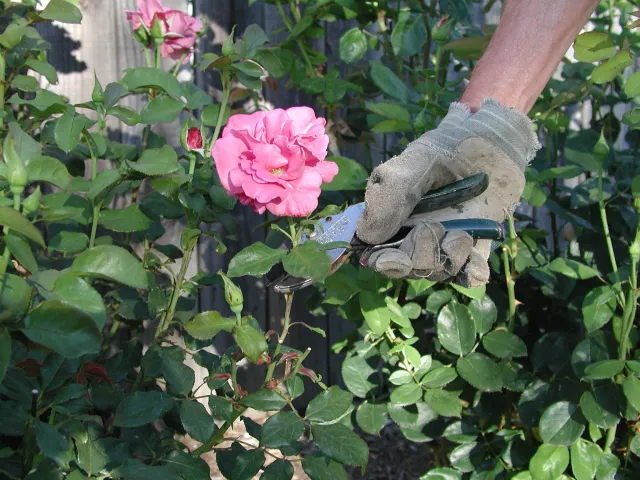
Q: How much should tea roses be pruned to prepare for fall flowering?
A: I suggest cutting them back about a fourth to maybe a little more for a fall flowering.
Q: Do you know why the company David Austin Roses recommends planting rose bushes deep?
A: No, I don’t. And I don’t know what “deep” means specifically in this recommendation. There are caveats here as to whether the roses have been grafted, whether this recommendation takes into account truly cold-weather areas, and so forth.
Q: What are some good shrub or landscape varieties for the foggy Santa Barbara coast? Any hybrids you recommend?
A: Available varieties change every year. In general, I would suggest a landscape or shrub rose variety. You could ask at a local nursery. I don’t know if roses are found at the Santa Barbara Botanic Garden, where you could see examples. I’ve been there, but it has been a few years.
Disorders & Diseases
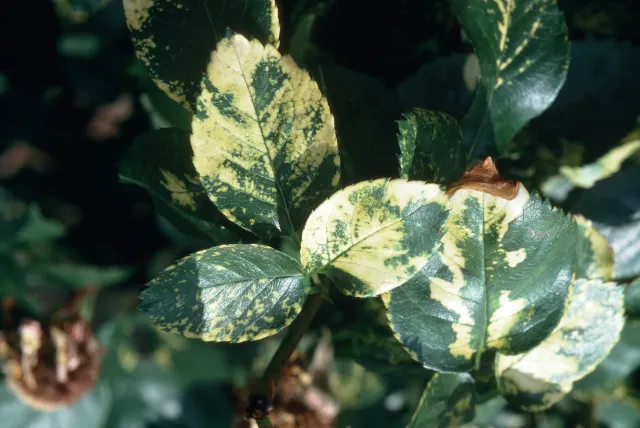
Q: Once a rose bush is trimmed of its infected leaves, do the fungal spores remain in the soil?
A: Depends on what disease we are talking about. In general, spores may be produced by fungi on the leaf tissue, but it is less likely spores will remain viable in soil. See the UC IPM Pest Note: Roses Diseases and Disorders for more specifics.
Q: What can we do to prevent spread of crown gall in a bed of roses? Should the soil and plants be removed? Can new plants be planted in this area?
A: This is a difficult problem. Crown gall, once in soil, is essentially impossible to remove. You could try removing all the soil and infected roses. Yes, you could plant new plants and see how they do. A wound is necessary for crown gall infection.
Q: Why is rose rosette virus not transmitted by pruning tools?
A: I can’t answer why. It just isn’t. We might consider the structure of viruses, but this becomes a discussion with a virologist. Most viruses that infect roses are not spread by pruning tools. I suppose in theory rose sap could be moved with pruning tools, or an eriophyid mite could hitch a ride. These scenarios are unlikely and I have never seen these possibilities put forward at a rose rosette research meeting. The major routes for transmission are the eriophyid mite and possible root grafts in a rose bed.
Q: Is there a pre-treatment for botrytis in roses?
A: I infer this is a question about a fungicide for preventative control. There may be, but is it worth it for the short time this disease is seen? You could check a couple of the common fungicide labels for roses to see if botrytis is claimed.
Q: What eriophyid mite (spp.) attacks roses?
A: Phyllocoptes fructiphilus is the eriophyid mite associated with rose rosette disease. The mite itself is not a problem; it’s the disease that’s a problem. Other eriophyid mites may also feed on roses, but I have not found those to be a concern for rose growth.